Back to Fruitpedia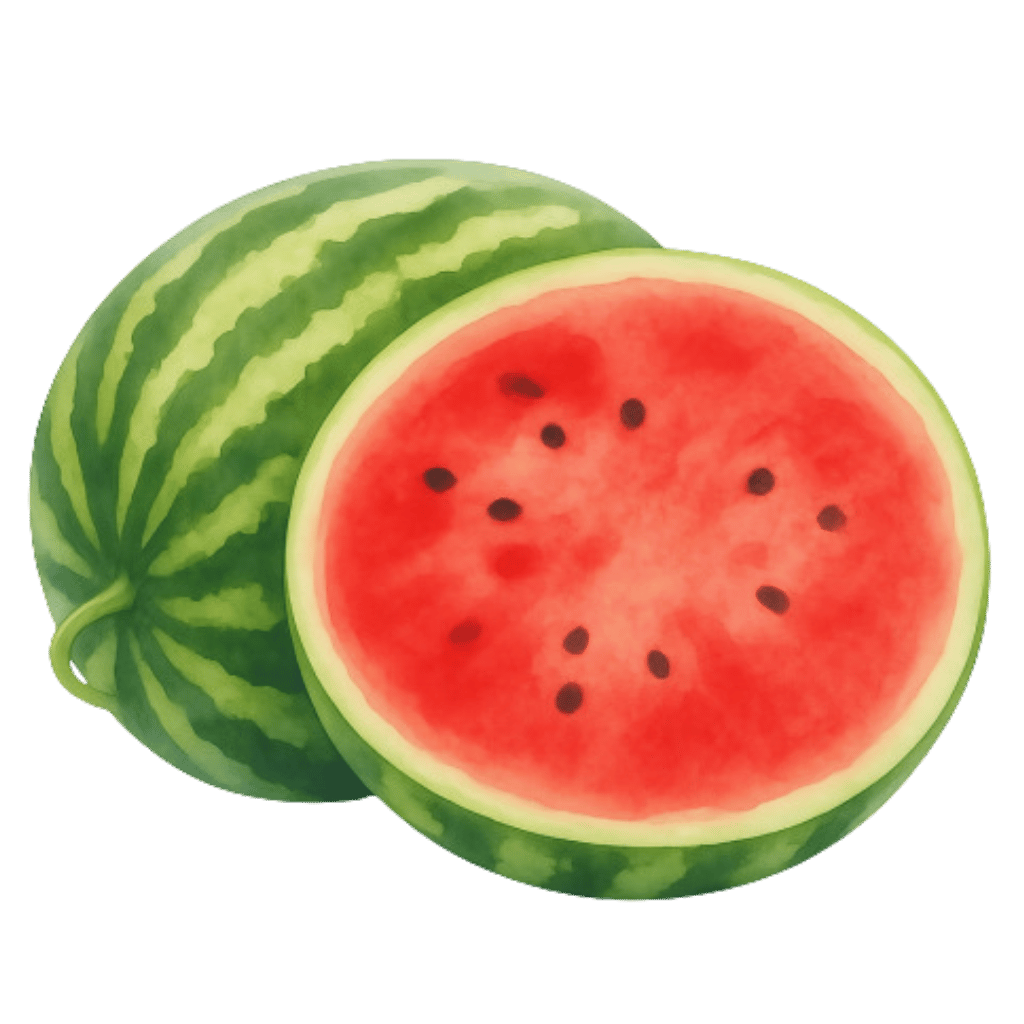
Watermelon
Citrullus lanatusVarieties
Crimson Sweet
9.4° BrixCharleston Gray
Sugar Baby
BRS Kuarah
≤13° BrixTiffany
Moon and Stars
Botanical View
- Leaves are herbaceous but rigid, rough-textured on both surfaces, borne on long petioles (up to about 150 mm), 60–200 mm long by 40–150 mm broad, broadly ovate in outline and typically deeply 3-lobed with the segments again lobed or doubly lobed (pinnatifid); watermelon is the only economically important cucurbit with this deeply lobed leaf form. Foliage is hairy, especially along the veins on the underside, and young shoot tips are densely woolly with yellowish to brownish hairs that are lost as tissue ages.
- The plant produces several herbaceous but firm, stout, trailing (occasionally weakly climbing) stems, angular and longitudinally striate in cross-section, pubescent when young and glabrescent with age, reaching up to about 3 m and, in vigorous field-grown vines, considerably longer. Branched, coiling tendrils arise at the nodes and allow the vine to climb over adjacent vegetation or structures, though the plant is naturally prostrate.
- The root system is extensive, of the taproot type with numerous lateral roots; under field conditions it is relatively shallow, with the great majority of roots concentrated in the top 60 cm of soil, though management practices such as furrow preparation and adequate drainage can favor deeper rooting and improve water and nutrient uptake.
- Flowers are solitary (not arranged in a compound inflorescence), borne singly in the leaf axils on hairy pedicels up to about 40 mm long. The receptacle is broadly campanulate, hairy, and up to about 4 mm; the corolla is rotate-campanulate, up to about 30 mm in diameter, usually 5-lobed, yellow to gold on the inner surface and often green or green-veined on the outside.
- Watermelon is monoecious, bearing separate staminate (male) and pistillate (female) flowers on the same plant; many modern cultivars are andromonoecious, producing staminate and perfect (hermaphroditic) flowers rather than true female flowers. Staminate flowers greatly outnumber pistillate/perfect flowers, typically in a ratio near 7:1 (range about 4:1 to 15:1), and flowers open for a single day. Commercial triploid ("seedless") cultivars are sterile hybrids whose staminate flowers produce largely nonviable pollen, so a diploid seeded cultivar must be interplanted as a pollen source (pollenizer) to trigger fruit set.
- Watermelon flowers require insect-mediated cross-pollination for fruit set; pollinator exclusion experiments yield no fruit. The honey bee (Apis mellifera) is the principal managed pollinator in commercial plantings, with wild bees also contributing; pistillate flowers typically require multiple bee visits, and triploid seedless types need even more visitation because much of the available pollen is nonviable. Growers commonly place beehives in or near fields and avoid insecticide applications during morning hours when bee activity peaks.
- The crop adapts to a wide range of soils but performs best in deep, well-drained soils of sandy to medium texture; heavy clay soils (Vertisols), shallow soils (Lithosols), poorly drained soils (Gleysols) and saline/sodic soils should be avoided. Sandy soils are workable if nutrient deficiencies are corrected. Near-neutral soil reaction is preferred; acidic soils are associated with physiological disorders such as blossom-end rot linked to calcium availability, which is corrected by liming (calcitic or dolomitic limestone) applied roughly two to three months before planting.
- Fertilization recommendations (based on Brazilian technical guidance) include a basal application at planting of around 30 kg/ha N, 60–120 kg/ha P2O5 (depending on soil phosphorus level) and 30 kg/ha K2O, plus organic manure at 10–20 m3/ha; a topdressing of about 90 kg/ha N and 30–90 kg/ha K2O is applied around 25 days after planting, split into two applications on sandy soils. Nutrient uptake is minimal in the first 30 days and peaks between 40 and 50 days after planting. For irrigation, watermelon requires roughly 300–550 mm of water per cycle and is highly sensitive to water stress; drip irrigation is increasingly favored over sprinkler or furrow systems for its water-use efficiency and disease reduction, with crop coefficients (Kc) rising from about 0.5 in early growth to about 1.1 during flowering and fruit development, then declining to about 0.7 near maturity.
- Watermelon is propagated by seed, either through direct field sowing (about 0.5–1.0 kg seed/ha, sown 2–3 cm deep with 2–3 seeds per hole later thinned to one plant) or, more commonly for hybrid and seedless cultivars, through transplanted seedlings raised in trays at about 18–22 °C using roughly 300–500 g seed/ha, which shortens the field cycle and improves stand uniformity. Grafting onto disease-resistant cucurbit rootstocks (e.g., bottle gourd or squash) is also used commercially to manage soil-borne pathogens.
- Seeds are numerous, flattened-ovate and variable in size (roughly 6–12 mm long in wild forms), with seed coat color and pattern ranging from black or dark brown in wild types to brown, tan, red, white or mottled patterns in cultivated varieties, a trait often used to distinguish cultivars. Triploid ("seedless") hybrids do not set true, viable seeds; instead they produce small, soft, immature seed coats ("seed traces") that are edible and require no separate propagation.
- In Brazil, 'Crimson Sweet' is the dominant cultivar, accounting for the great majority of production; it produces round to elliptical fruit averaging about 11–14 kg with light green, dark-striped rind and red flesh, a 75–85 day cycle, and tolerance to anthracnose and fusarium wilt. Elongated types such as 'Charleston Gray' and 'Congo' (10–14 kg, red flesh, transport-tolerant) were historically important and preceded the rise of Crimson Sweet. 'Sugar Baby' is a smaller, compact cultivar (3–5 kg, 70–75 day cycle, dark green rind). Seedless triploid hybrids evaluated and grown commercially include 'Tiffany', 'Shadow', 'Nova', 'AF-179' and 'AF-177'.
- Watermelon was domesticated in northeastern Africa; genomic comparisons indicate the cultivated crop descends primarily from the Kordofan melon of Sudan rather than from the South African citron/tsamma melon as long assumed. Archaeological seed remains from northeastern Africa date domestication to roughly 5,000 years before present, and ancient Egyptian tomb depictions and preserved plant material show watermelon was cultivated in the Nile Valley by the New Kingdom period. Domestication involved selection for red, sweet, non-bitter flesh (loss of cucurbitacin-driven bitterness) from an ancestral white, non-bitter or bitter wild type. In modern breeding, the discovery by Kihara (1951, Japan) that triploid hybrids are largely seedless launched commercial seedless-watermelon breeding: tetraploid lines are produced by treating diploids with colchicine, then crossed with normal diploids to generate sterile triploid hybrid seed; commercial triploid seedless cultivars became widely available roughly two decades later. In Brazil, breeding and cultivar-testing programs (including EMBRAPA trials) have focused on disease-tolerant, uniform hybrid cultivars, contributing to the dominance of cultivars such as Crimson Sweet.