Back to Fruitpedia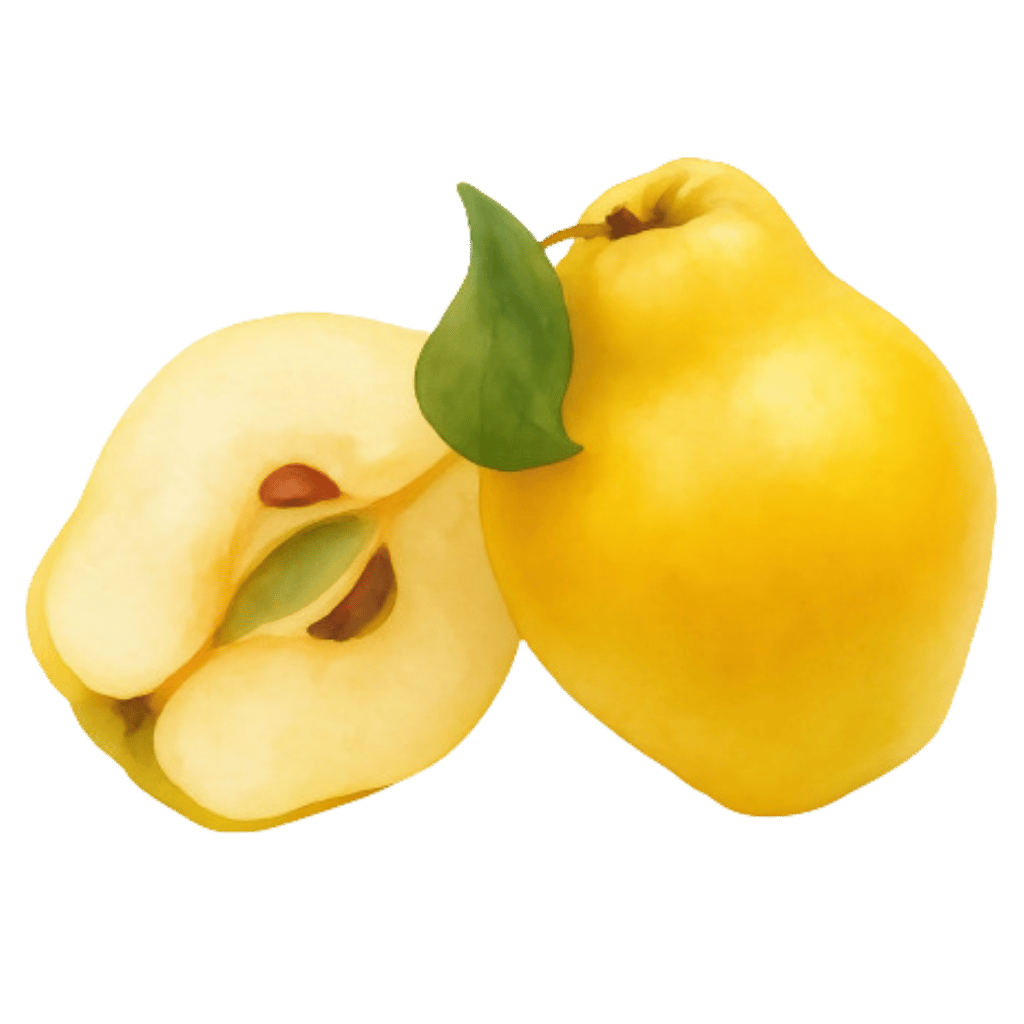
Marmelo
Cydonia oblongaVarieties
Smyrna
Portugal
Pineapple
Provence
Mendoza INTA-37
Aromatnaya
Botanical View
- Leaves are alternate, simple, oval to oblong (about 5–10 cm long, up to ~5 cm wide), with entire (untoothed) margins and short petioles. The upper surface is smooth, glossy and dark green, while the lower surface is densely covered in white-gray tomentum (downy hairs), a texture especially pronounced on young growth. Foliage is deciduous, dropping in autumn.
- The plant grows as a bush-like small tree with crowded, gnarled branches and a crooked, irregular growth habit rather than a strong central leader. Bark is thin and flaky/scaly with age. Young shoots and twigs are typically tomentose (covered in fine down), a trait shared with the undersides of the leaves.
- Quince has a comparatively shallow, fibrous root system, which makes trees more susceptible to drought stress and low soil-water availability than deeper-rooted pome fruits. Because of its shallow but well-branched roots and moderate vigor, quince (particularly the 'Provence'/BA-29 clone) is also widely used as a dwarfing rootstock for grafted pear (Pyrus) trees.
- Flowers are borne singly (solitary), not in clusters or corymbs as in apple or pear, arising terminally on short, leafy shoots of the current season's growth after leaf emergence. Each flower is large and showy (about 4–5 cm across), with 5 white to pale-pink petals, numerous (20 or more) stamens with yellow anthers, and an inferior, 5-carpellate ovary topped by 5 styles fused at the base; each carpel contains numerous ovules.
- Flowers are hermaphroditic (perfect, with functional male and female organs in the same flower). Cydonia oblonga is generally self-fertile/self-compatible, so isolated trees can set fruit, although cross-pollination between genotypes has been shown to increase fruit set and yield; some cultivars show reduced self-compatibility and benefit from a pollinizer.
- Pollination is chiefly entomophilous (insect-mediated), with honey bees (Apis mellifera) and other bees the principal pollen vectors visiting the nectar- and pollen-rich flowers; because bloom is self-fertile, pollinator visits mainly enhance rather than are strictly required for fruit set.
- Quince tolerates a wide range of soils, including heavier and moister soils than apple or pear can withstand, but performs best in deep, moist, well-drained loamy soil with a slightly alkaline pH (about 6.5–7.0). Its shallow root system makes it comparatively more sensitive to drought on light, sandy, or poorly water-retentive soils.
- Regular, moderate irrigation is needed through the growing and fruiting season (historically recommended as deep watering roughly weekly during active growth, less frequently in dormancy), while avoiding waterlogging, since insufficient water can cause fruit drop. Nitrogen fertilization should be applied conservatively and timed before bud break; excessive nitrogen promotes vigorous vegetative (leafy) growth at the expense of flowering and fruit set and increases susceptibility to fire blight. Phosphorus and potassium inputs later in the season support flower bud formation and fruit development.
- Commercial quince trees are propagated vegetatively to maintain cultivar identity — chiefly by hardwood cuttings, layering, or budding/grafting onto quince rootstocks (the same species is also used, e.g. 'Provence'/BA-29, as a dwarfing rootstock for pear). Seed propagation is used mainly for rootstock production or breeding rather than for named cultivars.
- As an outcrossing, highly heterozygous species, quince does not come true from seed: seedlings show wide variation in vigor, fruit shape, size and quality relative to the parent tree, and typically take several years to reach bearing age. Fresh seed generally needs an extended cold stratification period (about 18 weeks) to germinate reliably; older seed may first require a few weeks of warm stratification before cold treatment.
- Widely grown cultivars/landraces include 'Smyrna', 'Provence' (also called 'Champion' in some regions and used as the BA-29 pear rootstock), 'Portugal', 'Pineapple' (a Luther Burbank selection widely grown in California), 'Orange', 'Vranja', 'Bereczczki', 'Ekmek', 'Eşme', 'Isfahan', and 'Lescovatz', among others selected historically across the species' Old World cultivation range (Caucasus, Iran, Anatolia, Balkans, southern Europe).
- Quince was domesticated in the Trans-Caucasus/northern Iran region (spanning Armenia, Azerbaijan, Iran, southwestern Russia and Turkmenistan), with cultivation traced to ancient Mesopotamia (c. 5000–4000 BC) and well-documented use in ancient Persian and Greek civilizations by around 500 BC. From this center of origin, domesticated populations spread west and east along trade routes into Anatolia, Greece, southern Europe, the northern Black Sea/Russia region, and eventually the Americas, generating regional landrace cultivars such as 'Isfahan', 'Smyrna', 'Ekmek', 'Eşme', 'Vranja', 'Lescovatz' and 'Champion'. Because the species is largely self-fertile and propagated clonally, formal breeding has historically relied more on selection of superior seedlings/landraces than on planned hybridization; germplasm collections representing this diversity are maintained today in Russia, Iran, Turkey, Greece, Italy, Bulgaria, the Czech Republic, the UK, and the USA (including the USDA-ARS National Clonal Germplasm Repository).