Back to Fruitpedia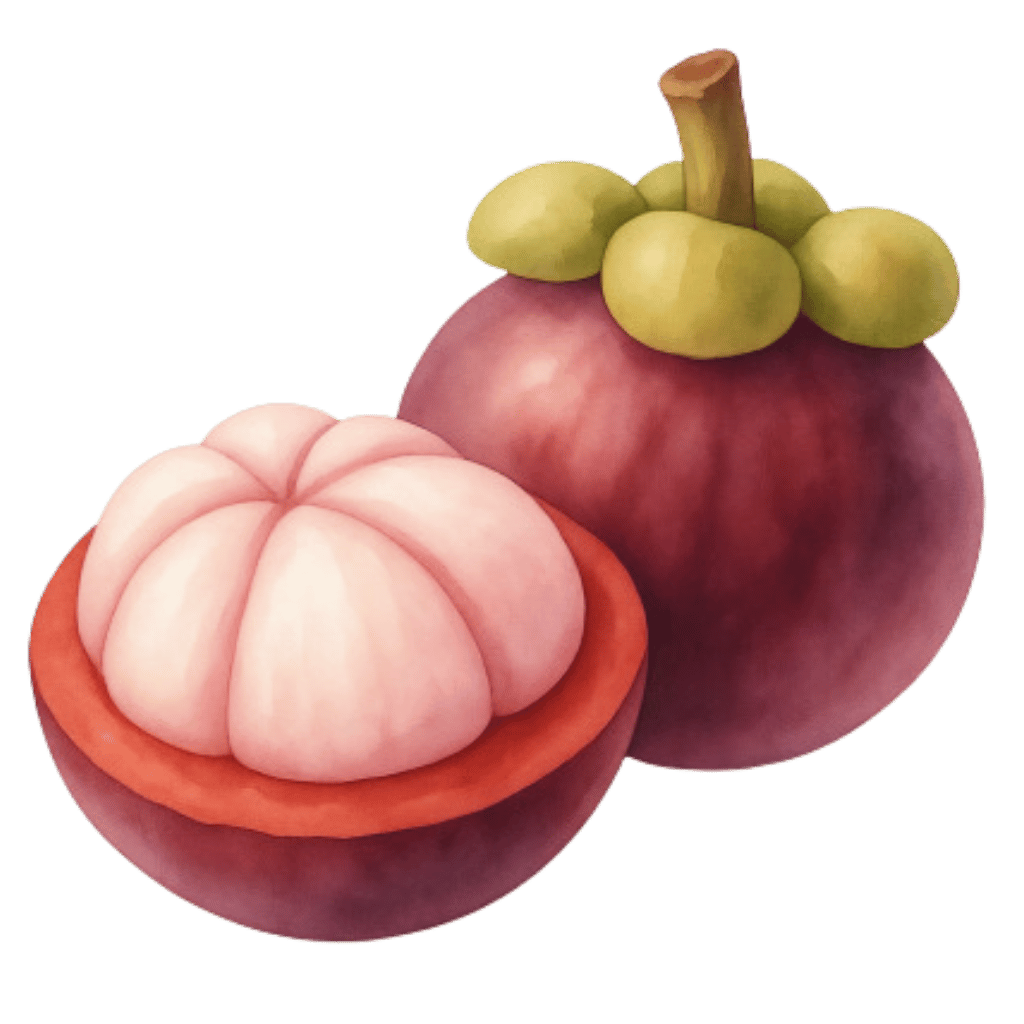
Mangosteen
Garcinia mangostanaVarieties
Wanayasa
17–18.5° BrixPuspahiang
15° BrixRatu Kamang
15–20° BrixRatu Tembilahan
Kaligesing
Mesta
Botanical View
- Leaves are simple, opposite, and entire, with a short petiole (1-2 cm). Blades are oblong-elliptic, leathery and thick, roughly 9-25 cm long by 4.5-10 cm wide, dark glossy green on the upper (adaxial) surface and paler yellowish-green beneath (abaxial); new flush growth emerges with a distinctive rosy-pink tint.
- The trunk is straight and slow-growing, covered in dark-brown to nearly black, flaking bark; the inner bark and wood contain yellow, gummy latex. Branching is opposite, giving the crown its characteristic pyramidal silhouette.
- Seedlings develop a long, comparatively fragile taproot with poor lateral root and root-hair development, which makes bare-root transplanting difficult once plants exceed about 60 cm in height (taproot depth soon surpasses shoot height). Arbuscular mycorrhizal associations have been shown to improve seedling growth and shorten the nursery period. In commercial groves, fertilizer and irrigation water are concentrated within the root-projection zone beneath the canopy.
- Flowers are borne terminally on young branchlets. Two flower forms occur: smaller staminate (male) flowers clustered 3-9 at a branch tip, bearing anthers that are aborted/sterile and produce no viable pollen; and larger, solitary or paired hermaphroditic but functionally female (pistillate) flowers, each with two pairs of sepals and four fleshy, yellowish-green petals edged with red. The stigma is sessile (style essentially absent) and divided into 4-8 rays, each corresponding to one of the ovary's locules and, later, one fruit segment. Petals abscise quickly after the flower opens.
- Cultivated mangosteen reproduces mainly by facultative agamospermy (apomixis): the structures commonly called "seeds" are in fact adventive/nucellar embryos that develop from maternal ovule tissue without fertilization, so offspring are genetically uniform clones of the mother tree. True sexual (zygotic) seed formation is rare but has been documented experimentally when viable pollen from wild diploid relatives is applied. Wild G. mangostana var. malaccensis includes diploid (2n=48) and triploid (2n=72) populations, whereas cultivated mangosteen is predominantly tetraploid (roughly 2n=88-96 depending on the study), consistent with an autopolyploid origin from the wild ancestor rather than the older interspecific-hybrid hypothesis.
- Because commercial fruit set occurs through apomixis rather than fertilization, cultivated mangosteen does not depend on pollinators for fruiting, and the rare male flowers it produces carry non-functional pollen. Insects such as the stingless bee Trigona spinipes visit flower buds and young fruit in Brazilian orchards, but as a pest that damages tissue rather than as a functional pollinator.
- The species prefers deep, well-drained soils rich in organic matter, ideally sandy loam or lateritic soils, with a water table around 1.5-1.8 m below the surface; it performs poorly on calcareous/limestone soils and is intolerant of waterlogging. In Brazil it is grown mainly on acidic, naturally low-fertility Yellow Latosols (Pará) and Red-Yellow Latosols (Bahia).
- Unbalanced fertilization causes documented disorders: an imbalance between zinc and iron has been associated with reduced leaf-blade size and shortened internodes in Brazilian orchards, and potassium deficiency is linked to "empedramento" (a physiological hardening/gumming disorder of the pericarp) affecting up to about 40% of fruit in some Bahia orchards. A Pará fertilization recommendation applies about 200 g potassium chloride per plant at the onset of flowering, repeated at 45-day intervals, plus roughly 300 g of NPK 10-28-20 fertilizer and organic poultry litter after harvest. Rainfall is generally sufficient for commercial production in Brazil's growing regions, but supplemental micro-sprinkler or drip irrigation is used during prolonged dry spells, applied to the root-concentration zone beneath the canopy.
- Propagation is predominantly by seed (technically apomictic embryos). These are recalcitrant, losing viability within about five days once removed from the fruit (though they remain viable 3-5 weeks while still inside the fruit); germination occurs in about 10-22 days under favorable moist conditions. Because seedlings form a long taproot, they must be transplanted while still small (before about 60 cm in height) to avoid root damage. Grafting (cleft/top-grafting) is technically feasible, with over 80% take reported in Brazilian trials, but is rarely used commercially because seed-propagated trees generally show greater vigor and productivity at maturity. Historically, cuttings and air-layering have shown poor rooting success; inarching onto rootstocks such as G. xanthochymus has been used with some success, notably in the Philippines.
- Because mangosteen "seeds" are apomictic (nucellar) embryos, seedling progeny are essentially genetic clones of the mother tree, and Brazilian cultivation guides note the species is considered to lack genetic variability for this reason. However, molecular marker studies have detected some genetic variability among apomictic seedling populations, and occasional facultative sexual reproduction — for example when wild diploid relatives supply viable pollen — can yield triploid, genetically distinct offspring.
- Because obligate/facultative apomixis limits conventional breeding, mangosteen has few named cultivars. Malaysia distinguishes two recognized types: "Manggis," the common seeded form, and "Mesta," a smaller, largely seedless form with a thicker mesocarp and preferred flavor and texture; the Malaysian Department of Agriculture has also released selections designated GA1 and GA2 from a survey of 16 accessions varying in fruit size, shape, seed number and shelf life. Brazilian production relies entirely on undifferentiated, seed-propagated material with no named commercial cultivars. A distinct seedling variant with larger fruit, a thicker rind and more acidic flavor has historically been reported from the Sulu Islands (Philippines).
- Because cultivated mangosteen reproduces mainly by obligate/facultative apomixis, no conventional breeding programs of the crop exist, and almost all cultivated trees are clonally propagated by seed from a narrow genetic base. Proposed domestication took place within the "forest-dusun interface" of Sundaland (the Malay Peninsula/Sumatra/Borneo region), likely through human selection of large-fruited, female-predominant apomictic trees near forest margins, with subsequent spread across Southeast Asia. Documented historical introductions outside the native range include India (1881), Ceylon/Sri Lanka (around 1800) and the Caribbean (1850s-1860s); the species was introduced to Brazil in 1935 and is today grown commercially mainly in the states of Pará and Bahia. Occasional gene flow between cultivated tetraploid trees and wild diploid/triploid var. malaccensis populations, revealed by molecular markers, is viewed as a potential future avenue for genetic improvement.