Back to Fruitpedia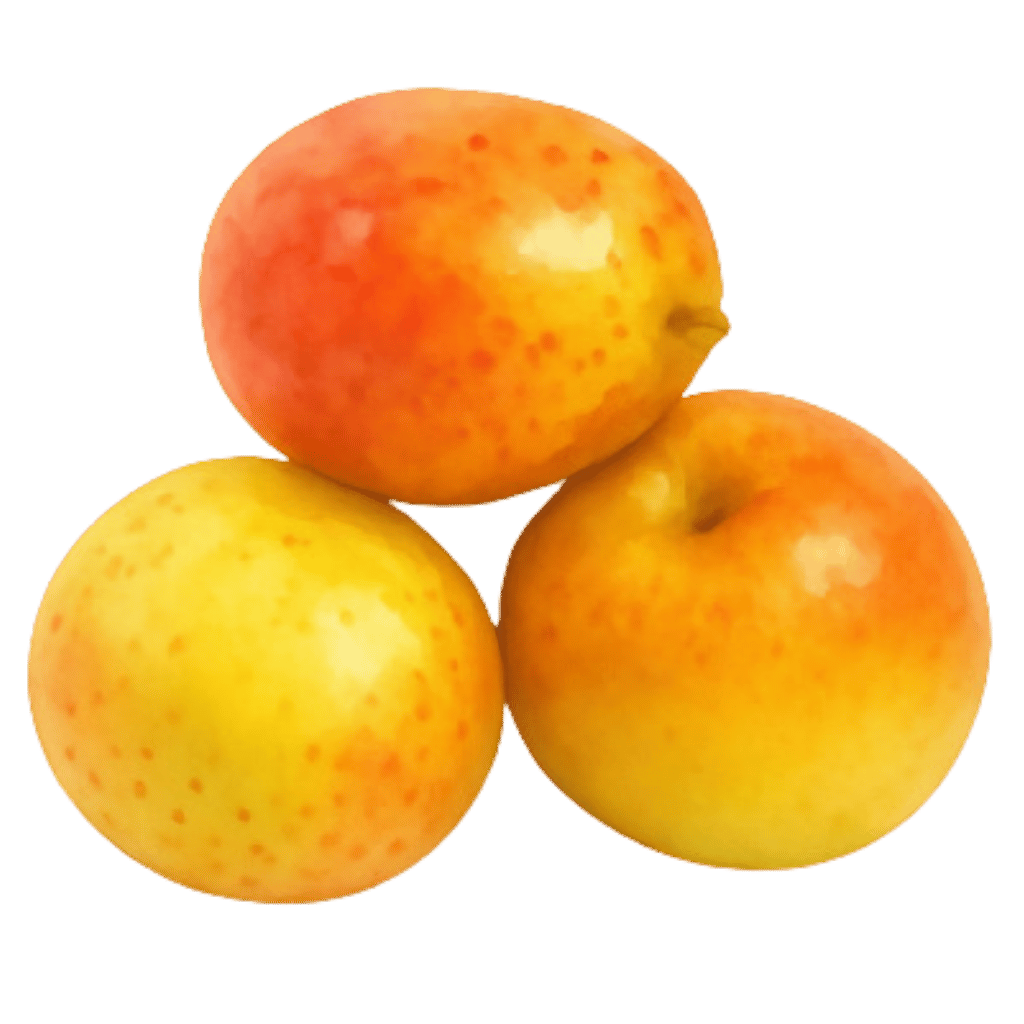
Mangaba
Hancornia speciosaBotanical View
- Leaves are simple, short-petiolate, coriaceous (leathery), and either glabrous or pubescent depending on the botanical variety; arrangement is described as alternate to sub-opposite/decussate. Blade shape and size are variable: a dendrological description gives narrow-oblong leaves with an acuminate apex, slightly asymmetric base and entire margins, about 10-11 cm long by 4 cm wide, colored green to reddish (new flushes are glossy red). Variety-level differences are documented: var. speciosa has glabrous leaves with a 9-15 mm petiole and blade to 6 x 2 cm, while var. gardneri (glabrous) and var. pubescens (hairy) both have shorter 3-5 mm petioles and larger 6-12 x 3-6 cm blades. New leaf flushes emerge together with flower buds at the branch tips, and heavier branching (natural or via pruning) is associated with more flowering and fruiting (Pereira et al., Embrapa/MMA, 2016; Moreira & Venturoli, Dendrologia de 12 espécies florestais na Escola de Agronomia da UFG, Universidade Federal de Goiás, 2021).
- The trunk is tortuous, rough-barked and fissured/cracked ("casca fendida"), typically gray with lichen cover on older bark. The whole plant is laticiferous, exuding copious white latex from leaves, stems and fruit when cut. The crown is broad, sometimes more spread than tall; Cerrado-ecotype trees typically show 4-6 m of height and crown diameter. Because of this latex production the species has historically been evaluated as a natural rubber source, though the rubber shows delayed cure that complicates vulcanization despite good plasticity-retention and high abrasion resistance (Wisniewski & Melo, 1982, cited in Pereira et al., Embrapa/MMA, 2016; Moreira & Venturoli, UFG, 2021).
- Detailed descriptions of the root system's architecture (taproot depth, lateral spread, etc.) were not found in the government/university literature reviewed. What is documented: the species tolerates seasonal water deficit well — a trial at Embrapa Cerrados (Distrito Federal) found no yield advantage from irrigation, consistent with an efficient/well-adapted root system for the long dry seasons of the Cerrado and semi-arid Nordeste. Roots are also known to be sensitive to excess organic matter in the planting hole: manure should be limited to a maximum of 10% of hole volume, since higher amounts favor root rot ("podridão-de-raízes") and seedling death (Pereira et al., Embrapa/MMA, 2016).
- The inflorescence is a terminal dichasium (cyme) bearing 1-7 flowers, with up to 10 flowers recorded per shoot apex. Flowers are hermaphroditic, white, hypocrateriform (salverform) with a long, narrow floral tube averaging about 3.4 cm in length. Anthers surround the apex of a vertically zoned stigmatic head (a sterile apical zone for pollen deposition, a mucilage-secreting middle zone, and a receptive basal stigmatic surface), a floral architecture typical of Apocynaceae. Nectar, the sole floral reward, is secreted around the ovaries at the tube base and is guarded by rows of hairs that force visitors to use long, strong mouthparts; nectar sugar concentration ranges 15-23% (Pereira et al., Embrapa/MMA, 2016; Schlindwein et al., "Polinização da Mangabeira," Embrapa, based on Darrault & Schlindwein, 2005/2006).
- Hancornia speciosa is self-incompatible and obligately allogamous (outcrossing): fruit set occurs only after cross-pollination between genetically distinct individuals. Natural insect-pollinated fruit-set rates are low and pollinator-limited — 11% (Tabuleiro population, Reserva Biológica Guaribas) to 13% (EMEPA planting) — far below the 21-40% achieved with hand cross-pollination. Because most pollinators make several successive visits within the same crown before moving on, repeated visits raise self (geitonogamous) pollen deposition and sharply cut fruit set: only the first two flower visits to an individual plant have a high probability of producing fruit, and from the fifth consecutive visit onward no fruit forms in experimental simulations. Grafted (clonal) orchards therefore require two or more genetically distinct, cross-compatible clones interplanted, or interplanting with seedling ("pé-franco") trees, to avoid excess geitonogamy (Schlindwein et al., "Polinização da Mangabeira," Embrapa, citing Darrault & Schlindwein 2005/2006 and Pinto et al. 2008).
- Pollination depends on insects with mouthparts long enough to reach the nectar at the base of the narrow floral tube. Nocturnal hawkmoths (Sphingidae) are the most abundant floral visitors and the principal pollinators — flowers open synchronously in the late afternoon and release an intense sweet fragrance typical of sphingophilous (hawkmoth-pollinated) flowers; proboscis length in visiting sphingids reaches up to 8 cm in Manduca difissa. In the morning hours before anthesis ends, flowers are additionally visited by long-tongued orchid bees (Euglossini) and skipper butterflies (Hesperiidae), with occasional Nymphalidae. Across a full year of sampling at Reserva Biológica Guaribas, 46% of local hawkmoth species carried Hancornia pollen, and most individual moths carried pollen of only one or two plant species, indicating high pollinator fidelity; roughly 46% of the pollen delivered to a visitor's mouthparts is captured by the receptive stigmatic surface in a single visit (Schlindwein et al., "Polinização da Mangabeira," Embrapa, citing Darrault & Schlindwein 2002/2005/2006).
- Mangabeira occurs naturally on soils that are marginal for conventional agriculture: rocky, sandy or sandy-clay, hilly, nutrient-poor and acidic, and subject to long dry spells — typical of both Cerrado uplands and semi-arid Nordeste coastal tablelands. Its broad natural distribution across such adverse substrates is taken as evidence of strong ecological plasticity and reproductive/adaptive efficiency (Pereira et al., Embrapa/MMA, 2016).
- Because the species is highly tolerant of acidic soils, liming at planting is not aimed at correcting soil acidity but simply at supplying calcium and magnesium, targeting a base saturation of about 30% (maximum 40%). Manure added to the planting hole should be limited to at most 10% of hole volume, since higher proportions promote root rot and seedling death. Recommended planting holes measure at least 30 x 30 x 30 cm (about 27 L capacity), set out in the rainy season, preferably in sandy-to-medium-textured soils, with 5-7 m spacing between plants based on adult canopy diameter and light requirements. A dedicated irrigation trial at Embrapa Cerrados found no significant benefit to formation-phase irrigation, reflecting the species' tolerance of seasonal water deficit (Pereira et al., Embrapa/MMA, 2016).
- Mangaba seeds are recalcitrant (cannot be dried) and should be sown within about two days of extraction from the fruit; if immediate sowing is not possible, depulped seed can be bagged and stored up to one month in a refrigerator crisper drawer near 10°C. Seedling-grown ("pé-franco") plants can subsequently be top-worked by budding or cleft/wedge grafting, which is currently the only viable method of clonal propagation, with a graft-take success rate above 90% — no reliable in vitro micropropagation protocol exists because of the seeds' recalcitrance. Because the species is self-incompatible, cross-pollination is essential for fruiting: seedling orchards cross-pollinate naturally among genetically distinct trees, but grafted orchards must interplant two or more compatible clones, or interplant seedling trees, to provide pollen sources (Pereira et al., Embrapa/MMA, 2016).
- As an obligately outcrossing, still largely undomesticated species, Hancornia speciosa shows substantial genetic and morphological variability across its natural range. Six botanical varieties are recognized (Monachino, 1945), distinguished chiefly by leaf pubescence, petiole/blade dimensions, and fruit size and coloration; intermediate, apparently hybrid forms occur where varieties with overlapping flowering periods meet, e.g., at the Goiás-Bahia border (Chaves & Moura, 2003). Fruit weight varies strongly by region and ecotype: about 5-50 g in Nordeste (coastal tableland) populations versus 30-260 g in Cerrado populations; selected Embrapa Cerrados matrices have produced individual fruits up to about 120 g with as many as 40 seeds each, and single trees bearing up to roughly 2,200 fruits in one harvest (Pereira et al., Embrapa/MMA, 2016).
- No formally released commercial cultivar (e.g., a registered "BRS" cultivar) was found in the government/institutional literature reviewed; the species remains in an early stage of domestication. The main recognized infraspecific units are the six botanical varieties described by Monachino (1945) — var. speciosa, maximiliani, cuyabensis, lundii, gardneri and pubescens — three of which (speciosa, pubescens, gardneri) were confirmed morphologically in Goiás/Tocantins by Rizzo & Ferreira (1990). Because grafting (>90% take) is the only reliable cloning method, breeding programs work with collections of elite clones selected directly from wild populations, maintained ex situ at Embrapa Cerrados and at the Universidade Federal de Alagoas, with an additional germplasm bank held by EMEPA (Empresa Estadual de Pesquisa Agropecuária da Paraíba) and in situ conservation areas maintained by Embrapa Tabuleiros Costeiros (Pereira et al., Embrapa/MMA, 2016).
- Hancornia speciosa remains in an early phase of domestication. Systematic Embrapa breeding/domestication work began in 1988 at Embrapa Cerrados (CPAC, Brasília), which sampled around 109 mother trees from 35 native Cerrado populations across Goiás, Tocantins, Mato Grosso, Mato Grosso do Sul and Bahia, spanning the pubescens, gardneri, speciosa and cuyabensis varieties. Because seeds are recalcitrant and in vitro micropropagation/conservation is not yet established, germplasm is conserved in vivo, as living ex situ collections at Embrapa Cerrados and the Universidade Federal de Alagoas, plus in situ reserve areas maintained by Embrapa Tabuleiros Costeiros and a germplasm bank at EMEPA-PB. Grafting (budding or cleft-grafting, >90% take) is the sole reliable cloning method and is used to fix elite genotypes selected directly from wild populations for further evaluation. Priority breeding targets identified by Embrapa include more resistant/attractive fruit peel color, a clearer harvest-ripeness signal, firmer and longer-lasting fruit, lower latex content in ripe pulp, and further pollination and pest/disease-control research to raise the species' naturally pollinator-limited fruit set (Pereira et al., Embrapa/MMA, 2016).