Back to Fruitpedia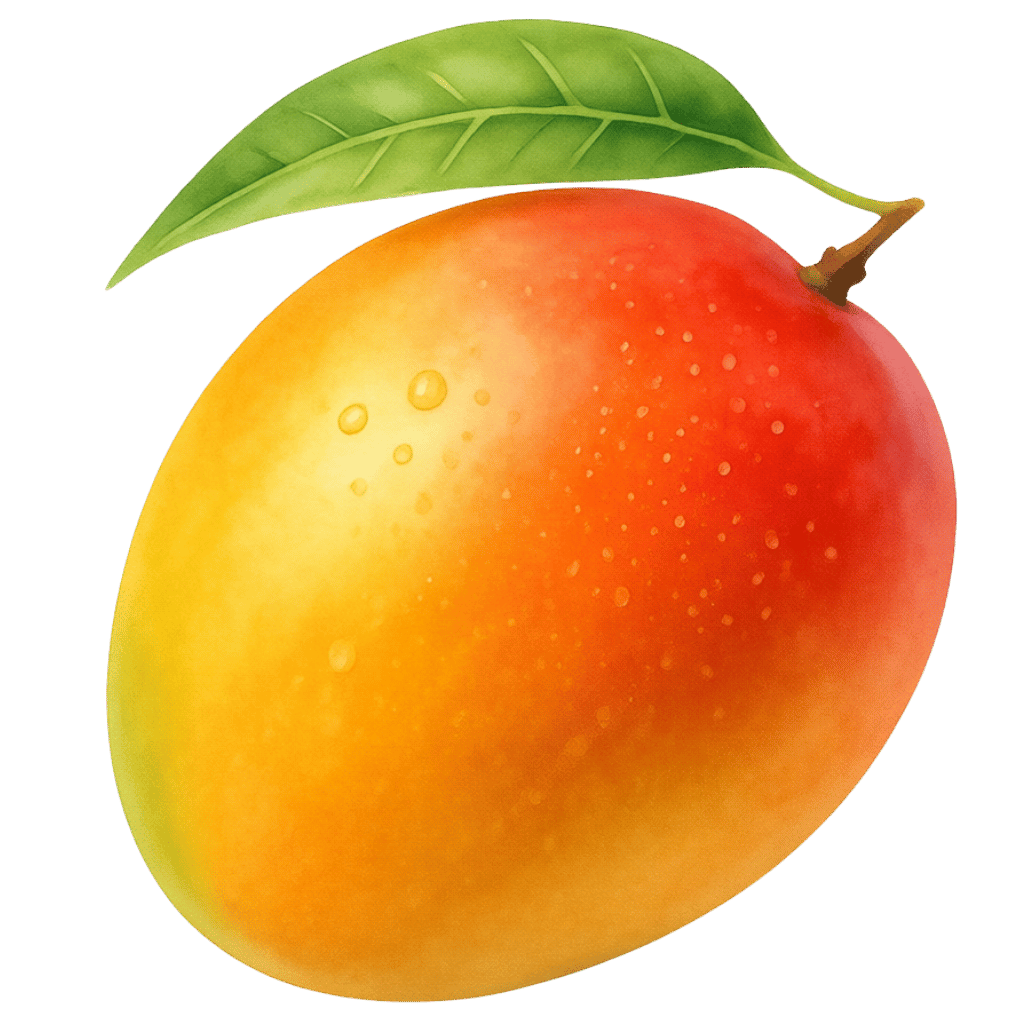
Mango
Mangifera indicaVarieties
Alphonso
18–22° BrixTommy Atkins
13–16° BrixPalmer
Keitt
Kent
Ataulfo
15–18° BrixBotanical View
- Leaves are alternate, simple, entire and leathery, oblong-lanceolate in shape, generally 16–30 cm long and 3–7 cm wide (up to about 50 cm on vigorous non-flowering shoots), tapering to a point and sometimes with slightly wavy margins. New flushes emerge coppery-red to purplish and limp, then harden to a glossy dark green above and paler beneath, with prominent yellowish venation. The petiole is up to about 4.5 cm long and swollen at the base. Crushed foliage is aromatic and, like the rest of the plant, contains irritant resins.
- The trunk is stout and erect, in old trees up to roughly 0.9 m in diameter (circumference over 3.7 m), supporting a heavy branching framework. Bark is grey to dark brown, at first fairly smooth with many thin fissures and becoming rough, scaly or furrowed with age; young branchlets are rather stout, pale green and hairless. The bark yields a resinous gum and a yellow dye, and the timber is used for plywood, low-cost furniture and musical instruments.
- Mango develops a strong, deep taproot together with an extensive framework of anchoring and feeder roots. This deep-rooted habit is an adaptation to monsoonal climates with pronounced dry seasons, allowing established trees to draw on deep soil moisture and tolerate drought. Because of it, the species performs best on soils with good, unimpeded depth (generally more than about 1 m).
- The inflorescence is a large, much-branched terminal panicle (a thyrse), commonly 15–30 cm or more long, broadly pyramidal and often reddish or yellow-green and finely hairy. Each panicle bears hundreds to several thousand small flowers, roughly 4–5 mm across, coloured greenish-white, yellowish or pinkish and faintly fragrant.
- Mango is andromonoecious: each panicle carries a mixture of functionally male (staminate) flowers and perfect (hermaphrodite) flowers on the same tree, with hermaphrodite flowers commonly making up somewhere between about a quarter and three-quarters of the total depending on cultivar and conditions. Flowers are small and 4–5-merous, usually with a single fertile stamen, and fruit set is characteristically very low relative to the enormous number of flowers produced. The fruit is a single-seeded fleshy drupe with a fibrous or fibreless mesocarp and a large, flattened stony endocarp (the stone).
- Mango is chiefly insect-pollinated, with flies (Diptera) being the dominant flower visitors, so myophily is regarded as its principal pollination syndrome. Flowers are also visited by Hymenoptera (including some bees and wasps), Lepidoptera and Coleoptera, while honey bees are comparatively minor visitors and wind plays only a limited role. Pollen is deposited on the receptive stigma, and its viability declines rapidly after anther dehiscence.
- Mango grows best in deep, well-drained sandy loam to loam soils with a clay content of roughly 15–25% and an unimpeded depth greater than about 1 m; it performs poorly on heavy, waterlogged soils. It tolerates a fairly wide pH range, with an optimum around 5.5–7.5. Good drainage matters more than high fertility, and the species adapts to a range of soil types wherever drainage is adequate.
- Established mango is fairly drought-tolerant and a dry period before flowering is beneficial, but irrigation improves growth, yield and fruit size, particularly from fruit set through the rapid fruit-expansion stage; water is usually withheld ahead of flowering to avoid stimulating vegetative flushing. Water requirements are managed by growth stage (flowering-to-set, rapid fruit expansion, and maturation). Fertilisation typically combines organic matter (compost or well-rotted manure) with balanced N-P-K applications timed to phenological stages to support flushing, flowering and fruit development.
- Mango is propagated both sexually (by seed) and, for commercial cultivars, almost exclusively vegetatively. Named cultivars do not come true from seed, so they are multiplied by grafting or budding — veneer, cleft or side grafting, and inarching — onto seedling rootstocks, which are usually raised from polyembryonic seed to give uniform, true-to-type rootstocks. Seedlings are used mainly for rootstock production and for breeding.
- Mango cultivars are either monoembryonic or polyembryonic. Monoembryonic seeds contain a single zygotic embryo, so their seedlings are genetically variable and differ from the mother tree; these are typical of many Indian cultivars. Polyembryonic seeds produce several embryos, most of them nucellar (apomictic) and genetically identical to the mother tree, usually alongside one zygotic embryo, so most seedlings breed true — a trait common in Southeast Asian cultivars and exploited for clonal rootstocks. Polyembryony in mango is controlled largely by a single dominant genetic locus.
- An estimated 500–1,000 or more cultivars have been named, the great majority in India. Prominent examples include 'Alphonso', 'Dasheri', 'Langra', 'Banganapalli' and 'Chausa' (India); 'Nam Dok Mai' and 'Carabao' (Southeast Asia); and the Florida-derived commercial group 'Haden', 'Tommy Atkins', 'Kent', 'Keitt' and 'Palmer' that dominates the international export trade, selected for colour, shelf life and shipping quality. Cultivars fall broadly into an 'Indian type' (often monoembryonic) and a 'Southeast Asian type' (often polyembryonic) germplasm group.
- Mango has been cultivated in the Indian subcontinent for at least 4,000 years and features in ancient Sanskrit texts. Its domestication was complex, involving multiple events, hybridisation and regional selection, and produced two main germplasm pools — an 'Indian type' and a 'Southeast Asian type'. Traditional Indian cultivars arose over centuries through selection of chance seedlings. Modern commercial breeding is exemplified by the 20th-century Florida program, where the 1910 'Haden' seedling (derived from 'Mulgoba') gave rise to shipping-oriented cultivars such as 'Tommy Atkins', 'Kent' and 'Keitt' that now dominate global trade. Contemporary breeding increasingly uses molecular markers (for example for polyembryony and fruit traits) for marker-assisted selection.