Back to Fruitpedia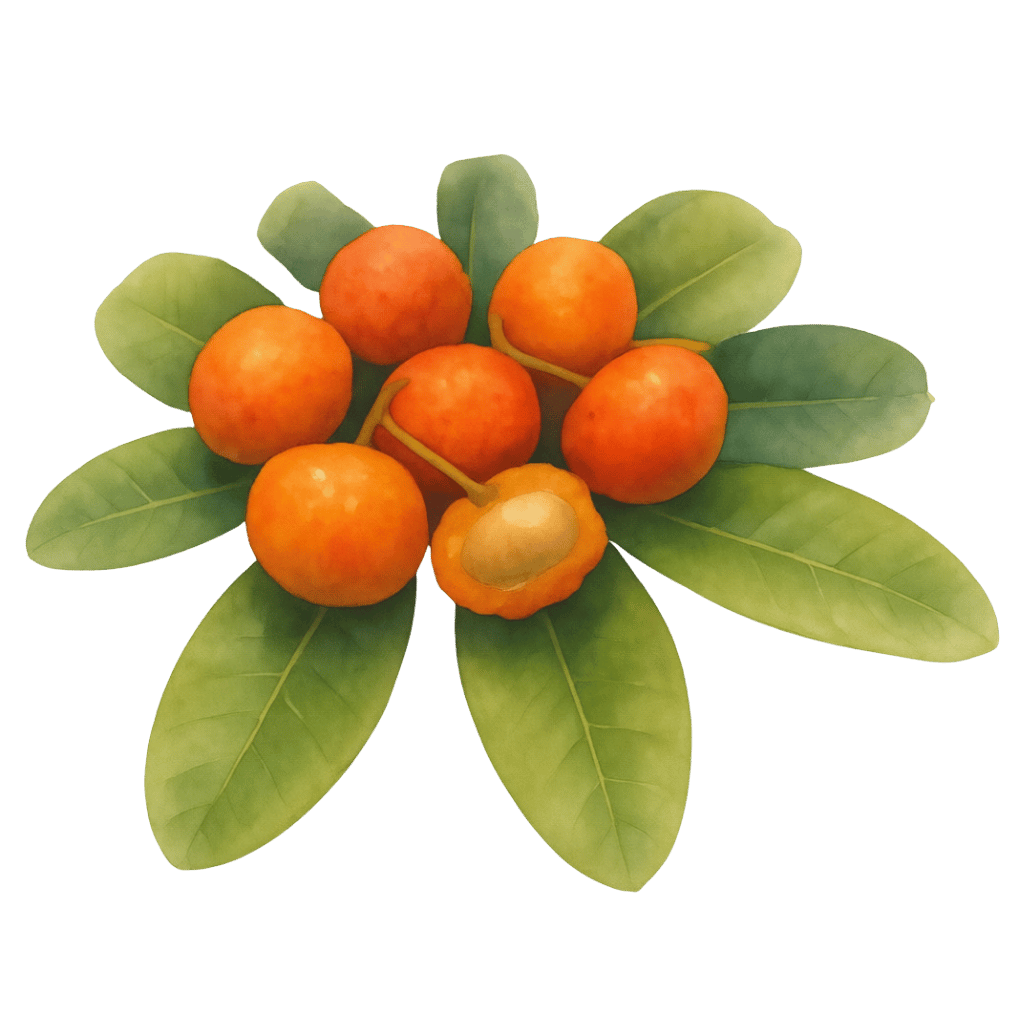
Mama-cadela
Brosimum gaudichaudiiBotanical View
- Leaves are simple, alternate, elliptic to lanceolate, subcoriaceous, 3-13 cm long by 2-6 cm wide, with marked dimorphism and a variable pilose (hairy) covering on the lower (abaxial) surface (Carvalho, EMBRAPA - Espécies Arbóreas Brasileiras vol. 5, 2014). Anatomically the leaf blade is dorsiventral and hypostomatic, with an oblique base, a cuspidate apex, and revolute margins; the abaxial surface bears a dense indumentum of papillae, unicellular non-glandular trichomes, and peltate glandular trichomes; venation follows a camptodromous-brochidodromous pattern with well-defined areoles (Jacomassi, Moscheta & Machado, "Morfoanatomia e histoquímica de Brosimum gaudichaudii Trécul (Moraceae)," Acta Botanica Brasilica 21(3):575-597, 2007).
- The trunk is generally tortuous with a very short bole and no defined apical dominance; branching is heavy, dichotomous or cymose, often multi-stemmed, forming a crown 3-4 m in diameter. Bark (rhytidome) is up to 5 mm thick, light gray, rough, rugose and exfoliating/scaling (Carvalho, EMBRAPA - Espécies Arbóreas Brasileiras vol. 5, 2014). Anatomically, young stems have a uniseriate epidermis with a high density of unicellular non-glandular trichomes and peltate glandular trichomes; the cortex comprises roughly 19 layers of parenchyma cells surrounding an extensive pith; adult stems develop secondary growth with larger-diameter xylem vessel elements. Abundant, branched, non-articulated laticifers occur throughout the stem (and other organs), frequently invading vessel elements, producing the characteristic white, milky latex; gelatinous fibers and phenolic idioblasts are also abundant in vegetative tissues (Jacomassi, Moscheta & Machado, Acta Botanica Brasilica 21(3):575-597, 2007). The wood is moderately dense (0.72 g/cm3), with poorly differentiated, brownish sapwood and heartwood, medium texture and straight grain, but low durability when exposed to weathering (Carvalho, EMBRAPA, 2014).
- The root system includes gemmiferous (bud-bearing) roots that are long and plagiotropic, typically occurring 10-30 cm deep in anatomical sampling, with secondary phloem markedly more developed than xylem; adventitious roots show diarch primary xylem with prominent secondary tissues, and starch grains accumulate in the phloem rays, particularly in the gemmiferous roots (Jacomassi, Moscheta & Machado, Acta Botanica Brasilica 21(3):575-597, 2007). Under field/cultivation conditions in the Cerrado of the Distrito Federal, roots commonly reach a natural depth of about 1-2 m, with uneven, non-uniform distribution that makes wild collection laborious (Palhares et al., 2006, cited in Silva et al., EMBRAPA Boletim de Pesquisa e Desenvolvimento 360, 2020). The root bark is the primary site of accumulation of the medicinal furanocoumarins bergapten and psoralen (Silva et al., EMBRAPA, 2020).
- Inflorescences are capitate (small globose heads), pedunculate and pendent, borne in pairs in the leaf axils, and covered by peltate bracts densely covered in trichomes; the receptacle is fleshy (carnose) and well developed. Each head bears numerous male flowers together with typically a single female flower. Male flowers are reduced to a single stamen surrounded by bracteoles, with a short filament, a broad connective, and two anther sacs that open by longitudinal (rimose) dehiscence. The female flower has a bifid stigma and a style that becomes exserted at anthesis, with an inferior ovary embedded in the fleshy receptacle; of the five carpels present, only one develops (the others atrophy), typically two ovules form in the developed locule but only one matures into a seed; the ovule is pendulous, hemianatropous, and bitegmic only near the micropylar region (Jacomassi, Moscheta & Machado, "Morfoanatomia e histoquímica de órgãos reprodutivos de Brosimum gaudichaudii," Revista Brasileira de Botânica 33(1):115-129, 2010).
- Brosimum gaudichaudii is monoecious: unisexual male and female flowers are borne separately but within the same capitate inflorescence on the same individual plant (Almeida et al., 1998; Silva Júnior et al., 2005, cited in Carvalho, EMBRAPA - Espécies Arbóreas Brasileiras vol. 5, 2014). This is confirmed anatomically — each head contains numerous male flowers and typically one female flower, both unisexual (Jacomassi, Moscheta & Machado, Revista Brasileira de Botânica 33(1):115-129, 2010).
- Pollination vectors are essentially bees and various small insects (Carvalho, EMBRAPA - Espécies Arbóreas Brasileiras vol. 5, 2014). The species also has recognized melliferous potential, producing both nectar and pollen (Carvalho, EMBRAPA, 2014).
- Brosimum gaudichaudii occurs naturally on soils of medium to high fertility that are well drained, with texture ranging from sandy to sandy clay-loam (Carvalho, EMBRAPA - Espécies Arbóreas Brasileiras vol. 5, 2014). It is nonetheless well adapted to the naturally low-fertility, acidic soils typical of the Cerrado (in an EMBRAPA cultivation trial conducted on a clayey dark-red Latosol/Oxisol with pH 5.8, 52% clay, 25% silt, 23% sand); under cultivation, plants develop better roots when the substrate is amended to a sandier texture than the native clayey subsoil (Silva et al., EMBRAPA Boletim de Pesquisa e Desenvolvimento 360, 2020, citing Pimenta & Coelho, 2000).
- In the only published cultivation trial (EMBRAPA Recursos Genéticos e Biotecnologia, Brasília, DF), seedlings were transplanted into a basic substrate mix of subsoil, coarse river sand and cured cattle manure (3:1:1), amended with dolomitic limestone and simple superphosphate, then further diluted with additional sand; the best root development occurred with a final mix of ~50% base blend plus 50% extra sand (overall soil:sand:manure ratio approximately 3:6:1). A slow-release NPK fertilizer with micronutrients (3 g/L, containing N, P2O5, K2O, Ca, Mg, S, B, Cu, Fe, Mn, Zn and Mo) was applied at planting. Only occasional watering was given, limited to the first year of cultivation, after which plants relied on natural rainfall. An earlier field study (Pimenta & Coelho, 2000, cited in Silva et al., 2020) found that different fertilization levels did not significantly affect early growth, indicating the species is well adapted to the naturally low-fertility soils of the Cerrado; organic (manure) plus modest mineral fertilization is nonetheless empirically recommended for larger-scale cultivation to promote root development (Silva et al., EMBRAPA Boletim de Pesquisa e Desenvolvimento 360, 2020).
- The species is propagated by seed and, vegetatively, by root cuttings (Silva et al., 2011; Silveira et al., 2020, cited in Silva et al., EMBRAPA Boletim de Pesquisa e Desenvolvimento 360, 2020). Micropropagation has been attempted, but no reliable, established protocol yet exists (Martins, 1998; Lima et al., 2014; Carneiro et al., 2019, cited in Silva et al., 2020). Seed-based production (Carvalho, EMBRAPA, 2014): fruits are harvested directly from the tree once they turn yellow and begin to fall, or collected from the ground; they are piled in plastic bags until the pulp partially decomposes, which eases seed extraction; each plant yields roughly 30-100 fruits; there are 570-600 seeds per kilogram; no pre-germination treatment is required; seeds are sown directly into containers (polyethylene bags or medium-sized tubes); germination is epigeal with phanerocotylar seedlings; emergence begins 30-40 days after sowing; germination rate is typically above 50%; seedlings reach plantable size 5-7 months after sowing.
- Seeds are globose, cream-colored, up to 1.5 cm in diameter, with 1-2 seeds per fruit; they show recalcitrant physiological behavior with respect to storage, meaning they do not tolerate desiccation and cannot be stored long-term. Germination rate is typically above 50% under nursery conditions (Carvalho, EMBRAPA - Espécies Arbóreas Brasileiras vol. 5, 2014).
- No named cultivars or improved varieties have been developed for Brosimum gaudichaudii; all plants used in cultivation trials and in trade derive from wild-collected Cerrado populations (Silva et al., EMBRAPA Boletim de Pesquisa e Desenvolvimento 360, 2020). The genus Brosimum Sw. (1788) comprises about 13 species distributed from Mexico to Paraguay (Berg, 1972, cited in Carvalho, EMBRAPA, 2014), none of which are commercially bred varieties of B. gaudichaudii.
- Brosimum gaudichaudii has never been domesticated. Historically and still today, essentially all root material used by folk medicine and the pharmaceutical industry (for bergapten/psoralen extraction) comes from destructive, unsustainable wild extraction in the Cerrado, which, combined with agricultural-frontier deforestation, has eroded natural populations and their genetic variability (Carvalho, EMBRAPA, 2014; Silva et al., EMBRAPA Boletim de Pesquisa e Desenvolvimento 360, 2020). Because of high demand and strong anthropogenic pressure, the species was ranked a high priority for genetic-resource conservation and research at a 2001 EMBRAPA technical meeting, and it was later included in the "Plantas para o Futuro" (Plants for the Future) list for Brazil's Center-West region (Silva et al., 2018, cited in Silva et al., 2020). No cultivar-development or formal breeding program exists; the first systematic agronomic trials on root cultivation/production date only to the 2000s-2020s (Palhares et al., 2006, 2007; Pereira et al., 2006; Silva et al., 2020).