Back to Fruitpedia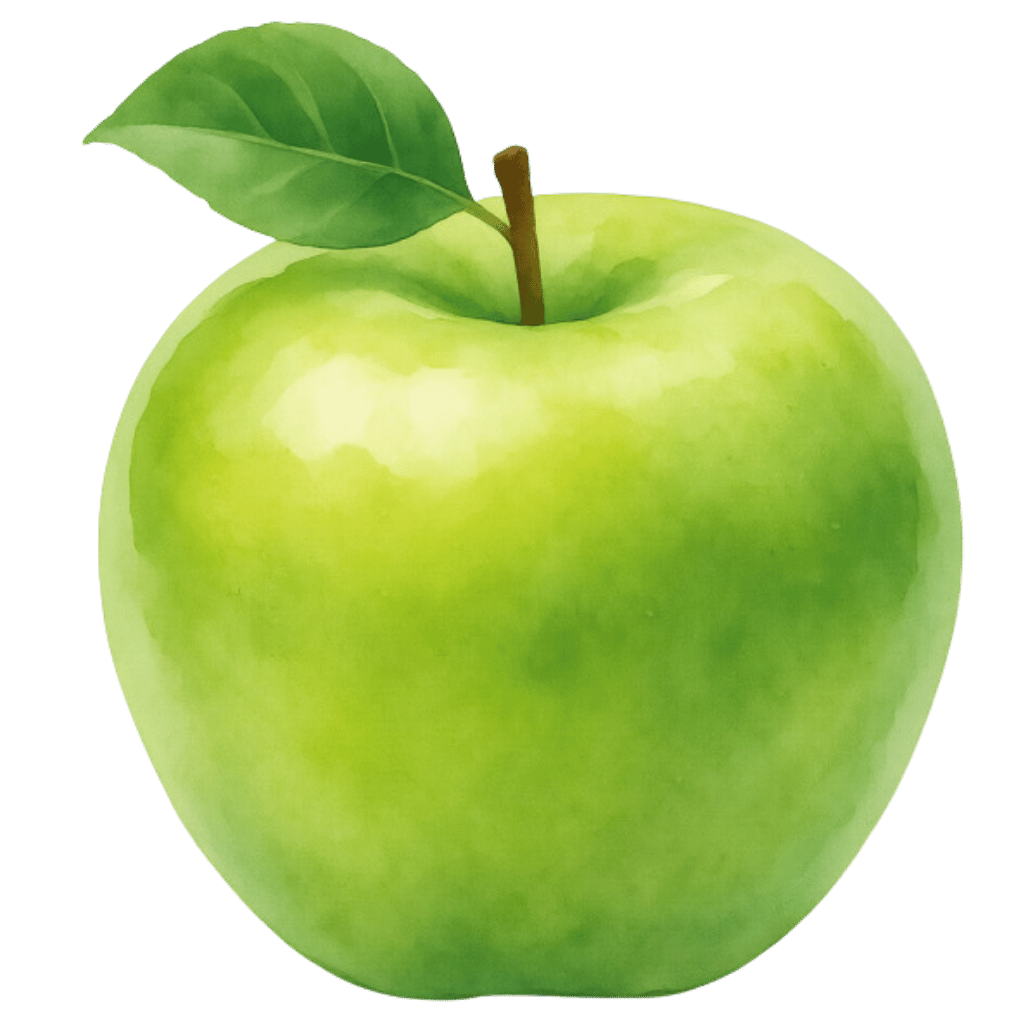
Green apple
Malus domesticaVarieties
Granny Smith
11–13° BrixGolden Delicious
12–15° BrixBramley's Seedling
Mutsu
Rhode Island Greening
Newtown Pippin
Botanical View
- Leaves are simple, alternate, petiolate, deciduous, with pinnate venation. Blades are elliptic to ovate, roughly 5-9 cm long by 3.5-6 cm wide (up to about 10-12 cm in vigorous shoots), with a blunt-toothed to serrate margin. The upper surface is bright to dark green and largely glabrous, while the underside is paler, grayish-silver, and finely pubescent (downy), a texture also present on young twigs.
- The trunk is a relatively short structure, about 50-100 cm tall, whose main function is to support the aerial framework of the tree; from it emerge, typically, three to five primary scaffold branches (pernadas), whose number and angle depend on how the young tree was trained/pruned. Bark is smooth and brownish when young, becoming rougher with age. Fruiting occurs on specialized short shoots that arise on the scaffold and secondary branches: brindilas (one-year shoots, 15-30 cm, usually bearing a single terminal flower bud and giving the best-quality fruit), esporões/spurs (two-year-or-older, up to 15 cm, branched or not, bearing one or more flower buds, generally lower-quality fruit), and dardos (short, unbranched structures of 4-6 cm producing small fruit).
- The root system comprises roots of different ages and thickness: older, thicker "principal" roots responsible for anchorage and long-distance transport of water/nutrients, and finer, younger roots -representing roughly 75-85% of the total root system- responsible mainly for absorption and conduction. Root architecture depends on propagation method: seed-propagated plants initially form a pivoting taproot with lateral branches, whereas vegetatively propagated plants (cuttings, stool-bed layering used for clonal rootstocks) emit roots uniformly around the base of the cutting, later developing a more vigorous main root as the plant grows. Root development is further influenced by rootstock vigor, soil physical characteristics (texture, structure, depth), water and nutrient availability, soil temperature, and hormonal regulation; leaves supply metabolites and hormones that also affect root growth. Roots require deep (usable depth greater than 50 cm), well-drained soil; heavy clay or compacted subsurface layers restrict root development and water infiltration.
- The inflorescence is a corymb (cacho floral), typically composed of five to seven flowers, most commonly six, borne on spurs or the tips of one-year shoots. The central flower of the corymb (the "king" or "queen" flower) opens first and, if pollinated, generally develops into the largest fruit of the cluster.
- Flowers are hermaphroditic (bearing both functional male and female organs) but the species is largely self-incompatible: a gametophytic S-RNase-based system arrests growth of self (and genetically related) pollen tubes inside the style, so more than 50 distinct S-RNase alleles are recognized across apple germplasm and most cultivars require cross-pollination with a genetically compatible cultivar to set commercial fruit. Typically the flower has 5 sepals, 5 petals, an inferior ovary with 5 locules each containing 2 ovules, 5 moist stigmas, and roughly 20 stamens with free filaments and longitudinally dehiscent anthers.
- Pollen grains are smooth, tricolporate, and poorly adapted to wind dispersal, so effective pollination depends almost entirely on insect vectors, principally honeybees (Apis mellifera). Commercial growers are recommended to place a minimum of two beehives per hectare inside or near the orchard during bloom, or to plant compatible pollinizer cultivars interplanted in rows or blocks (e.g., 'Dorsett Golden'/'Golden Ashmi' for early cultivars; 'Melrose' for 'Golden Delicious'); hand pollination is possible but slow and costly.
- Apple trees require deep soils (root-usable depth greater than 50 cm) that are well drained; excessively clayey soils or soils with a compacted subsurface layer are avoided because they restrict root development and water infiltration. Soil physical structure is considered more important than nutrient content, because a well-structured soil allows a well-developed root system to exploit whatever nutrients are naturally present or supplied by fertilization. In southern Brazil, apple-growing soils tend to be naturally acidic (pH 4.0-5.0) with low native phosphorus, calcium, and magnesium but generally adequate potassium and organic matter, requiring substantial liming (commonly over 10 t/ha of dolomitic limestone, calcium:magnesium ratio above 3:1) to raise pH to about 6.0 before planting.
- Pre-plant fertilization applies phosphorus and potassium according to soil analysis, generally sufficient to sustain the trees until they enter commercial production around the fourth year. During the growth phase, only nitrogen is normally applied, split into several applications tied to phenological stages (bud swell, petal fall, post-harvest), increasing in amount each year. From the fourth year onward, maintenance fertilization is based on combined leaf analysis (about 100 leaves sampled from at least 20 representative trees, collected mid-January to mid-February) and periodic soil analysis, adjusted for tree age, previous fertilization, fruit load, and spacing; potassium is withheld if soil levels already exceed about 100 ppm (0-20 cm layer) or 50 ppm (20-40 cm layer). Organic fertilizer is recommended in place of mineral fertilizer when available. Regarding irrigation, EMBRAPA research in southern Brazil found that combining irrigation with fertilization (fertigation), allowing nutrient rates to be adjusted to real-time vegetative development, offset negative effects of climate variability and raised average yields by about 34% in 'Gala'-group cultivars and by more than 120% in 'Fuji Suprema'.
- Because apple seedlings are highly heterozygous and do not breed true, commercial trees are propagated clonally by grafting or budding the desired scion cultivar onto a rootstock, rather than from seed. Rootstocks range from vigorous, seed-propagated ("standard") stock to size-controlling clonal rootstocks propagated by stool-bed layering or cuttings, including dwarfing types such as M.9 (and M.9 EMLA) and Bud.9 (about 35-45% of standard tree size, precocious but sometimes fire-blight susceptible), semi-dwarfing types such as M.26 (about 40-50%), MM.106 (about 60-75%) and MM.111 (about 85-90%), and Geneva-series rootstocks bred for disease resistance. At planting, the graft union is set roughly 3 cm above soil level. In Brazil, planting is done in winter (June to early September) while nursery trees are dormant and leafless, with the soil firmly compacted around the roots to avoid air pockets.
- Apple is a highly heterozygous, obligately outcrossing species, so seedlings grown from apple seed are genetically unique individuals that differ substantially from their parent tree in fruit size, flavor, productivity, and disease resistance; commercial cultivars therefore do not come true from seed and must be maintained by clonal propagation (grafting). Each fruit can contain up to about ten relatively small seeds that are pale in color when immature and darken as they mature.
- The dominant cultivars grown commercially in Brazil are 'Gala', 'Golden Delicious', and 'Fuji', with 'Senshu', 'Braeburn', 'Sansa', and 'Jonagold' planted on a smaller scale, alongside more deeply colored bud-sport mutations of 'Gala' and 'Fuji' (e.g., 'Royal Gala', 'Imperial Gala', 'Gala RW1', 'Gala SM7', 'Fuji nº1', 'Fuji nº2'). Cultivars are grouped by harvest season: early ('Princesa', a low-chill selection requiring roughly 400 hours below 7.2°C), semi-early ('Gala' and its clones, the Japanese 'Hatsuaki'), mid-season ('Golden Delicious' and low-russeting clones such as 'Belgolden', 'Melrose', the Japanese 'Senshu'), and late-season, harvested from April onward ('Fuji' and its clones, 'Romu 50'). Additional pollinizer cultivars with limited market appeal in Brazil include 'Willie Sharp', 'Mollie's Delicious', 'Royal Red Delicious', and 'Granny Smith'. Worldwide, 'Golden Delicious' has been among the most widely planted apple cultivars for over a century.
- The domesticated apple's center of origin and primary genetic contributor is the wild apple Malus sieversii, native to the Tian Shan mountain forests of what is now southeastern Kazakhstan, near Almaty; wild apple forests there were first formally documented by German botanist Johann August Carl Sievers during an 1793 expedition, and in the early twentieth century Russian botanist Nikolai Vavilov identified this region as the center of highest apple genetic diversity. From this center, apples spread westward along Silk Road trade routes (roughly 130 BCE to 1453 CE), carried by traders, pack animals, and wildlife that fed on the fruit and dispersed seeds, hybridizing en route with other wild Malus species (M. sylvestris, M. orientalis, M. baccata) to generate the genetic diversity underlying modern cultivars. From antiquity onward, humans propagated selected trees by grafting to fix desirable traits, since seedlings do not breed true. Modern commercial breeding in the 20th century, conducted in countries such as the United States, New Zealand ('Gala'), Japan ('Fuji'), and Israel, produced today's leading cultivars; Israeli breeding programs in particular developed low-chill cultivars (requiring fewer than 300 hours below about 7.2°C) that enabled commercial apple growing to expand into subtropical regions, including southern Brazil, where modern commercial cultivation began in Santa Catarina in the 1960s.