Back to Fruitpedia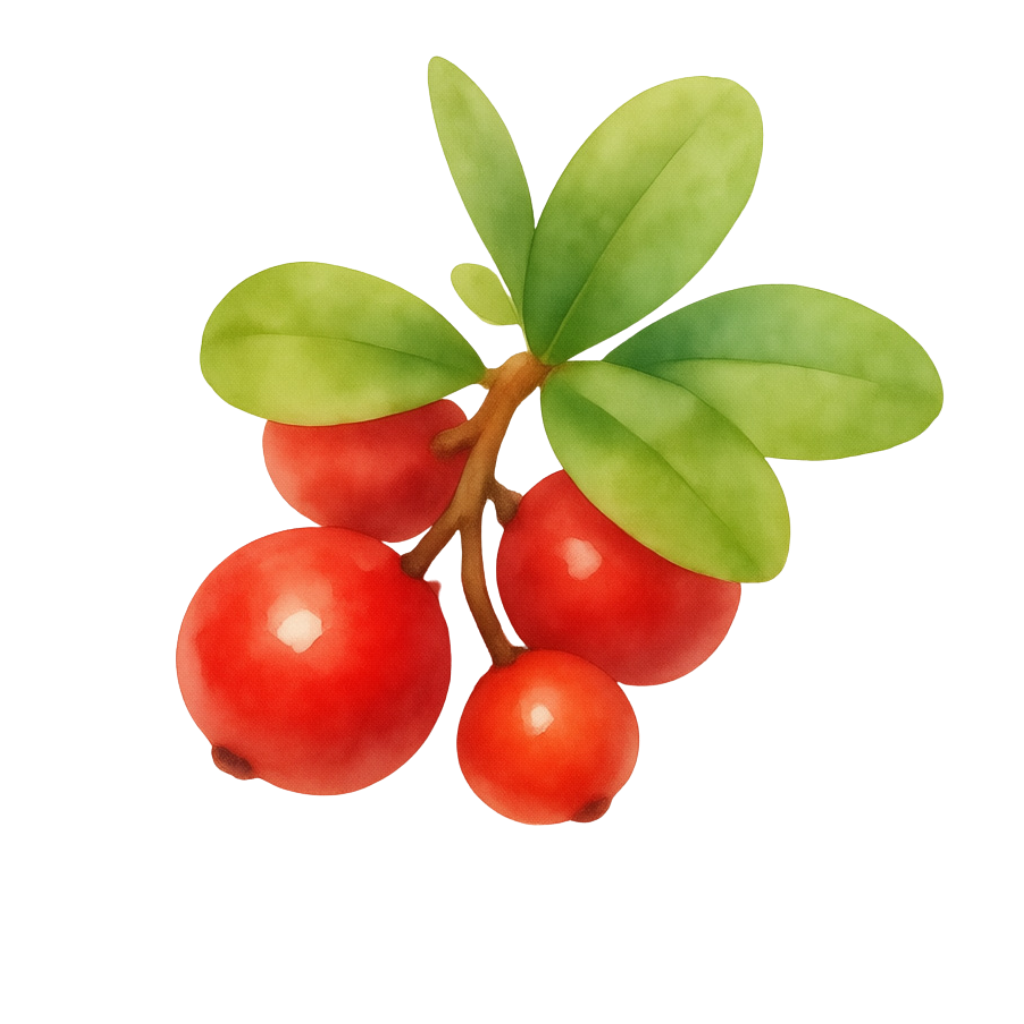
Lingonberry
Vaccinium vitis-idaeaVarieties
Koralle
Red Pearl
Sanna
Sussi
Ida
Regal
Botanical View
- Leaves are alternate, simple, thick and leathery, evergreen, obovate to oblong or elliptic, roughly 5–30 mm long (larger in subsp. vitis-idaea, smaller in subsp. minus). The upper surface is dark glossy green and the paler undersurface bears scattered dark bristle-like glands; margins are entire and slightly rolled under (revolute), and the blade appears single-veined. Foliage often turns purplish or bronze in autumn and winter.
- Stems are slender, low-growing, trailing to creeping and rounded in cross-section, often rooting at the nodes and forming mats. From the horizontal rhizome system arise short erect flowering shoots reaching about 10–40 cm tall. Young stems are finely hairy; older growth becomes woody.
- The root system is shallow and fibrous, composed of fine, brittle, hairlike roots, sometimes with a weak taproot. Plants spread mainly by dichotomously branched underground rhizomes (modified stems) that produce new shoots, forming extensive clonal colonies; rooting depth is generally about 5–28 cm and is inversely related to the thickness of the soil organic layer. Like other Ericaceae, lingonberry forms ericoid mycorrhizal associations that aid nutrient uptake in acidic, low-fertility soils.
- Flowers are borne in short, dense, nodding terminal racemes carrying about 3–15 (commonly 5–12) flowers. Each flower has a small campanulate (bell-shaped) corolla that is white to pale pink and shallowly 4-lobed, roughly 3–8 mm long, with about 8 stamens and an inferior ovary. The fruit is a globular red berry about 6–10 mm in diameter, four-celled and many-seeded.
- Reproduces both sexually by seed and vegetatively (clonally) by rhizomes and by layering of rooting stems, with clonal spread often dominant in wild stands. Flowers are hermaphroditic but only partially self-fertile and largely dependent on insect cross-pollination; fruit set is much higher after cross- or open-pollination (~58–64%) than after self-pollination (~28%) or insect exclusion (~2%). Interplanting compatible cultivars markedly improves yield.
- Entomophilous (insect-pollinated). Principal pollinators are bumblebees (Bombus spp.), the solitary bee Andrena lapponica, other solitary bees, and bee flies/hoverflies (syrphid flies); honeybees also visit. Buzz/vibration foraging by bees aids pollen release from the poricidal anthers.
- Requires acidic, well-drained soils that are high in organic matter and low in fertility, calcium, and lime. Optimal pH is about 4.0–5.0 (tolerated range roughly 2.7–8.2, but growth and fruiting are best under acidic conditions). Thrives on sandy loams, peat, and drained organic soils; intolerant of alkaline soils and prolonged waterlogging.
- Has a low nutrient requirement and is sensitive to high nitrogen — a safe range is about 50–100 mg N/L, with damage near 200 mg N/L. Fertilize lightly in early spring with an acid-forming (azalea/blueberry-type) fertilizer; over-fertilizing promotes leafy growth at the expense of fruit. Needs consistent, even moisture but excellent drainage; overwatering, high irrigation rates, or heavy soils promote Phytophthora root rot.
- Propagated commercially mainly by vegetative means: semi-hardwood stem cuttings of current-season growth (taken in late summer or autumn), layering, and rhizome division, which preserve cultivar identity. It can also be grown from seed (slow and genetically variable) and by in vitro micropropagation (tissue culture). Its naturally spreading rhizomes make clonal propagation straightforward.
- Because the species is outcrossing, seed-grown plants are genetically variable, so named cultivars are maintained clonally rather than from seed. Each berry contains roughly 10–30 small seeds (about 1 mm long); seeds are heat-sensitive and germinate best under cool, moist conditions. Several North American cultivars (e.g. 'Regal', 'Splendor') originated as selections from Finnish seed lots, illustrating the variability available from wild seed.
- At least a dozen named cultivars have been released, most as selections from wild germplasm. Examples include 'Sussi' and 'Sanna' (Sweden); 'Koralle', 'Ammerland', and 'Red Pearl' (Netherlands/Germany; the Koralle Group holds the RHS Award of Garden Merit); 'Erntekrone', 'Erntedank', and 'Erntesegen' (Germany); 'Masovia' (Poland); and 'Splendor' and 'Regal' (USA, University of Wisconsin, from Finnish seed). 'Sussi' and 'Red Pearl' are noted as good pollenizers, and reliable cross-pollination pairings include 'Koralle' with 'Red Pearl' and 'Erntedank' with 'Sussi'.
- Selection and breeding began in the late 1960s in Sweden and expanded through the 1970s to Germany, the Netherlands, Poland, and later the USA (University of Wisconsin–Madison). Commercial cultivation dates from around the 1960s. Most released cultivars are clonal selections from wild populations rather than products of controlled crosses; more recently, intersectional hybridization with heat-tolerant species such as Darrow's blueberry (V. darrowii) has been explored to broaden adaptation.