Back to Fruitpedia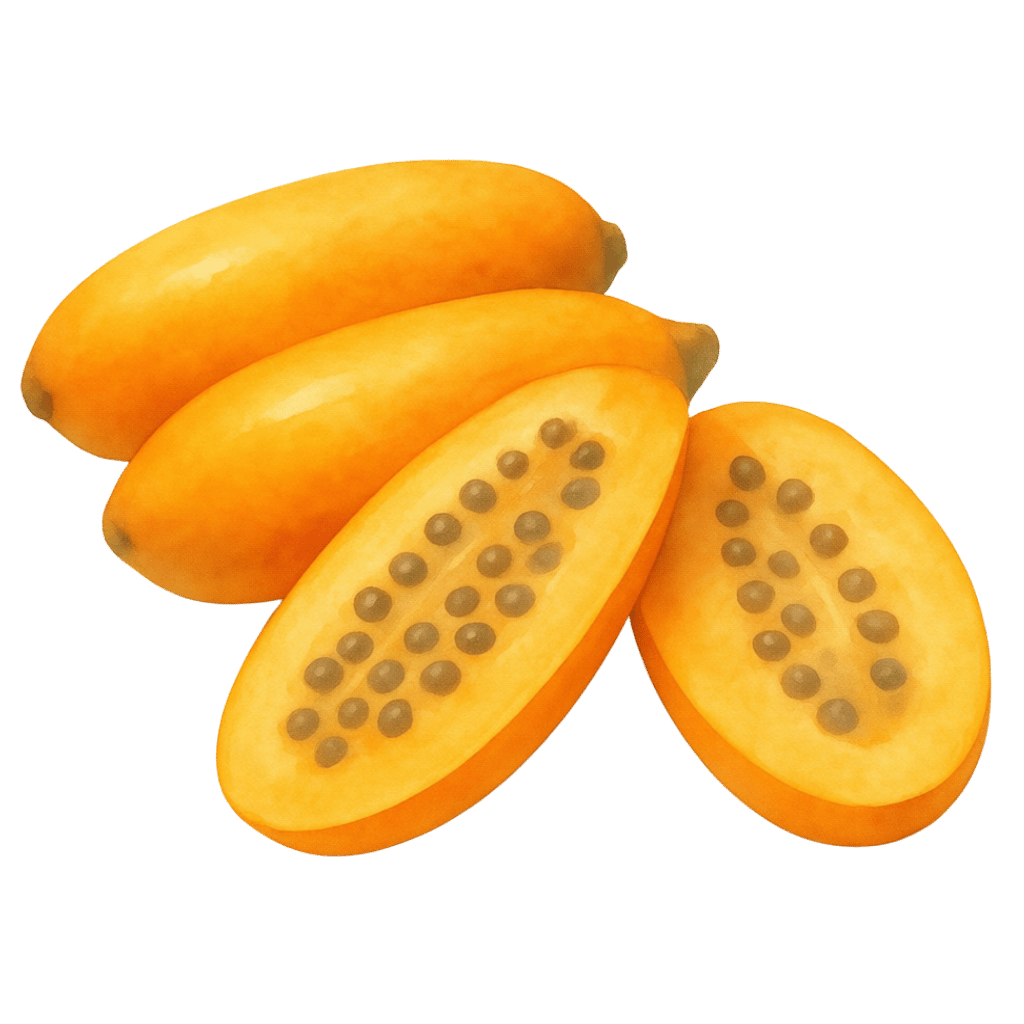
Jaracatia
Jacaratia spinosaBotanical View
- Leaves are alternate, digitately compound (palmate), long-petiolate, with 5 to 12 subsessile leaflets that are oval to narrowly lanceolate, glossy, and relatively sparse, clustered near the branch tips. Leaflets measure 4.5-18 cm long by 1.5-6 cm wide, are bicolored (dark green above, whitish beneath), and have a broad tip at both ends. Foliage is deciduous, shed seasonally.
- The trunk is straight, thick, sharply tapering (markedly conical), and sounds hollow when struck. Bark is up to 3 mm thick, grayish, nearly smooth with fine flaking and horizontal lenticels, and bears numerous flattened spines up to 5 mm long (occasionally spineless). Beneath the bark lies a soft, white pulp/pith that exudes white latex when cut; the wood itself is extremely light, whitish, soft and hollow (pithy), with essentially no use as sawn or round timber, though trunk sections are used in some countries to make barrels. Branching is cymose; branches are spiny, nearly horizontal, arising from a single trunk, and weak/drooping. Growth habit is monopodial, with the trunk tapering toward the crown.
- Detailed root architecture (depth, lateral spread, taproot form) has not been formally characterized in the consulted literature. Like the stem, the root has a soft, fleshy, latex-bearing interior: the tender part of the root is traditionally processed, together with the stem pith, into a paste mixed with coconut to prepare a sweet ("doce"), indicating fleshy, non-woody root tissue rather than a documented taproot/lateral system.
- Inflorescences are unisexual and axillary. Male inflorescences are multiflorous, cymose/racemose clusters about 7-9 cm long bearing numerous pedunculate, greenish, strongly aromatic flowers; female inflorescences are axillary and uniflorous (solitary), cream-green and inconspicuous. Male flowers are tubular, about 10-20 mm long with a corolla tube around 9 mm and five corolla lobes. Female flowers are yellow, solitary on broad stalks, with five fleshy petals 2-3 cm long and stigmatic lobes about 7.2 mm long, 5-8 mm in diameter. Anthesis is chiefly nocturnal, peaking between about 20:00-22:00h (and again near 01:00h in males); male flowers remain open roughly 24 hours, female flowers about 48 hours.
- Jacaratia spinosa is dioecious, with separate male and female trees showing marked floral dimorphism and asynchronous phenology: in a studied southeastern Brazilian population, male trees flowered for about 52 days versus about 22 days for females. Only male flowers secrete nectar (sugar concentration around 13.9%); female flowers, despite offering no reward, closely mimic male flowers in color, shape and scent — a floral mimicry strategy that helps them attract the same pollinators drawn to the rewarding male flowers.
- The main pollinators are moths, including hawkmoths (Sphingidae); the flowers show a phalaenophilous syndrome consistent with nocturnal anthesis and a sweet scent that intensifies at dusk and dawn. Secondary floral visitors recorded include butterflies, hummingbirds (Chlorostilbon aureoventris, Amazilia lactea, A. versicolor and Eupetomena macroura), bees and wasps.
- In nature it grows on moist soils of alluvial floodplains and slope depressions, forming large, well-developed trees on both fertile soils and comparatively poor soils, though vigor is reduced on the weakest soils. Documented preference is for soils rich in organic matter, pH 5.0-6.5.
- No formal fertilization or irrigation protocol is established for this species in the consulted literature, as it is chiefly harvested from native/wild stands or grown in mixed reforestation plantings rather than under agronomic cultivation. Its documented cultural requirement is a consistently moist, organic-matter-rich soil (see Soil).
- Propagation is by seed; no vegetative propagation method is documented. Ripe fruit is picked directly from the tree or collected from the ground after natural fall, then opened by hand to remove seeds, which are washed in running water and dried in the shade. There are about 28,700 seeds per kilogram. No pre-germination treatment is required, but seed viability in storage is very short. Germination is epigeal (phanerocotylar); seedling emergence begins 10-27 days after sowing and germination percentage is generally high, though the fleshy sarcotesta and surrounding mucilage contain inhibitors that reduce germination unless removed. Seeds are sown as soon as harvested in semi-shaded beds; seedlings are pricked out at 4-5 cm height (about 2 months after germination) and reach plantable size about 4 months after sowing. Mixed planting is recommended for regeneration; growth is moderate, with trial plantings in Paraná and São Paulo reaching an estimated volumetric yield of up to 11 m³/ha/year by 4 years of age.
- Seeds are small, ovoid and yellow, 1-3 mm in diameter, enveloped in mucilage, with a fleshy sarcotesta and a dark-brown, finely ridged sclerotesta similar in structure to those of cultivated papaya (Carica papaya). Fruit-to-fruit variation in seed number is best predicted by fruit weight, which shows the strongest correlation with seed count. Removing the sarcotesta and mucilage (which contain germination inhibitors) measurably increases germination performance relative to intact seeds.
- No named cultivars or formally improved varieties have been developed; Jacaratia spinosa remains an undomesticated, wild-harvested species propagated from seed collected from native populations. Molecular studies show it is genetically well differentiated from cultivated papaya (Carica papaya): a microsatellite survey found it clustering with Vasconcellea accessions at only about 7% similarity to C. papaya cultivars and carrying a notably high number of rare alleles, underscoring its distinctness from commercial papaya germplasm.
- Jacaratia spinosa has no history of formal domestication or crop breeding; it is exploited as a wild/extractive resource for its edible fruit and pith (the latter processed with coconut into a sweet paste) and in folk medicine, rather than cultivated as an orchard crop. It is listed in the "rare" category of the red list of plants threatened with extinction for the state of Paraná, reflecting pressure on wild populations rather than any breeding program. Recent complete mitochondrial and chloroplast genome sequencing has begun to clarify its phylogenetic position relative to cultivated papaya (Carica papaya) and other Caricaceae genera, which may inform future interspecific breeding or genetic-resource use, though no such program has yet been reported.