Back to Fruitpedia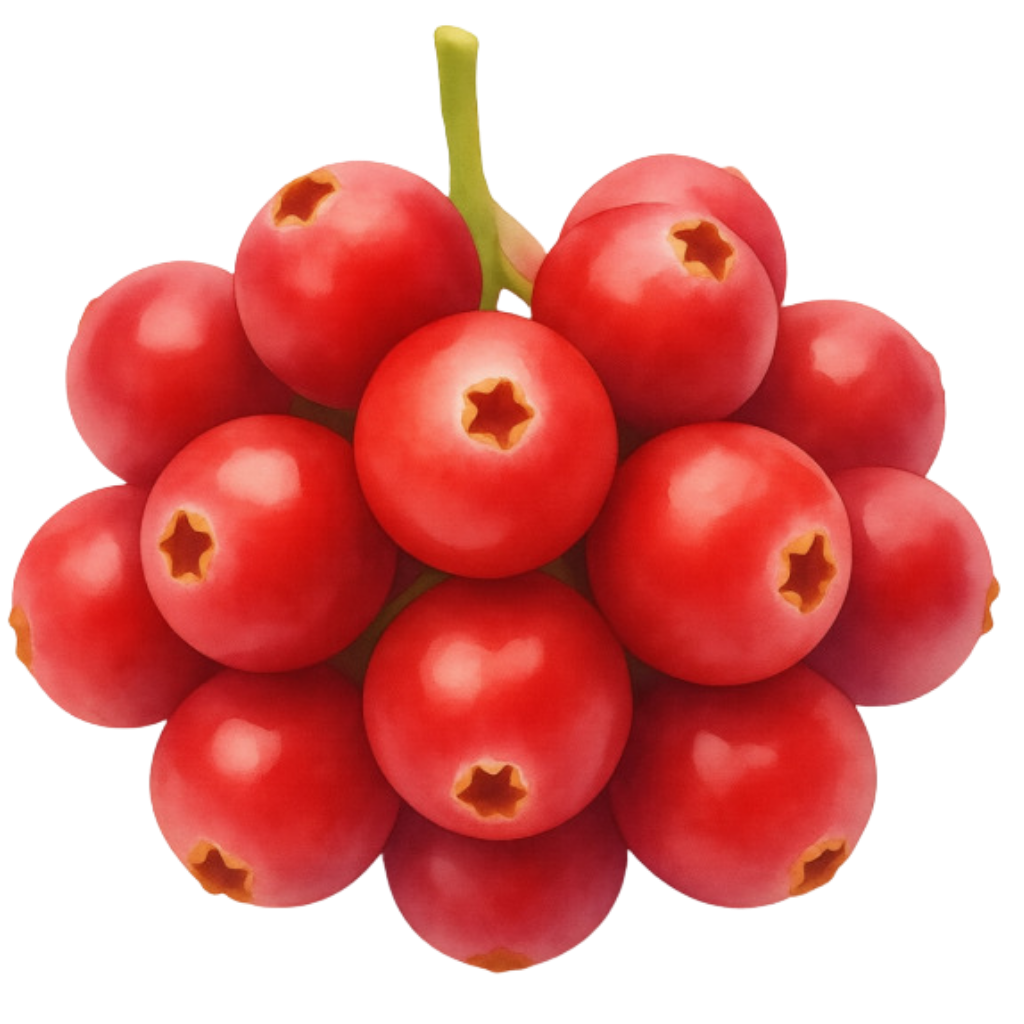
Highbush Cranberry
Viburnum trilobumVarieties
Wentworth
Andrews
Hahs
Phillips
Redwing
Compactum
Botanical View
- Leaves are deciduous, opposite, simple and broadly maple-like, ovate to rounded in outline, about 5-12 cm long and typically three-lobed (trilobed) with coarsely toothed margins and pointed lobes. The upper surface is dark green and somewhat wrinkled, turning yellow, orange, red to red-purple in autumn. The petiole bears small raised glands (extrafloral nectaries), typically 1-6, near the junction with the leaf blade, a diagnostic feature of the Opulus group.
- A multi-stemmed shrub with erect to arching branches forming a rounded crown. Young twigs are slender and smooth; older stems and bark are grayish and smooth to somewhat rough. Branch structure is dense and upright, and the shrub commonly suckers to form thickets over time.
- Shallow, fibrous root system. The plant tolerates moist to poorly drained soils and can spread and colonize by suckering from the root zone.
- The inflorescence is a flat-topped to slightly rounded cyme (lacecap), 5-8 cm (about 2-3 inches) across. It is dimorphic: a ring of large, showy, white sterile (neutral) flowers forms the outer margin and surrounds a dense central cluster of much smaller, fertile, perfect white flowers that produce the fruit. The showy sterile flowers serve to attract pollinators to the small fertile flowers at the center.
- Reproduces sexually by seed and vegetatively by suckering and layering. The small central flowers are hermaphroditic (perfect, with both stamens and pistil); the marginal flowers are sterile and neutral. Reports on self-fertility conflict, but cross-pollination between separate plants markedly improves fruit and fertile-seed set, so planting two or more shrubs is recommended. The fruit is a one-seeded drupe (berry-like), globose, bright red, about 8-10 mm in diameter, containing a single large, strongly flattened stone.
- Insect-pollinated. The fertile flowers are visited by a range of flies, native and honey bees, and beetles; the broad flat clusters act as easy landing platforms for small insects. The foliage also hosts caterpillars of various moths.
- Adaptable to light (sandy), medium (loamy) and heavy (clay) soils; grows best in consistently moist, moderately fertile soils and tolerates imperfectly to poorly drained sites. Prefers neutral to slightly acidic pH (roughly 5.5-7.5) but tolerates mildly acid to slightly basic conditions. Performs poorly in very poor or droughty soils; established plants are moderately drought tolerant.
- Prefers evenly moist soil, especially while establishing; benefits from mulch to retain moisture. Grows well in soils of average fertility and generally needs little supplemental fertilizer beyond incorporating organic matter; excessive nitrogen is unnecessary. Provide supplemental water during prolonged drought.
- Propagated vegetatively and by seed. Softwood cuttings taken in early summer and semi-ripe (half-ripe) cuttings in July-August root readily, especially with rooting hormone under mist (success commonly around 70-80%). Layering also works. Seed is slow and difficult, requiring a warm-then-cold stratification (about 2 months warm followed by 3 months cold); untreated seed may take 18 months or more to germinate and germination can be low.
- Each drupe contains a single flattened stone. Seedlings are variable, and seed dormancy is complex; germination rates from stored seed are low without the required warm/cold stratification. Because of this variability and slow germination, named fruiting selections are propagated clonally rather than from seed.
- Named cultivars include 'Wentworth' (selected for good-quality edible fruit and red fall color), 'Redwing' (J.N. Select; verified as true V. trilobum, with reddish new growth), 'Compactum' (dwarf, dense, about 1.5 m), 'Hahs', 'Andrews', and 'Phillips' (a selection noted for less bitter fruit). Selections have generally been made for fruit quality, compact habit, and fall color.
- Formally described by Humphry Marshall in 1785 as Viburnum trilobum. It has long been used by Indigenous peoples of North America and by settlers for its edible fruit. Modern improvement has been limited and consists mainly of clonal selection from wild and cultivated populations for fruit quality, compactness, and autumn color (e.g., 'Wentworth', 'Phillips', 'Compactum', 'Redwing') rather than formal hybrid breeding programs. Taxonomically it has been variously treated as a distinct species or as a variety of V. opulus.