Back to Fruitpedia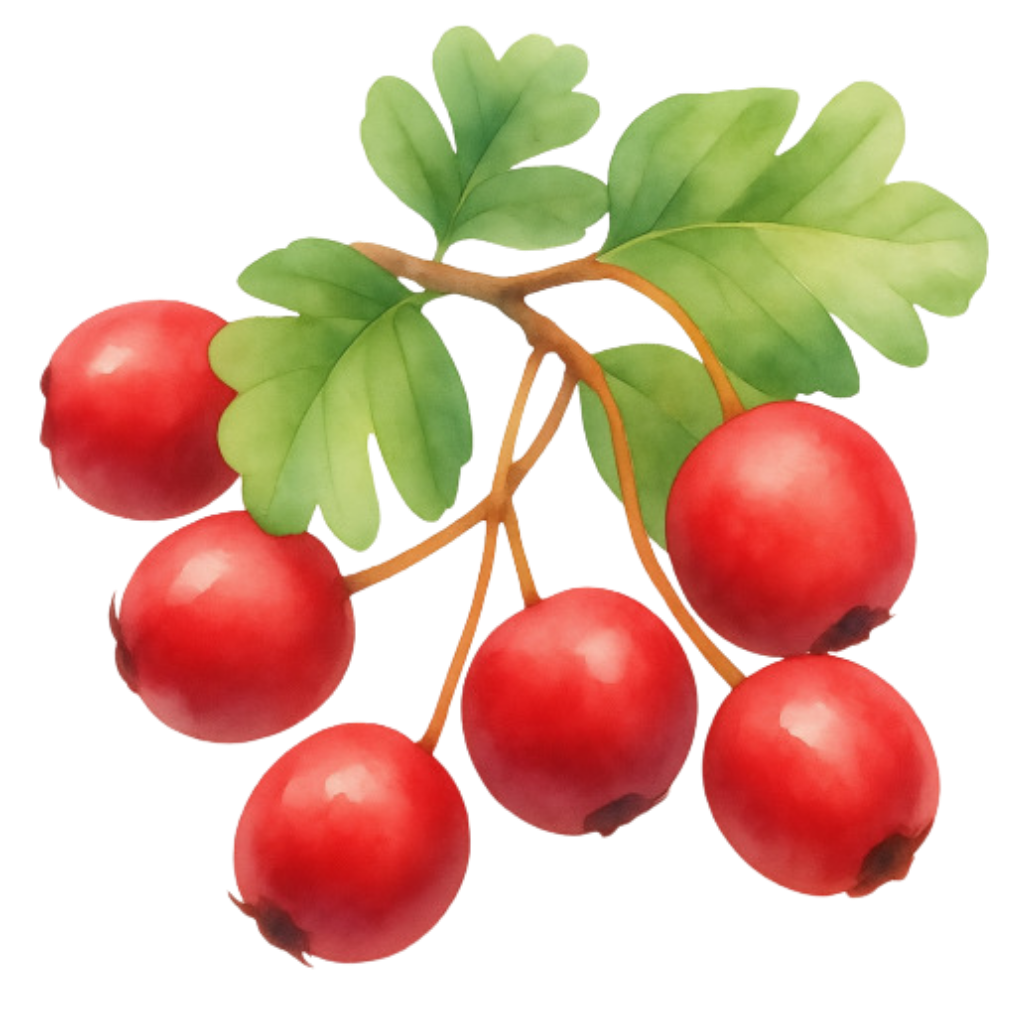
Hawthorn
Crataegus spp.Varieties
Red Sun
Da Jinxing
Botanical View
- Leaves are deciduous, alternate and simple, borne on short spurs and on long shoots. Blades range from obovate to broadly ovate and are lobed and/or toothed: in common hawthorn (C. monogyna) they are about 2-4 cm long and deeply pinnately lobed, sometimes nearly to the midrib, with the lobes spreading at a wide angle, whereas other species are only shallowly lobed or merely serrate. The upper surface is dark, glossy green and paler beneath, often turning yellow to orange-red in autumn. Small leaf-like stipules are present at the leaf base.
- Habit is a shrub or small tree to roughly 10-15 m with a dense, twiggy, rounded crown, frequently multi-stemmed. Young stems bear stiff, sharp thorns (modified short branch shoots) about 1-2.5 cm long, occurring both along the shoots at bud joints and terminating them; a few species are nearly thornless. Bark is smooth and grey-brown on young stems, becoming dull brown and cracked with narrow vertical orange fissures or breaking into small scales with age. The wood is diffuse-porous, fine-grained, pale reddish, and notably hard and heavy.
- Hawthorn develops a deep, far-reaching taproot system with strong lateral roots. This anchors the plant firmly, contributes to its drought tolerance once established, and makes older specimens difficult to transplant.
- Flowers are borne in flat-topped or slightly domed clusters (corymbs) of typically about 5-25 flowers, though they are solitary or few in a few species (e.g. C. uniflora). Each flower is bisexual, radially symmetric and roughly 1-1.5 cm across, with five white (sometimes pink) petals, numerous stamens with pink to red anthers, and 1-5 styles seated on a cup-shaped hypanthium. The number of styles/carpels (one in C. monogyna, usually two in C. laevigata) is a key identification character. The flowers are strongly, sometimes unpleasantly, scented.
- Flowers are hermaphrodite and insect-pollinated. Diploid species such as C. monogyna and C. laevigata are largely self-incompatible (gametophytic self-incompatibility) and reproduce sexually by outcrossing. Many hawthorns are polyploid (triploid or tetraploid), and these frequently reproduce asexually through seed by pseudogamous gametophytic apomixis (agamospermy), in which pollination is still needed to fertilize the endosperm but the embryo forms without fertilization. Polyploidy, apomixis and frequent interspecific hybridization are central to the genus's reproductive biology and its taxonomic complexity.
- Pollination is by insects. Flowers attract visitors both visually, through conspicuous white petals, and by a strong scent (containing trimethylamine, giving a musky to foetid odour), rewarding them with nectar and pollen. The main pollinators are flies (many Diptera) and bees, along with beetles and other insects. Hawthorn can be pollen-limited, with fruit set significantly reduced when pollinating insects are excluded from the flowers.
- Hawthorn grows on most soil types, including chalk, clay, loam and sandy soils, across a wide pH range, provided drainage is adequate. It prefers deep, fertile, moist but well-drained loam; it tolerates heavy clay and periodic drought once established, but does not tolerate permanent waterlogging.
- Hawthorns are low-maintenance and undemanding. Young or newly planted trees benefit from regular watering during their establishment period and in prolonged drought, but established plants are relatively drought-tolerant and usually need little supplemental irrigation. They seldom require feeding; where growth is poor a general-purpose fertilizer may be applied in early spring before new growth begins. Excessive nitrogen is avoided because it encourages soft, succulent growth that is more susceptible to fire blight.
- The species are propagated mainly by seed. The nutlets have hard coats and deep dormancy and normally need a period of warm stratification followed by cold, moist stratification (often several months at about 5 C, sometimes preceded by acid scarification); even so, germination is slow and erratic and may take up to 18 months, sometimes spread over two seasons. Named cultivars and hybrids, which do not come true from seed, are propagated vegetatively by budding or grafting (typically in late winter or early spring) onto hawthorn seedling rootstocks; layering is also possible.
- Seed-grown progeny of sexual, self-incompatible diploids are genetically variable and outcrossed. In contrast, apomictic polyploids produce seed that is essentially clonal, giving genetically uniform offspring that resemble the mother plant. Because hybridization between species is frequent and apomixis fixes new gene combinations, the genus contains many stabilized microspecies and intermediate forms, and seedlings of hybrids can be highly variable.
- Numerous ornamental cultivars have been selected, mostly from English hawthorn (C. laevigata) and the hybrid C. x media, including the popular double-flowered forms 'Paul's Scarlet' (deep rose-red, a branch sport dating to about 1858 and introduced by William Paul in 1866), 'Rosea Flore Pleno' (double pink) and 'Plena' (double white). Cold-hardy Canadian hybrids such as C. x mordenensis 'Toba' and 'Snowbird' were bred at the Morden Research Station. Other cultivated species include Washington hawthorn (C. phaenopyrum), cockspur hawthorn (C. crus-galli, including thornless 'Inermis'), C. viridis 'Winter King', and, for fruit, Chinese hawthorn (C. pinnatifida) and mayhaws (C. aestivalis, C. opaca).
- Hawthorn has been used and shaped by people for centuries, chiefly as a stock-proof hedging plant (widely planted during agricultural enclosure in Britain and Europe) and as an ornamental and medicinal plant, rather than as an intensively bred crop. The genus's taxonomy is notoriously complex because polyploidy, apomixis and pervasive hybridization have generated hundreds of microspecies. Deliberate breeding has mostly targeted ornamentals, for example double-flowered and coloured selections from C. laevigata and C. x media in 19th-century European nurseries and cold-hardy hybrids from Canada's Morden Research Station in the 20th century, while fruit improvement has centred on Chinese hawthorn (C. pinnatifida, shan zha) in East Asia and mayhaws in the southeastern USA.