Back to Fruitpedia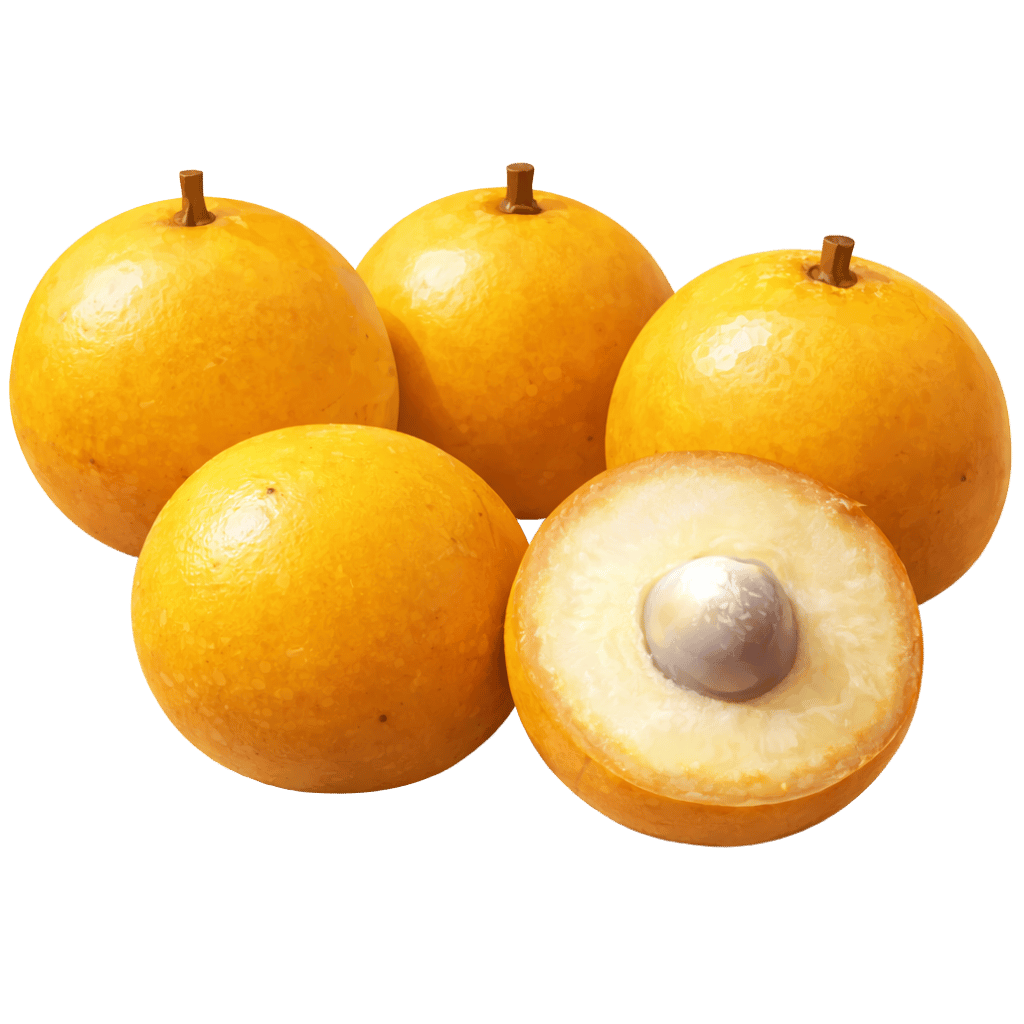
Guapeva
Pouteria gardneriBotanical View
- Leaves are simple, arranged in an alternate-spiral phyllotaxy, discolorous (paler beneath), glabrous to slightly pubescent, with entire margins and eucamptodromous venation. Blades measure approximately 5-12 cm long by 3-5 cm wide, borne on cylindrical petioles about 2-3.5 cm long.
- The trunk bears moderately thick bark, grey to nearly black in color, longitudinally furrowed and peeling (desquamating), with reddish inner bark (slash). Young branches are pubescent with pale, whitish hairs, soon becoming glabrous, smooth to slightly striate, and generally lenticellate. The wood is heavy, with yellowish to light-brown heartwood, described as resistant and easy to work, and is used locally for furniture, flooring, doors, windows and roof framing.
- Flowers are borne in axillary fascicles or occur solitary, yellowish-green, actinomorphic (radially symmetric) and pentamerous (5-parted): the calyx has 5 sepals, the corolla is cyathiform (cup-shaped) with 5 lobes with entire margins and obtuse apices, the filaments are glabrous, the style lacks a constricted region, and the ovary has 2-3 locules. Flowers measure about 3-4 mm long.
- Individual trees bear hermaphroditic (bisexual) flowers (the species is described in the source literature as monoecious/bearing perfect flowers on the same individual), consistent with the predominantly hermaphroditic flower structure typical of Pouteria (Sapotaceae).
- Flowers are visited mainly by small bees, including honeybees, which forage for nectar and pollen and act as pollinators.
- In the wild it grows in riparian (gallery) forest, semi-deciduous seasonal forest, and cerradão formations. For nursery propagation, a substrate of clay and sand mixed 1:1 with decomposed organic matter is recommended.
- Para produção de mudas, recomenda-se substrato de solo argilo-arenoso misturado com matéria orgânica decomposta (proporção 1:1), semeado em sacos de polipropileno de 25 x 15 cm. Não há dados específicos publicados sobre adubação ou irrigação em plantios definitivos desta espécie.
- Propagation is by seed. Seeds show physical (seed-coat) dormancy and, left untreated, take 40-120 days to germinate. Drying seeds for 10-15 days loosens the seed coat, allowing more rapid and uniform germination within 15-40 days. Seeds are sown in polypropylene nursery bags filled with a clay-sand substrate mixed 1:1 with decomposed organic matter.
- Seeds are brown, 8-12 mm long, with a narrow hilum. Germination time is variable, ranging from 40-120 days for untreated seeds to 15-40 days after a 10-15 day drying pretreatment that loosens the seed coat.