Back to Fruitpedia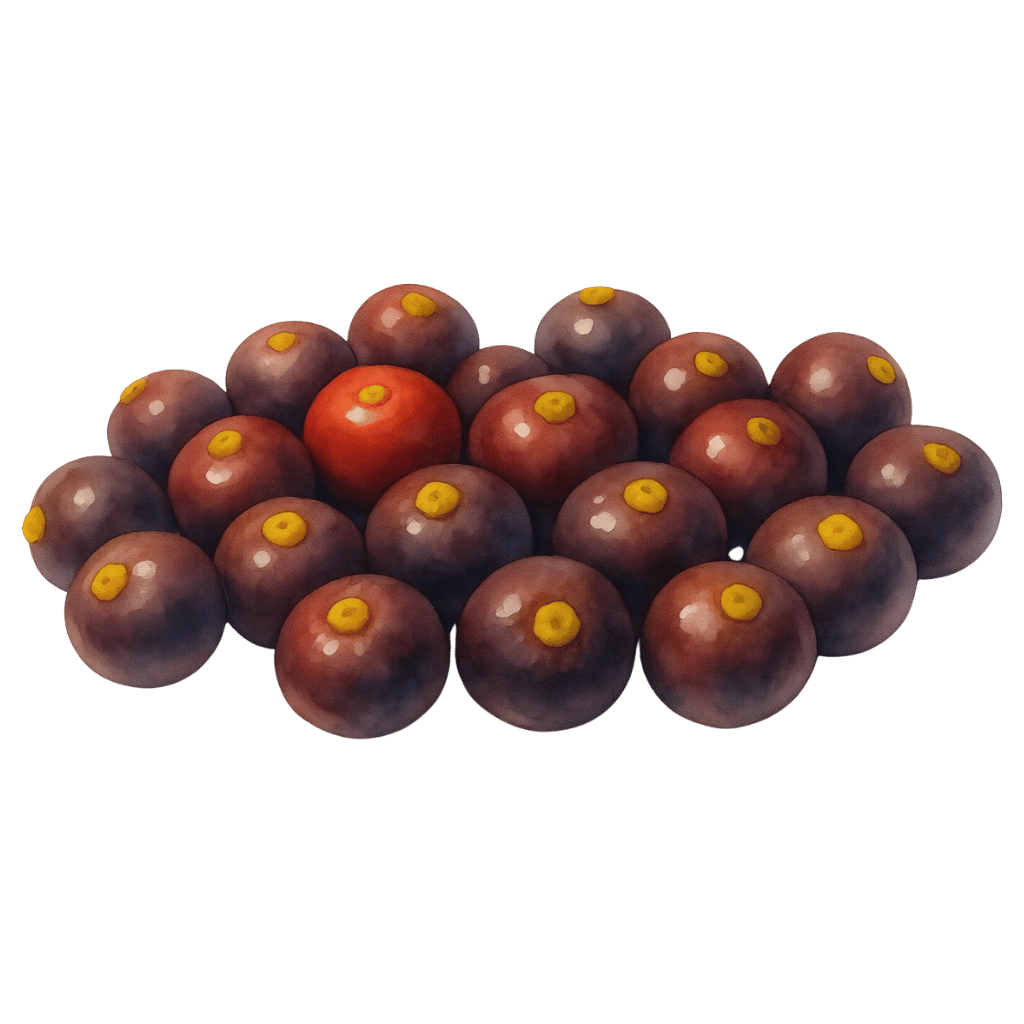
Guamirim
Myrcia splendensBotanical View
- Leaves are dorsiventral and hypostomatic (stomata restricted to the lower surface), with a uniseriate epidermis. The mesophyll has a single-layered palisade parenchyma and a 7-10-layered spongy parenchyma. Secretory oil glands (typical of Myrtaceae) occur throughout the mesophyll and in the midrib cortex; the essential oil stored in these glands is dominated (about 95%) by sesquiterpenes (hydrocarbon and oxygenated forms). Leaf perenniality is semi-deciduous (semi-caducifolious), meaning the tree sheds part of its foliage seasonally rather than remaining fully evergreen. Source: Ramos et al., structural/chemical study of M. splendens leaves under thrips galling, PMC (NCBI); Embrapa species sheet.
- The species is a shrub to small/medium tree with a bole (trunk) diameter of approximately 15-25 cm and an irregular, low-density (sparse) crown. Bark of the stem is traditionally harvested by local communities for use as a dye in artisanal gourd (cuia) crafting. Wood is light brown to reddish-brown, medium-textured and straight-grained, ranging from soft to hard, and is used locally for posts, crates, fuelwood and charcoal, as well as in civil construction per Embrapa. Sources: Embrapa species sheet; Useful Tropical Plants (compiled from published floras); Phytochemistry Reviews (De Almeida et al. 2025) ethnobotanical summary.
- ""
- Flowers are borne in small axillary or terminal panicles typical of Myrtaceae/Myrcia. Individual flowers are small and hermaphroditic, with a turbinate (obconic) hypanthium bearing a sericeous/tomentose (hairy) indumentum; single-celled trichomes cover the outer calyx and hypanthium of the flower buds. Sepals are free; the floral disc is hair-covered; the ovary is bilocular (two-celled) with equal anther thecae, and the stamens are characteristically incurved/folded, a trait used in Myrteae systematics. Flowering (floração) occurs from November to December according to Embrapa; other sources note that in parts of its range the species can flower and fruit for much of the year. Fruits are small, dark blue to blackish berries with a thin layer of flesh surrounding a single large seed, dispersed by animals (zoochory). Sources: Embrapa species sheet (flowering period, zoochory); Vasconcelos et al., "A Systematic Overview of the Floral Diversity in Myrteae (Myrtaceae)" (hypanthium/stamen morphology); Useful Tropical Plants (fruit description).
- Myrcia splendens is reported to be xenogamous, i.e., dependent on cross-pollination between individuals rather than self-pollination, consistent with the general pattern in Myrtaceae where pollen is the principal (often sole) floral reward and outcrossing is favored. Source: reproductive-ecology literature on Myrcia/Myrtaceae floral biology (search-aggregated from peer-reviewed floral biology studies of Myrcia; specific primary study not independently verified in full text — treat with some caution).
- Flowers are pollinated mainly by bees, which either contact the anthers directly or use buzz (sonication) pollination to release pollen; in Myrtaceae generally, and in small hermaphroditic Myrcia flowers specifically, pollen is the main or sole floral reward, attracting small social bees such as Trigona spp., Apis mellifera, and Augochloropsis spp. (Meliponini and Apini/Halictidae). Source: aggregated floral-biology literature on Myrcia/Myrtaceae pollination (peer-reviewed studies on bee-mediated pollen collection in Myrtaceae).
- Occurs on soils ranging from sandy to clayey texture, and preferentially on fertile, deep soils, per Embrapa. It also tolerates periodically waterlogged/flooded ground. Source: Embrapa species sheet ("Ocorre em solos de textura arenosa a argilosa. Prefere solos férteis e profundos. Tolera geada e terrenos alagados").
- ""
- Propagation is primarily by seed, sown fresh; germination rates above 50% have been reported, with seedlings emerging in about 25-35 days. Vegetative propagation via herbaceous stem cuttings (about 10 cm long, cut on a bevel at the base, retaining one to two leaf pairs) has also been investigated in nursery trials, since M. splendens has been identified as one of the native tree species with the lowest seedling availability in commercial nurseries in São Paulo state. Sources: Useful Tropical Plants (seed germination rate/timing, compiled from published propagation trials); Parajara, "Propagação vegetativa e desenvolvimento de mudas," graduate thesis (Instituto de Botânica/PGIBT, São Paulo) — vegetative cutting protocol and nursery-availability finding.
- Fruits typically contain a single large seed per fruit (occasionally reported with more than one ovule, but usually developing one seed), with a membranous testa (seed coat) surrounding a hypocotyl-radicle axis and cotyledons, as described in anatomical studies of Myrcia/Myrtaceae seeds. Detailed population-level data on seed size/viability variability specific to M. splendens was not found in available government/university sources; further primary literature review is recommended before treating this as definitive. Source: aggregated seed-anatomy literature on Myrcia/Myrtaceae (general morphological description); exact variability data unverified — left general in the absence of a citable primary study.
- No named or formally registered cultivars of Myrcia splendens are documented in government, university, or floristic sources consulted; it remains an undomesticated, wild-collected native species used mainly for reforestation, apiculture, and local extractive/food uses rather than commercial fruit cultivation. Source: absence of cultivar records in Embrapa species sheet and Kew POWO taxonomic treatment.
- Myrcia splendens is a wild, non-domesticated native forest species with no documented formal plant-breeding or cultivar-development program. It is used directly from wild or reforestation-planted stock for human food (fruits eaten fresh or processed into jelly, ice cream, and liqueur per Embrapa), timber/fuelwood, essential oil and tannin extraction, and apiculture (melliferous/bee-forage use), rather than through selective breeding. Its main documented "improvement" activity is agronomic/nursery research (seed germination and vegetative-cutting propagation trials) aimed at increasing seedling availability for reforestation, not trait selection or cultivar breeding. Source: Embrapa species sheet (Utilidades section); Parajara graduate thesis on vegetative propagation and nursery seedling development.