Back to Fruitpedia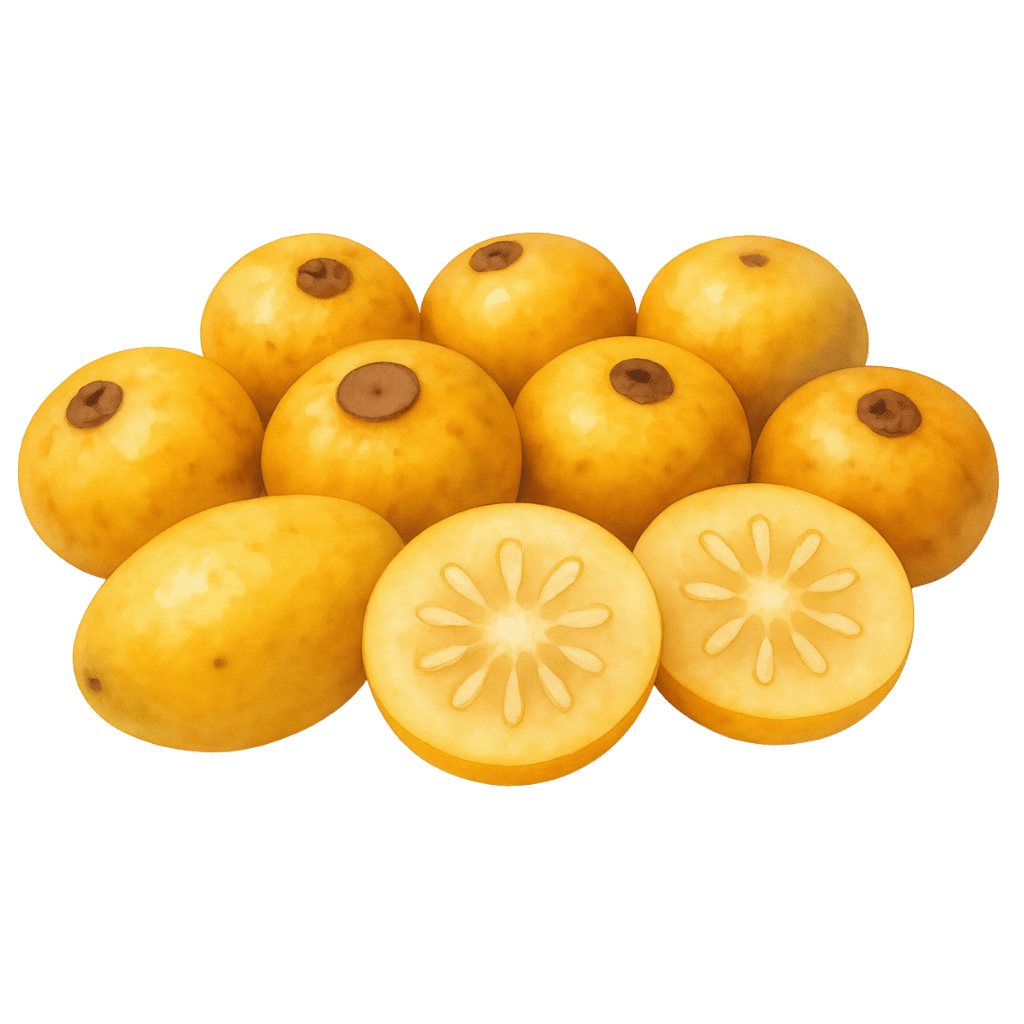
Guabiraba
Campomanesia aromaticaBotanical View
- Foliage is deciduous, with young leaves still immature at the time of anthesis (flowering). The abaxial (lower) leaf surface bears tufts of trichomes (hairs) in the axils where secondary veins meet the midrib. Detailed data on leaf shape, size, margin, phyllotaxy and venation pattern specific to this species were not found in the consulted sources.
- Young growth (shoots) is sparsely to densely puberulent (fine short hairs). No source-verified description of trunk form, bark texture/color, or branching architecture specific to this species was found.
- No source-verified information on the root system of this species was found.
- Flowers are quite small, white, and borne with frequently narrow calyces; bracteoles are puberulent, the sepals oblong-truncate to ovate, and the floral disc puberulent. The ovary has up to 5 locules, and the flowers overall are described with four to six locules. No source-verified detail on inflorescence arrangement (solitary vs. racemose/cymose, position) was found for this species specifically.
- No source-verified, species-specific data on the reproductive/breeding system (e.g., self-compatibility, dichogamy) of Campomanesia aromatica was found.
- No source-verified, species-specific pollinator data for Campomanesia aromatica was found. (Studies on the congener C. adamantium report Apis mellifera as a principal floral visitor, but this cannot be extrapolated to C. aromatica without direct evidence.)
- No source-verified information on soil preference or requirements for this species was found.
- No source-verified information on fertilization or irrigation practices for this species was found; it is not documented as a commercially cultivated crop.
- Propagation is by seed, per general horticultural compilations; no detailed, species-specific germination or nursery protocol was found in priority sources. (Related congeners such as C. adamantium and C. xanthocarpa have documented seed-propagation protocols, but these should not be assumed to apply directly to C. aromatica.)
- No source-verified information on seed variability for this species was found.
- No named cultivars are documented; the species is a wild, undomesticated native forest plant rather than a cultivated crop.
- No breeding or domestication history is documented; the species remains an undomesticated wild native forest plant with no reported formal breeding program.