Back to Fruitpedia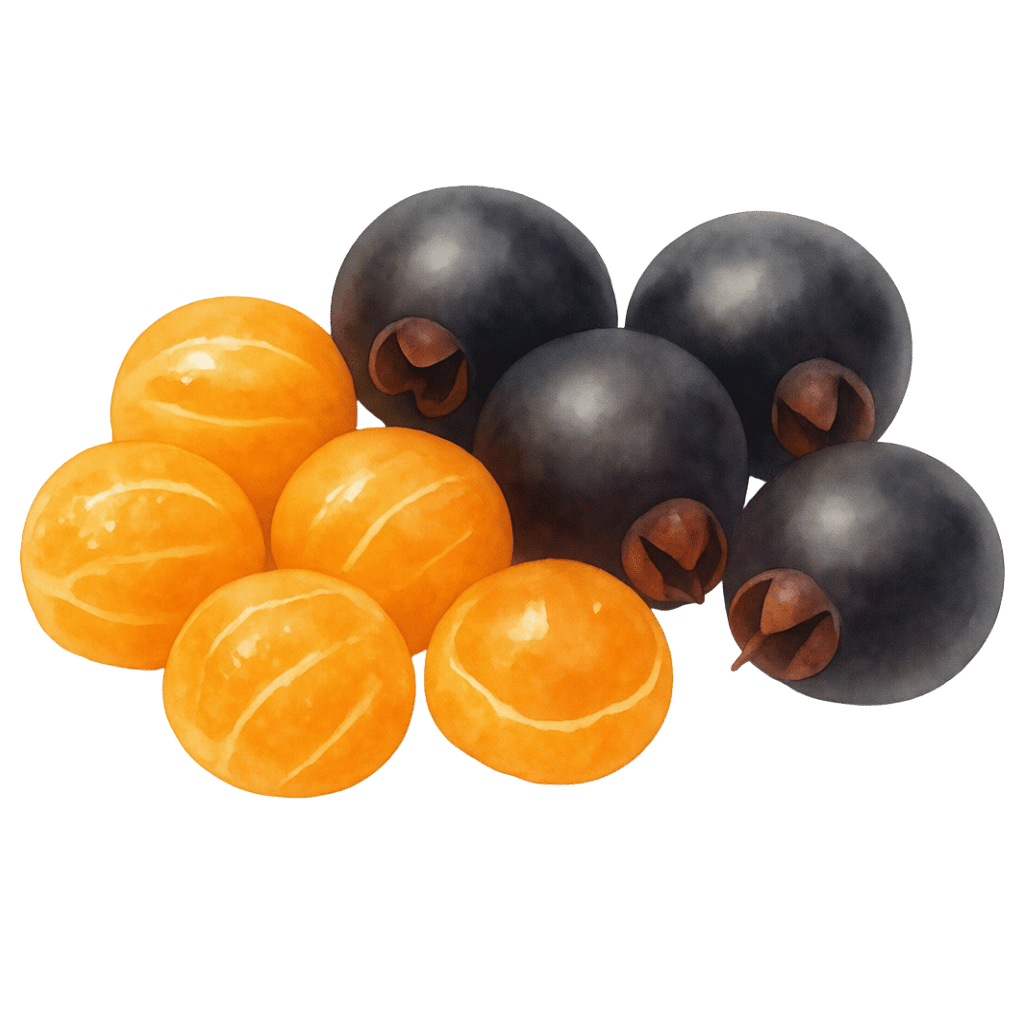
Guabiju
Myrcianthes pungensBotanical View
- Leaves are simple, opposite, petiolate, coriaceous (stiff), oval-oblong to elliptical, obtuse to acuminate at the tip with a small mucronate/spiny apex used as an identification character, about 3-7 cm long and 1.5-5 cm wide. The upper surface is a strong dark green, the underside paler, and the leaf blade bears glandular (sebaceous) punctations that produce aromatic terpenoid-rich essential oils typical of Myrtaceae.
- The trunk has a relatively smooth surface and moderate thickness. Wood is reddish, dense and elastic, valued for its durability; numerous branches are pubescent in young growth.
- The root system is described as strong and deep, providing firm anchorage; detailed architecture (taproot vs. lateral spread) has not been systematically documented in the literature reviewed.
- Flowers are borne on new-season shoots ("branch of the year"), typically in small groups of about 5-6 or solitary at leaf axils. Individual flowers are hermaphrodite, radially symmetric, 1.5-2.0 cm in diameter, with four white petals, four green sepals, numerous free yellow stamens with longitudinally dehiscent anthers, a simple exserted style, and a bilocular ovary with roughly 30 ovules per locule. The fruit that develops is a small globose berry-like drupe (anatomically shown to be drupe-like in the Eugeniinae), 1-3 cm in diameter, dark purple at maturity with juicy, sweet-astringent yellow pulp and 1-2 recalcitrant seeds.
- Myrcianthes pungens is self-compatible and capable of autogamy (spontaneous self-pollination without pollinator dependence), but also undergoes cross-pollination; overall natural fruit set from open flowers is low, around 20%. Anthesis is predominantly nocturnal (about 75% of flowers begin opening around 10 pm, finishing in ~2 hours; the remainder open near 5 pm). Stigmas are receptive from pre-anthesis through the start of senescence, and anther dehiscence is synchronized with peak stigma receptivity; flowers senesce roughly 30 hours after full opening. Pollen is recalcitrant, losing viability within about 30 days regardless of storage method.
- The species lacks nectaries and offers pollen as its main floral reward; anthers emit a fetid odor (atypical for Myrtaceae) linked to volatile oils and osmophores, and UV-absorbing flavonoid pigments in the anthers may guide visitors. Recorded floral visitors include hoverflies (Syrphidae, ~49% of visits), wasps (Vespidae, ~22%), the honey bee Apis mellifera (~13%), and moths (Pyralidae, ~5%); moths were identified as the most effective, legitimate pollinators, while beetles, ants and ladybirds acted mainly as pollen thieves.
- Detailed edaphic (soil-type) requirements were not found in the government/university/CABI literature reviewed; the species is reported to occur across a range of native forest formations along river basins, suggesting adaptability, but specific soil texture, pH or drainage preferences are unknown ("").
- No government or university-sourced data on fertilization or irrigation protocols for cultivated guabiju were found in the sources reviewed.
- Propagation is traditionally by seed, but seed propagation has drawbacks including genetic segregation and a long juvenile period. Vegetative propagation by cutting (staking) of adult specimens has been demonstrated as an alternative that is economical and rapid; rooting success was independent of IBA (indole-3-butyric acid) and ascorbic acid treatment but varied by collection season, with better rooting for cuttings collected in February (Southern Hemisphere summer), per research published in Iheringia, Série Botânica.
- Seeds are small (about 6-7 mm), smooth-coated, generally 1-2 per fruit, and classified as recalcitrant (intolerant of desiccation and difficult to store), with reported seed moisture content around 68%. Seeds are positively photoblastic (light-stimulated) and germinate within about 90 days under appropriate conditions. Biometric studies of guabijuzeiro accessions have found variability in fruit circumference (1.65-1.98 cm), total fruit weight (~2.87 g), pulp mass (~1.28 g), peel mass (~0.76 g) and soluble solids (~12.53° Brix), indicating genetic variability among individuals suitable for future selection.
- No named commercial cultivars of Myrcianthes pungens have been formally released; research institutions (e.g., germplasm/accession collections referenced in rust-resistance studies) maintain numbered accessions (e.g., "G03", "G05") for breeding and selection purposes, but these are research materials rather than registered cultivars.
- Myrcianthes pungens remains a semi-domesticated, underutilized native fruit tree; no formal breeding program has produced released cultivars. Current improvement work is at an early, exploratory stage: researchers have established and biometrically characterized germplasm accessions (evaluating fruit size, weight, pulp yield and Brix) and screened accessions for rust (Austropuccinia psidii) susceptibility/resistance to identify promising selections for future breeding, and vegetative (cutting) propagation protocols have been developed to allow cloning of superior adult trees while avoiding the genetic segregation and long juvenility associated with seed propagation.