Back to Fruitpedia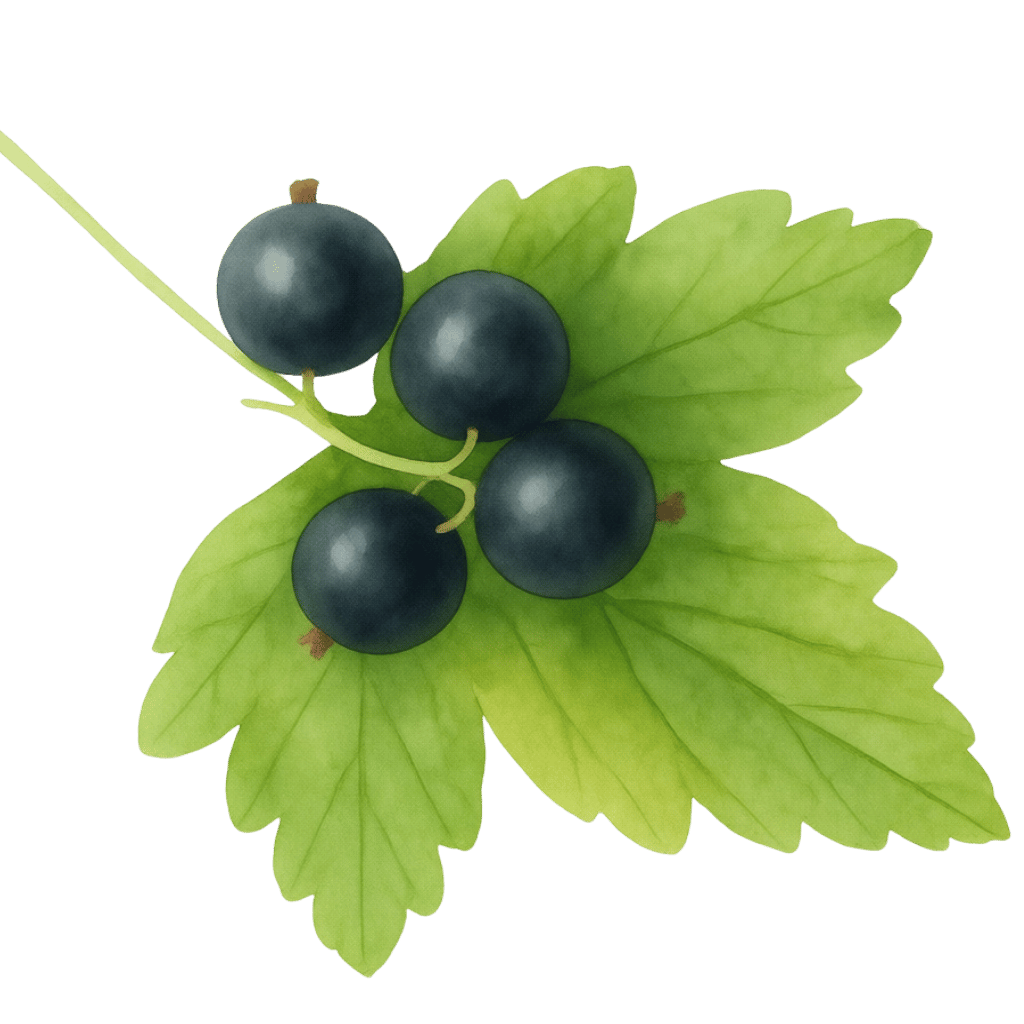
Black Gooseberry
Ribes nigrumVarieties
Ben Lomond
Ben Sarek
Titania
Consort
Ben Alder
Ben Connan
Botanical View
- Leaves are alternate, simple, palmately 3- to 5-lobed, 3-10 cm long and broad, with a serrated (toothed) margin and pale-to-dark green coloring. The undersides bear resinous yellow glands that give the foliage a distinctive, strong aromatic scent when crushed.
- Stems are erect to arching, glandular, and unarmed (without spines or thorns), distinguishing the species from gooseberry (Ribes uva-crispa). Buds are scented and yellowish to reddish in color. New basal shoots arise readily from the crown, giving the plant its characteristic multi-stemmed, bushy habit.
- The root system is fibrous and relatively shallow ("heart root" pattern), branching from the crown into several primary roots that spread outward and downward. The plant also produces suckers from underground runners, allowing new shoots to emerge some distance from the original crown. Shallow rooting makes the plant responsive to irrigation and mulching.
- Flowers are borne in racemes known as "strigs," up to about 8 cm long, each containing roughly 10-20 (up to about 10-12) small greenish-yellow to yellow-green flowers approximately 8 mm in diameter. Each flower has a hairy calyx bearing yellow glands, with five sepal lobes longer and more conspicuous than the small petals.
- Ribes nigrum is hermaphroditic and self-fertile (self-compatible), able to set fruit with its own pollen. However, fruit set, berry size, and seed number are improved under open, insect-mediated cross-pollination compared with self-pollination alone.
- Pollination is primarily entomophilous. Honey bees (Apis mellifera) and wild bees are effective pollinators; research has specifically identified the red mason bee (Osmia rufa) and buff-tailed bumblebee (Bombus terrestris) as important pollinators that improve fruit set and berry quality.
- Prefers moisture-retentive, well-drained soils and tolerates a range of textures including clay, loam, and sand. Ideal soil pH is slightly acidic to neutral, roughly 6.0-6.8; at pH above about 6.5, availability of micronutrients such as iron and manganese declines, which can cause deficiency symptoms.
- Because of its shallow root system, blackcurrant responds well to irrigation, with trickle/drip irrigation recommended to deliver consistent moisture to the root zone. Fertilization commonly follows a balanced program (e.g., approximately 2-4 oz of a balanced 10-10-10 fertilizer per plant applied at planting and again in early spring as buds swell); excessive nitrogen is avoided since it favors vegetative growth at the expense of fruiting. Annual mulching with well-rotted manure or compost is also recommended to maintain soil organic matter and moisture retention.
- Propagated almost exclusively by vegetative means, principally hardwood stem cuttings taken during winter dormancy from healthy, pencil-thick, one-year-old wood (commonly 20-30 cm/8-12 inch sections with several buds). Unlike many fruiting shrubs, all buds—including those below the eventual soil line—are left intact, since buried buds produce the vigorous basal shoots characteristic of the multi-stemmed habit. Cuttings root readily without hormone treatment, though rooting rates improve markedly with auxin (rooting hormone) application. Layering is also used. Cuttings taken in late autumn typically root by spring and can produce a fruiting bush within 2-3 years.
- Commercial and garden plants are propagated vegetatively (cuttings/layering) to preserve cultivar trueness-to-type, since seed-grown plants segregate and do not reliably reproduce the characteristics of the parent cultivar. Seed propagation is used mainly in breeding programs to generate new genetic variation for cultivar development.
- Numerous cultivars have been bred for yield, disease resistance, and fruit quality. Prominent examples include the "Ben" series developed by the Scottish Crop Research Institute (e.g., 'Ben Lomond', released 1972, and its descendants 'Ben Alder' and 'Ben Tirran'), as well as 'Ben Connan', 'Ben Como', 'Titania' (a vigorous, disease-resistant cultivar widely used as a breeding parent), 'Blackcomb', 'Cheakamus', and 'Stikine', among others. Newer cultivars emphasize resistance to white pine blister rust while maintaining fruit quality and yield.
- Systematic breeding of blackcurrant intensified in the 20th century, notably through the Scottish Crop Research Institute's "Ben" series, beginning with 'Ben Lomond' (released 1972), which became a major parent for subsequent cultivars such as 'Ben Alder', 'Ben Tirran', and 'Ben Connan'. Parallel breeding programs in continental Europe (e.g., Poland, at Skierniewice) produced cultivars such as 'Titania', later used as a breeding parent for cultivars like 'Tihope'. Modern breeding objectives emphasize resistance to white pine blister rust and gall mite/reversion virus, improved cold hardiness, fruit quality, and mechanical-harvest suitability.