Back to Fruitpedia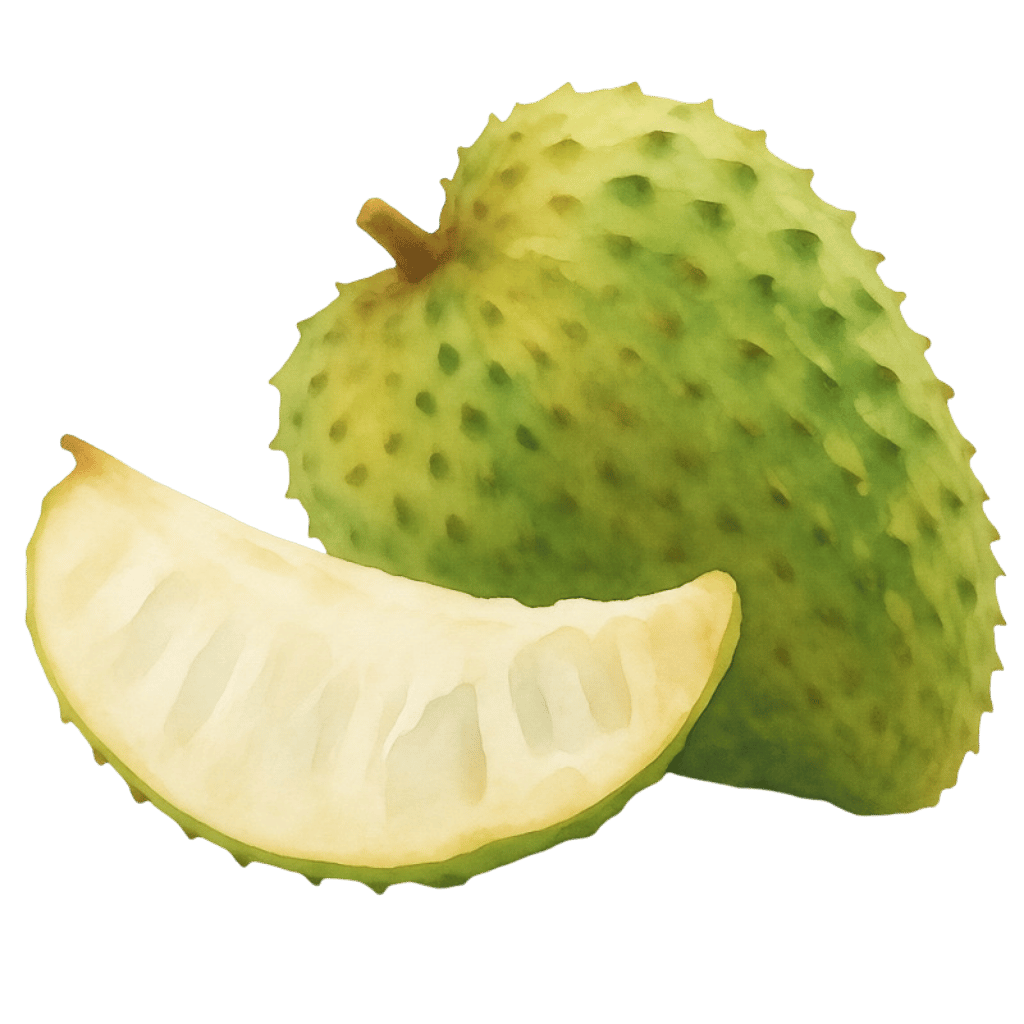
Soursop
Annona muricataVarieties
Morada
Lisa
FAO II
Bennett
Botanical View
- Leaves are alternate, simple, entire, and leathery (coriaceous), with short petioles. Blade shape is ovate, oblong, or elliptic, 5-18 cm long by 2-7 cm wide (some sources report 6-20 cm x 2.5-6 cm), glossy dark green on the upper surface and yellowish-green to paler green on the lower surface. Young branches and leaves may show a fine rusty pubescence. The foliage has a characteristic strong odor when crushed.
- The tree is small, typically 3.5-8 m tall (occasionally reported up to 10 m), low-branching and bushy, with a small canopy and asymmetric ramification. The trunk is generally straight with smooth, dull grey to grey-brown bark that becomes rough and fissured with age. Branches are ascending when young, later spreading; because the species lacks strong apical dominance, the mature crown tends toward a rounded or spherical form. In cultivation, formative pruning (heading the central shoot at about 0.60 m and selecting 3-4 scaffold branches) is used to keep tree height manageable (around 2.20 m) for spraying and harvest.
- The root system is shallow and extensive, spreading laterally beyond the diameter of the canopy. Young plants form a taproot, but this is largely lost as the tree matures and is replaced by an abundant network of fine lateral roots concentrated near the soil surface. Because of this shallow rooting habit, the area around the trunk base is kept weed-free or mulched to prevent desiccation of surface roots during dry periods, and mechanical cultivation near the trunk is avoided to prevent root injury.
- Flowers are borne singly or in small clusters of 2 to 4, arising from short axillary peduncles or directly from the trunk and older branches (a tendency toward cauliflory), originating from short twigs on older wood. In bud ("capulho") stage the flower is subglobose to pyramidal in shape, dark green while growing and turning pale green as anthesis approaches.
- Flowers are hermaphroditic (perfect), each with three fleshy, somewhat spreading outer petals (yellow-green) and three smaller, close-set pale-yellow inner petals. As in other Annonaceae, the flowers are believed to show protogynous dichogamy (the stigma becomes receptive before the flower's own pollen is shed), which limits efficient self-pollination within the same flower. Graviola is noted to have chronic pollination problems in the field, resulting in sparse, irregular natural fruit set.
- Natural pollination of graviola is described as inefficient, and commercial growers are advised to hand-pollinate to improve yield: flowers are selected in the afternoon and, the following morning, pollen is applied with a brush to the receptive stigmas the day after the flower opens (timed to the greenish coloring change of the petals). Natural fruit set without hand pollination yields roughly 10-12 fruits per plant, versus 20-30 fruits per plant with artificial pollination. In Annonaceae generally, flowers are pollinated by small beetles (families such as Nitidulidae, Curculionidae, Staphylinidae and Chrysomelidae) attracted by the flowers' strong scent, but a specific, well-documented natural pollinator for A. muricata itself is not established in the agronomic literature reviewed.
- The species adapts to a range of soil types but performs poorly on soils with high clay content prone to waterlogging. The ideal soil is deep, well-drained, rich in organic matter, with pH between 6.0 and 6.5. It also tolerates acidic, sandy soils and even oolitic limestone-derived soils in some growing regions.
- Graviola is demanding in phosphorus and potassium and should be fertilized at least three times a year, with quarterly applications during the first three years of growth. Recommended field practice (for Amazonian conditions) includes correcting soil acidity and applying dolomitic lime, simple superphosphate, potassium chloride, micronutrient mix (FTE BR-12) and cattle or poultry manure at planting, followed by escalating annual doses of nitrogen (60-180 g/plant), phosphorus (60-180 g/plant as P2O5) and potassium (70-240 g/plant as K2O) through the third year. Supplemental irrigation has a strong positive effect on yield: in a 30-ha planting in northeastern Brazil, average annual production rose from about 72 t to 101 t after supplemental irrigation was introduced. A mulched, weed-free area around the trunk base is recommended to reduce water loss from the shallow root zone.
- Propagation is by seed or by vegetative methods. Seed propagation is simple but produces variable plant size, vigor and yield, and delays the start of production. Vegetative propagation (mainly grafting, less commonly cuttings, air-layering or tissue culture) gives more uniform trees with earlier production; grafting (garfagem/cleft or whip grafting) gives a higher graft-take rate and faster scion development than budding. Common rootstocks are seedling Annona montana (the most widely used and most rustic), A. muricata itself, and A. reticulata; seeds for rootstock production are soaked in cold water for 24 hours to break dormancy, and grafting is performed once the rootstock reaches about 1 cm diameter, roughly 30 cm above the base.
- Because graviola is still largely propagated from seed and lacks clearly fixed varieties, seedling populations show marked variability in botanical and genetic characteristics, including tree size, productivity, and fruit shape, flavor and pulp consistency. Documented seedling types have been classified by fruit shape (rounded, heart-shaped/cordiform, angular), by flavor (sweet, subacid, acid), and by pulp consistency (soft and juicy versus firm and comparatively dry). Fruits contain more than 95 seeds each, ovoid and flattened, 15-20 mm long, weighing 0.57-0.61 g, with a hard, shiny dark-brown seed coat.
- Formal, widely standardized cultivars of A. muricata are still scarce; most planting material derives from selected seedling "types" rather than true clones. For Amazonian growing conditions, EMBRAPA identifies "Morada" (yielding up to 40 kg of pulp per plant per year, with lower susceptibility to fruit and trunk borers) and "FAO II" (averaging 35 fruits per plant, tolerant of trunk borer) as the most productive types. In major producing countries such as Venezuela, Puerto Rico and Costa Rica, numerous undifferentiated seedling types are distinguished mainly by fruit shape, flavor and pulp texture. In Brazil, Colombian-derived types named "Morada," "Lisa" and "Blanca" were introduced by EMBRAPA-CPAC in 1981. In Florida, the selection 'Bennett' has been noted for large, well-formed, high-yielding fruit.
- Deliberate genetic improvement of A. muricata has been more limited than for some sister species. The wide natural morphological and genetic variability among seedling populations has historically made it difficult to fix well-defined cultivars, so most improvement effort has focused on selecting superior seedling "types" from existing populations (e.g., the Colombian-derived "Morada," "Lisa" and "Blanca" types introduced by EMBRAPA-CPAC in Brazil in 1981) and on rootstock selection for grafting (Annona montana, A. reticulata, and dwarfing A. glabra), rather than on formal hybridization or breeding programs. This contrasts with the related atemoya, which arose from deliberate hybridization of A. cherimola and A. squamosa in Florida in the early 20th century specifically to combine cherimoya fruit quality with sugar-apple's tropical adaptability and productivity.