Back to Fruitpedia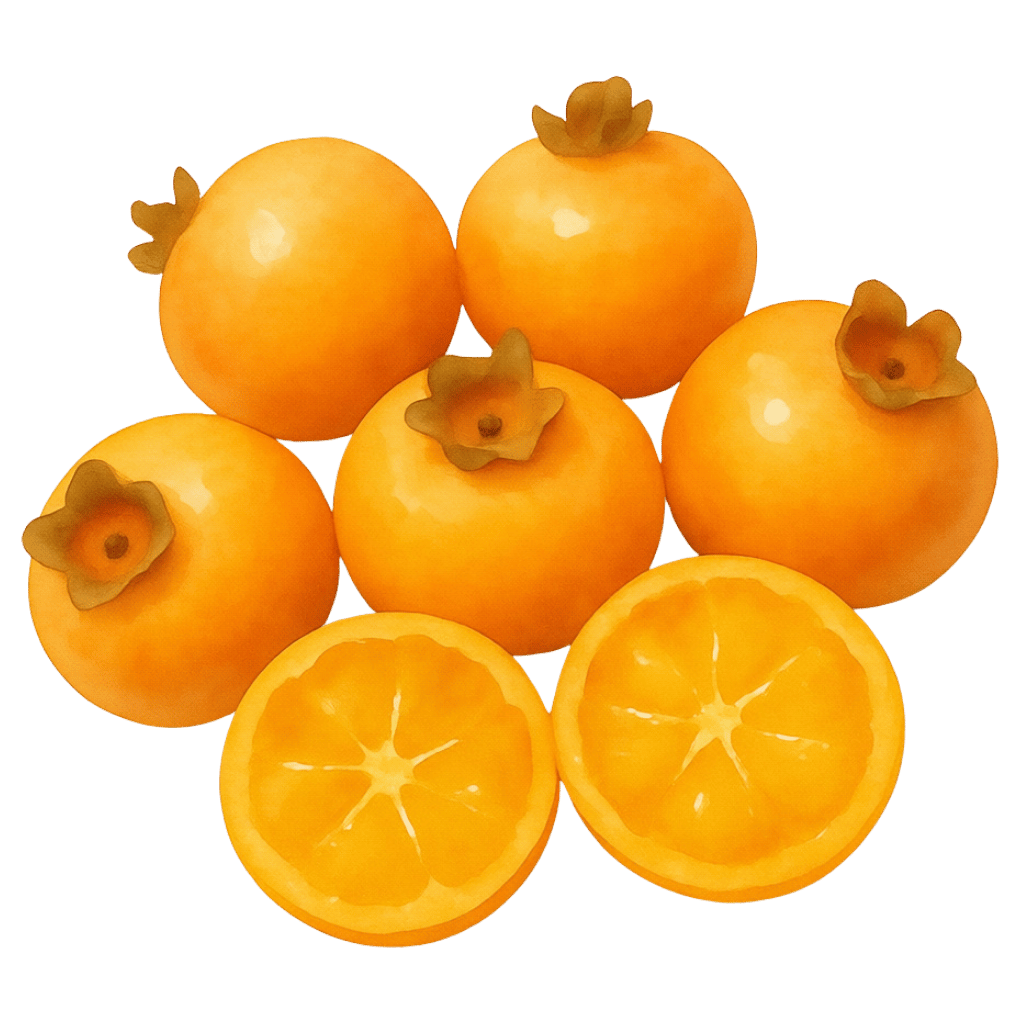
Gabiroba
Campomanesia xanthocarpaBotanical View
- Simple, opposite (decussate) leaves, 6-12 cm long by 2.5-5.5 cm wide; blade shape ranges from oval to elliptic-lanceolate to oblong, base obtuse to acute, apex acute to acuminate, margin wavy to smooth (slightly revolute near the apex), texture membranous to slightly leathery, color light to dark green. Indument is pubescent, with short-to-long unicellular, uniseriate (non-branched) trichomes on both faces. Venation is camptodromous-brochidodromous, with the midrib and secondary veins impressed on the upper face and prominent beneath. Numerous translucent, yellow-orange punctate secretory (oil) cavities are visible to the naked eye on the blade and petiole. Pouch-shaped domatia occur at the junctions of the midrib with secondary veins. Leaves are hypostomatic, with predominantly anomocytic and paracytic stomatal complexes; the petiole is 0.5-1.5 cm long, concave-convex to plano-convex, green to wine-red. The species shows marked phenotypic leaf plasticity — up to 7 distinct morphotypes have been described within a single population — which causes frequent confusion with the closely related C. guaviroba.
- The trunk is fluted/grooved (canelado) with flaking, peeling bark. The wood is moderately heavy, hard, compact and of good durability, and is used for flooring, tool handles, musical instruments and charcoal. Microscopic wood (xylem) anatomy of the species has been formally described in the botanical literature (Santos & Marchiori, 2009). In the petiole and leaf midrib, the vascular system is bicollateral (amphiphloic, with phloem both external and internal to the xylem) — a trait typical of Myrtaceae — surrounded by a sclerenchymatous fiber sheath; the surrounding cortical parenchyma contains phenolic idioblasts and calcium-oxalate (druse and prismatic) crystals.
- Apresenta sapopemas (raízes tabulares) na base do tronco (CARVALHO, P.E.R. Guaviroveira: Campomanesia xanthocarpa. In: Espécies Arbóreas Brasileiras, v. 2, p. 261-268. Brasília: Embrapa Informação Tecnológica, 2008). Em ambientes ripários sujeitos a alagamento periódico (de até 60 dias), a espécie desenvolve adaptações morfoanatômicas que favorecem a difusão de oxigênio da parte aérea para as raízes (PIVA et al., 1998, citado na mesma fonte), o que lhe permite ocupar margens de rios bem drenadas e solos úmidos e compactos de planícies e várzeas.
- Flowers are borne solitary or in small axillary clusters/fascicles; they are white, fragrant, and pentamerous (5 sepals, 5 petals) with numerous stamens, following the general floral plan of Myrtaceae. The fruit is a fleshy, globose berry with smooth skin, yellow to orange at maturity, up to about 3 cm in diameter, containing several seeds embedded in firm, juicy, sweet pulp.
- Flowers are hermaphroditic (bisexual/perfect). A study of floral structural development (perianth, androecium, gynoecium and ovule) and of the breeding system, using controlled cross-pollination and geitonogamous (self-) pollination treatments followed by monitoring of fruit, seed and embryo development, has been conducted on wild populations in Santa Catarina, Brazil. A definitive self-(in)compatibility index specific to C. xanthocarpa was not found in the sources reviewed; the closely related congener C. adamantium is self-incompatible and depends on cross-pollination (xenogamy) via bees for fruit set, a pattern documented elsewhere in the genus.
- Bees, including the honeybee (Apis mellifera) and native bees, are the principal flower visitors; the species is regarded as melliferous, and its white, fragrant flowers are attractive to bees and other flying insects.
- The species occurs across a range of soil types, from sandy soils (including coastal restinga sands occupied by the coastal variety, var. littoralis) to clay-containing soils, generally requiring good drainage; it is described as tolerant of poor, low-fertility soils.
- No fertilization or irrigation protocol specific to research-based or commercial cultivation of Campomanesia xanthocarpa was found in EMBRAPA, university, or CABI sources; the species is still mostly wild-harvested or grown from seedlings in home orchards rather than managed under a documented agronomic production system.
- Propagation is mainly by seed. Fresh seed germinates readily (reported germination in about 15-30 days); germination trials found sand and vermiculite to be the most efficient substrates for germination speed and mean germination time, with 30°C the recommended incubation temperature. Seedlings are raised in lightly shaded nursery beds and transplanted to individual containers at 3-5 cm height, becoming ready for field planting after about 6-7 months. Vegetative propagation by stem cuttings from juvenile material has given the best rooting with decapitation treatments (25.5% rooting) and winter trunk-fragment cuttings (44.4% rooting). Air-layering (alporquia) on field-grown branches, using indole-3-butyric acid (IBA, 0-2000 mg/kg in a vaseline carrier), failed to induce rooting in a trial conducted in Irati, Paraná (80-100% branch mortality, zero rooting at all IBA concentrations tested).
- Seed-grown plants show considerable phenotypic variability, consistent with the pronounced leaf-morphotype variation documented for the species (up to 7 morphotypes identified within a single wild population in Paraná), reflecting both environmental plasticity (e.g., light availability) and underlying genetic variability. Because the species is not clonally propagated from selected cultivars, propagation by seed does not guarantee uniform tree habit or fruit characteristics.
- No named or formally registered cultivars of Campomanesia xanthocarpa were found in EMBRAPA, university, or CABI sources; it remains propagated from wild or seedling-grown stock rather than clonal, selected material. Two botanical varieties are recognized taxonomically: var. xanthocarpa and the coastal var. littoralis (D.Legrand) Landrum, the latter associated with sandy restinga soils of the southern/southeastern Brazilian coast. Regional trade names used by nurseries (e.g., "gabiroba paulista," "guabiroba amarela do litoral") refer to regional seed provenance/varieties, not registered cultivars.
- Campomanesia xanthocarpa is an undomesticated native forest fruit tree. No formal breeding program, no registered/named commercial cultivars, and no dedicated germplasm bank specific to this species were found in the literature reviewed. Institutional research (EMBRAPA, federal universities) has focused on taxonomic/anatomical characterization (wood and leaf anatomy, chromosome counts, plastome sequencing), propagation trials (seed germination protocols, stem cuttings, air-layering), and phytochemical/nutritional profiling rather than genetic improvement or domestication. It is documented as a native fruit species with recognized economic and nutritional potential (e.g., in Lorenzi, Lacerda & Bacher's "Frutas no Brasil, nativas e exóticas," Instituto Plantarum) and is flagged by EMBRAPA as a species meriting further agronomic development, but systematic selection or breeding history was not found.