Back to Fruitpedia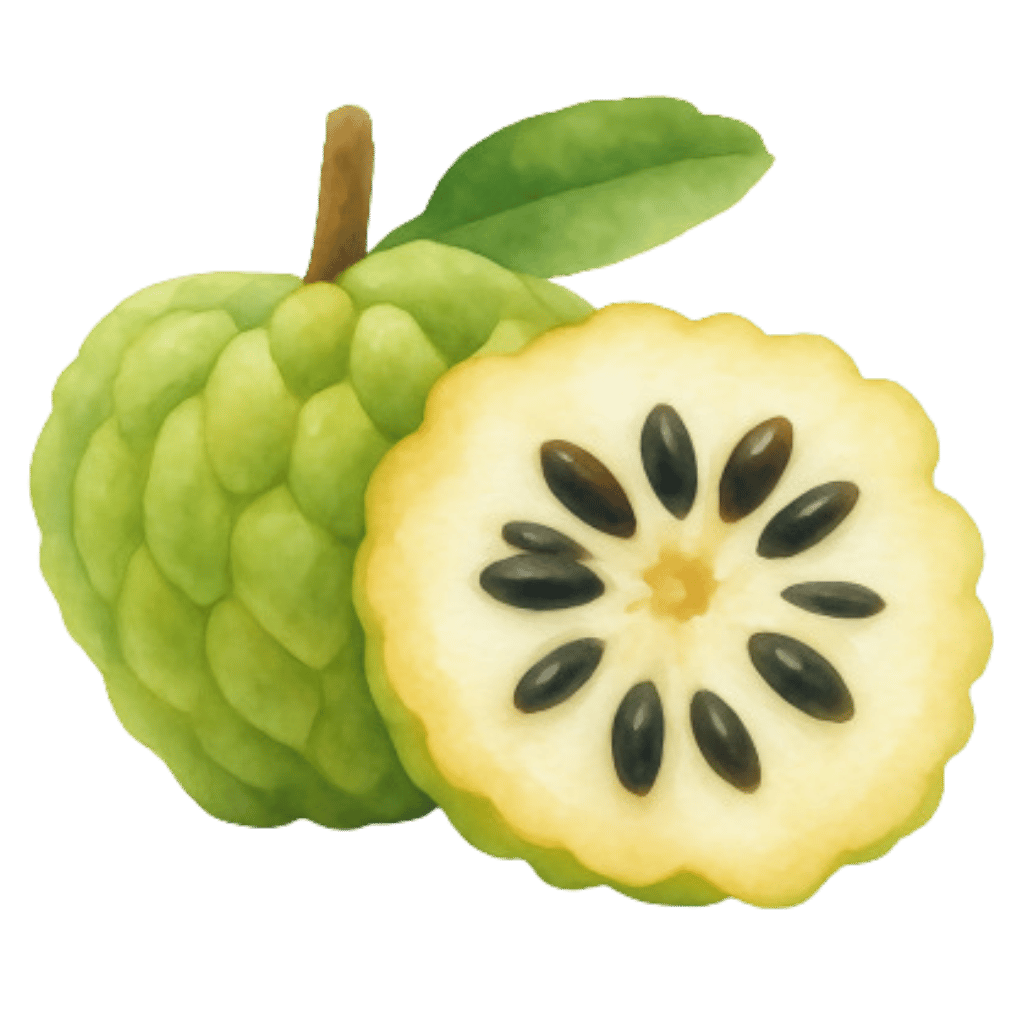
Sugar-apple
Annona squamosaVarieties
Ata de Pitaguari
Balanagar
21–24.5° BrixPhule Purandar
23.5–23.6° BrixThai Lessard
Kampong Mauve
Cuban Seedless
Botanical View
- Leaves are simple, alternate, borne singly on short (0.6-1.3 cm), sparsely hairy petioles. Blades are lanceolate to oblong-lanceolate, roughly 5-17 cm long by 2-6 cm wide, with an obtuse to acuminate (short- or long-pointed) apex and a rounded to short-pointed base; margins are entire. The upper surface is dull to dark green, the lower surface pale blue-green with a waxy bloom; young leaves are minutely hairy, becoming nearly glabrous with age, and are aromatic when crushed (EMBRAPA Documentos 106, 2006; Morton, Fruits of Warm Climates, 1987; World Agroforestry/Orwa et al., 2009).
- The trunk and branches form a low, much-branched tree with a broad, open crown; bark is light brown, smoothish to slightly fissured into small plates, with visible leaf scars, and inner bark is light yellow and slightly bitter. Young twigs are hairy, becoming brown with pale lenticels and a somewhat zigzag growth habit. The wood (light-yellow sapwood, brownish heartwood) is soft, light and weak, of little value beyond firewood (World Agroforestry/Orwa et al., 2009; Morton, Fruits of Warm Climates, 1987).
- Annona squamosa develops a comparatively shallow root system with abundant fine lateral roots and a taproot that is weaker than in many other tropical fruit trees; longer taproots develop in lighter-textured soils. The root collar and roots are notably susceptible to waterlogging-associated rots (Phytophthora sp., Rhizoctonia solani) and to bacterial wilt (Ralstonia/Pseudomonas solanacearum), which is why free-draining soil and planting with the collar slightly above grade are recommended (EMBRAPA/CNPAT Instruções Técnicas 01, 1998; World Agroforestry/Orwa et al., 2009).
- Flowers are borne on new growth, singly or in short axillary clusters of 2-4, on slender, hairy pedicels, and are pendent, fragrant and greenish-yellow, never fully opening. The 3 sepals are triangular, about 1.6-3 cm long. There are 3 thick, fleshy outer petals (about 1.5-2.5 cm long), yellow-green outside and pale yellow within, each keeled with a purplish/reddish spot at the swollen base, alternating with 3 minute, scale-like inner petals. Numerous white to yellow stamens are crowded at the base of a conical, raised receptacle, with the numerous purplish carpels (pistils) massed at its center, separate from the stamens (EMBRAPA/CNPAT Instruções Técnicas 01, 1998; EMBRAPA Documentos 106, 2006; World Agroforestry/Orwa et al., 2009).
- The flower shows protogynous dichogamy: the pistils, occupying the center of a conical receptacle, mature and become receptive before the surrounding anthers (located at the periphery) dehisce, so the stigmas are receptive in an earlier "female phase" and pollen is shed later in a separate "male phase" of the same flower, largely preventing self-pollination within a single flower and favoring cross-pollination between flowers of different ages (Vithanage, 1984, Annals of Botany, cited in EMBRAPA Documentos 106, 2006). Because the two phases rarely overlap and natural pollinator visitation is often insufficient, poor fruit-set is common and hand pollination is routinely used in commercial orchards (EMBRAPA/CNPAT Instruções Técnicas 01, 1998).
- Natural pollination is carried out mainly by small beetles rather than bees, chiefly nitidulid ("sap") beetles (Carpophilus spp., especially C. mutilatus and C. fumatus, and Haptoncus luteolus), which are drawn into the partly closed flower by its fragrance and carry pollen between female-phase and male-phase flowers; beetles of the families Staphylinidae, Chrysomelidae, Curculionidae and Scarabaeidae have also been recorded as visitors. Because natural beetle pollination is often inadequate for commercial fruit-set, growers commonly hand-pollinate, transferring pollen collected from newly opened (male-phase) flowers onto receptive (female-phase) stigmas with a small brush (EMBRAPA/CNPAT Instruções Técnicas 01, 1998; peer-reviewed studies on nitidulid pollination of Annona spp.).
- The species tolerates a wide range of soils, including shallow, gravelly or rocky ground, but performs best in deep, fertile, well-drained sandy loams with a pH of about 6 to 8 (slightly acid to alkaline); it is intolerant of heavy, poorly drained, waterlogged or saline soils, which favor root and collar rots (World Agroforestry/Orwa et al., 2009; EMBRAPA/CNPAT Instruções Técnicas 01, 1998).
- Fertilization is normally guided by soil analysis; where unavailable, Brazilian recommendations apply an organic base dressing (about 20 L of well-rotted manure, 500 g simple superphosphate, 100 g potassium chloride and 50 g FTE BR-12 per planting hole) plus escalating annual N-P2O5-K2O top-dressings (roughly 60-90 g N in year 1, rising to 150-210 g N by year 4 onward, with proportional P2O5 and K2O), split into 4-6 applications a year (or monthly/weekly under irrigation/fertigation) and applied in a band under the canopy; foliar analysis of fully expanded leaves after harvest is used to monitor micronutrients, and organic manure is reapplied every six months. Because the crop is sensitive to both drought and waterlogging, drip or micro-sprinkler irrigation is preferred (it saves water, limits weed competition and enables fertigation), while overhead sprinkler irrigation during flowering, fruit-set and ripening is discouraged because it promotes fungal disease and lowers fruit quality (EMBRAPA/CNPAT Instruções Técnicas 01, 1998).
- Propagation is chiefly by seed in most producing regions, giving own-rooted seedlings ready for field planting at 4-5 months; seeds show orthodox storage behavior and remain viable for several years if kept dry (no viability loss after 6 months of hermetic storage at -20°C and 1.5% moisture content, but rapid loss at room temperature), with germination often improved by a short after-ripening period, soaking or light scarification. More technified orchards use shield/patch budding, grafted about 20 cm above the root collar onto seedling rootstocks, commonly Annona reticulata (bullock's-heart, "condessa") or Rollinia spp. ("Cabeça-de-Negro"/marolo, selected for root-rot resistance), producing plants ready for field planting in 5-7 months and yielding earlier, more productive and more uniform trees (EMBRAPA/CNPAT Instruções Técnicas 01, 1998; World Agroforestry/Orwa et al., 2009; Morton, Fruits of Warm Climates, 1987).
- Fruits normally contain numerous hard, oblong, glossy, dark brown to blackish seeds (roughly 1.3-2 cm long), each individually enclosed within its own segment of pulp; seed counts vary widely by fruit and type, with reports ranging from about 20-40 up to an average near 68 seeds per fruit. Naturally occurring seedless (parthenocarpic) types have been recorded, arising from somatic mutation, including a Ceará (Brazil) seedless selection and the "Seedless Cuban Sugar Apple," though such types tend to be less productive than seeded forms (EMBRAPA/CNPAT Instruções Técnicas 01, 1998; Morton, Fruits of Warm Climates, 1987).
- No fixed, universally adopted cultivars exist for sugar-apple in Brazil; regionally recommended selections include 'Pinha FAO I', 'Pinha AP' and 'Pinha FAO II', alongside a naturally occurring seedless mutant grown in Ceará. Internationally, notable selections include India's 'Balanagar' (a rain-fed, thick-rinded, high-pulp, few-seeded, long-shelf-life selection from Telangana), 'Purandar Selection', 'Washington', 'Mammoth', 'Red Sitaphal', 'British Guinea' and 'Barbados', plus interspecific hybrids such as 'Arka Sahan' developed by ICAR-IIHR (India) from crosses with atemoya-type material (EMBRAPA/CNPAT Instruções Técnicas 01, 1998; ICAR-IIHR, Improvement of Annona for Yield and Quality).
- Sugar-apple itself has undergone limited formal domestication beyond farmer selection of superior seedling trees and occasional natural somatic mutants (e.g., seedless types found in Brazil and Cuba). Its main breeding legacy is as the paternal parent of the atemoya, a hybrid with cherimoya (Annona cherimola x A. squamosa) first produced through deliberate crosses in Florida, USA, in the early 20th century and later repeated in other countries to combine sugar-apple's tropical hardiness and productivity with cherimoya's fruit quality; about 15 atemoya cultivars are known, of which 'Gefner' became the most commercially successful. More recently, institutions such as ICAR's Indian Institute of Horticultural Research (IIHR) have run half-sib progeny selection from the 'Balanagar' cultivar and interspecific hybridization programs (crossing A. squamosa selections with atemoya-type material such as Island Gem and Pink's Mammoth) to develop improved hybrids such as 'Arka Sahan' (EMBRAPA Documentos 106, 2006; ICAR-IIHR, Improvement of Annona for Yield and Quality).