Back to Fruitpedia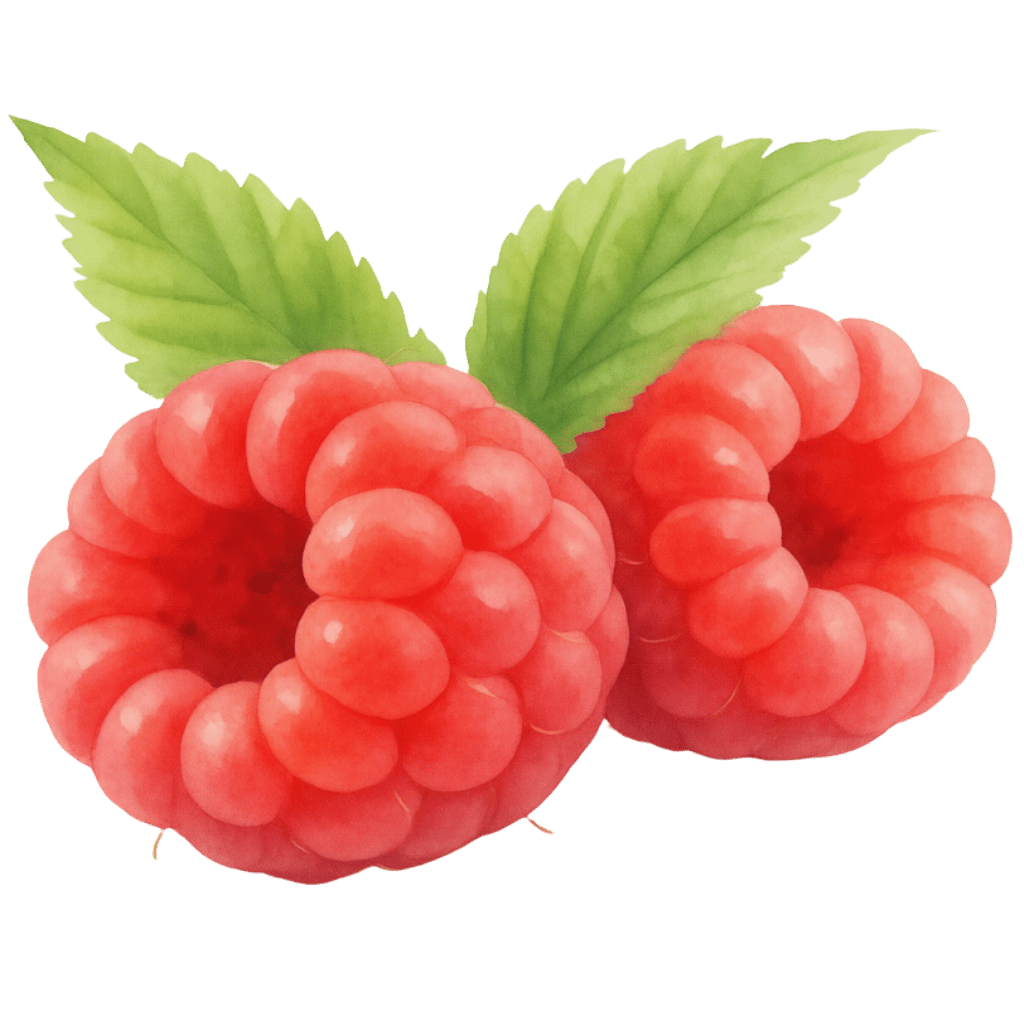
Raspberry
Rubus idaeusVarieties
Heritage
Autumn Bliss
8–8.8° BrixBatum
Tulameen
Fallgold
Meeker
Botanical View
- Leaves are alternate and pinnately compound, typically with 3-5 (occasionally up to 7) serrate to doubly-serrate leaflets. First-year primocane leaves are usually larger with 5-7 leaflets, while second-year floricane leaves are smaller with 3-5 leaflets. The upper leaf surface is green and glabrous to sparsely pubescent; the lower surface is paler, often gray-white and tomentose (felted with fine hairs). Individual leaflets range from about 5 to 20 cm in length. (Sources: US Forest Service FEIS; Missouri Botanical Garden Plant Finder; NC State Extension Plant Toolbox)
- Canes (stems) are woody, biennial, and typically bristly or prickly with exfoliating yellow-brown bark. First-year canes (primocanes) grow erect and unbranched, reaching roughly 1.5-2 m in height, and remain vegetative (non-flowering). In the second year these same canes (now called floricanes) do not increase in height but produce numerous lateral, arching branches bearing smaller leaves and the flower/fruit clusters; after fruiting, floricanes senesce and die, while new primocanes are produced annually from the crown and roots. (Sources: US Forest Service FEIS; WSU Small Fruit Horticulture Extension; EMBRAPA-referenced agronomic descriptions)
- Rubus idaeus has a long-lived, perennial root system consisting of a woody crown and a network of shallow, spreading, rhizome-like roots that give rise to adventitious buds. These root buds (often within about 6 cm of the soil surface) and the crown produce new primocanes and root suckers each year, allowing the plant to form spreading thickets and to regenerate vegetatively after cane removal, fire, or other disturbance. (Source: US Forest Service FEIS species review)
- Flowers are small, white, perfect (hermaphroditic), and borne in groups of one to several in racemose or compound cymose clusters (corymbs) produced on lateral floricane branches (and, in primocane-fruiting types, at primocane tips). Each flower has 5 sepals, 5 small white petals, numerous stamens, and numerous separate carpels arranged on a convex receptacle; each fertilized carpel develops into a drupelet, and the drupelets coalesce into the aggregate fruit. (Sources: US Forest Service FEIS; CABI Compendium; horticultural pollination literature)
- Raspberry flowers are hermaphroditic and largely self-fertile/self-compatible, but floral morphology (protogyny and the arrangement of numerous separate carpels requiring repeated pollinator visits) limits complete self-pollination without insect activity. Commercial fruit set and berry quality (drupelet number, shape) are strongly improved by cross- and insect-mediated pollination, and inadequate pollinator visitation results in small, misshapen ("crumbly") fruit. The species also reproduces vegetatively via root suckers.
- Bees are the primary pollinators, accounting for an estimated 90-95% of effective pollination; honey bees (Apis mellifera) and bumble bees (Bombus spp.) are the most important, with several bumble bee visits generally required per flower for well-formed fruit because the many carpels open and become receptive in sequential rings over a few days. Commercial growers often stock roughly 6-9 bumble bee colonies per hectare for open-field pollination where wild pollinator density is insufficient.
- Raspberries perform best in deep, well-drained, fertile soils with high organic matter, ranging in texture from sandy loam to silty clay loam; the species tolerates a range of soil textures but is notably sensitive to poor drainage, which predisposes roots to Phytophthora root rot. Preferred soil pH is slightly acidic, generally below 6.0-6.5 (sources vary; ideal target is often cited around 5.6-6.5).
- Raspberry has a comparatively low nutrient requirement relative to many perennial fruit crops; annual aboveground nitrogen accumulation has been measured at roughly 62-110 lb/acre in field-grown plantings. Primocane growth relies mainly on current-season fertilizer nitrogen, while floricane growth draws heavily on nitrogen stored in the crown, roots, and overwintering canes from the previous season; typical programs apply balanced NPK plus supplemental nitrogen in early spring, avoiding placement directly against the crown. Consistent soil moisture is important, especially during flowering and fruit development, with irrigation recommended roughly weekly outside of fruiting and more frequently (up to daily under high demand) during bloom and berry development; the shallow, fibrous root system is sensitive to both drought stress and waterlogging.
- Rubus idaeus is propagated primarily vegetatively, since it does not come true from seed. Common commercial methods include division/transplanting of root suckers, root cuttings (root pieces roughly 10 cm long placed horizontally in moist media), and tip layering (in black/purple raspberries). Certified, virus-free planting stock is increasingly produced by micropropagation (tissue culture) via shoot-tip culture, in vitro multiplication, and rooting prior to acclimatization, which reduces transmission of viruses and soilborne pathogens common in field-propagated material.
- Raspberry seeds have a hard, thick, largely impermeable seed coat and physiologically dormant embryos that require a period of warm stratification (about 68-86°F for ~90 days) followed by cold stratification (about 36-41°F for ~90 days) to germinate; seeds can remain viable in the soil seed bank for 60 years or more. Because the species is outcrossing and highly heterozygous, seedling progeny show substantial genetic and morphological variability and do not reproduce cultivars true to type — commercial cultivars are therefore propagated clonally rather than by seed.
- Rubus idaeus encompasses two principal subspecies of horticultural importance — the European red raspberry (R. idaeus subsp. idaeus) and the North American red raspberry (R. idaeus subsp. strigosus, treated by some authors as the separate species R. strigosus) — plus numerous derived cultivars. Cultivars are broadly grouped as floricane-fruiting ("summer-bearing," fruiting on second-year canes) or primocane-fruiting ("fall-bearing" or "everbearing," fruiting on first-year canes), and also occur in yellow and purple-fruited forms (the latter from hybridization with black raspberry, R. occidentalis). Major public breeding programs contributing modern cultivars include the James Hutton Institute/Scotland, East Malling Research (UK), Washington State University/USDA-ARS (Pacific Northwest, USA), and others worldwide; specific named cultivars are documented in national and regional extension cultivar guides (e.g., Oregon State University Extension "Raspberry Cultivars for the Pacific Northwest").
- Rubus idaeus has been gathered and cultivated in Europe for over 2,000 years — the Roman naturalist Pliny the Elder (1st century AD) recorded people collecting "Ida fruits" (red raspberries) on Mount Ida in present-day Turkey, the source of the species epithet. Formal cultivar breeding began in Europe from roughly the 19th century and expanded through the 20th century via public programs such as East Malling Research (UK) and, more recently, the James Hutton Institute (Scotland), alongside North American programs (including USDA-ARS and university programs such as Washington State University) that began improving the North American red raspberry (subsp. strigosus) and its hybrids with European stock roughly 150 years ago. Modern breeding — supported by genetic linkage maps, QTL mapping, and draft red and black raspberry genome sequences — targets fruit flavor, texture, machine-harvestability, yield, primocane- vs. floricane-fruiting habit, and resistance to pests and diseases such as raspberry aphid (Amphorophora idaei) and root rot (Phytophthora rubi); intensive domestication has also been noted to have reduced morphological and genetic diversity relative to wild germplasm, prompting continued use of wild Rubus genetic resources in breeding programs.