Back to Fruitpedia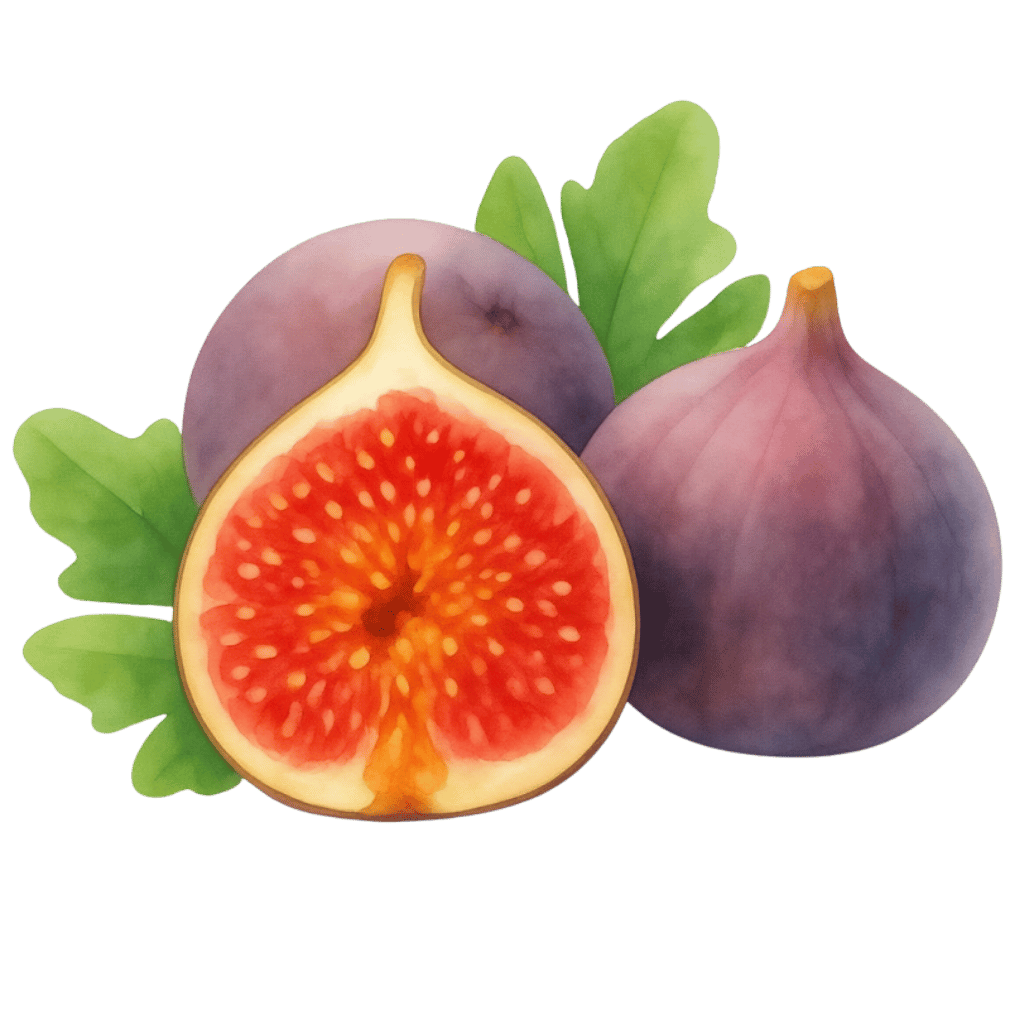
Fig
Ficus caricaVarieties
Roxo de Valinhos
7° BrixBlack Mission
Brown Turkey
Kadota
16–20° BrixCeleste
Calimyrna
Botanical View
- Leaves are alternate, palmately veined and deeply divided into 3 to 7 (commonly 3 or 5) lobes, with lobes typically obovate and irregularly toothed; blades can reach up to about 20-25 cm long. Both leaf surfaces are rough to the touch due to stiff, stout hairs, with a darker green upper surface; petioles are several centimeters long (Morton, Fruits of Warm Climates, Purdue Center for New Crops).
- The trunk is typically short, with smooth, pale gray bark, and rarely exceeds about 18 cm (7 in) in diameter; the tree branches freely from low on the trunk, giving a broad, spreading, often multi-stemmed habit. All vegetative parts (stems, leaves, unripe fruit) exude a milky, latex-like sap when cut or broken (Morton, Fruits of Warm Climates, Purdue Center for New Crops).
- The fig develops a vigorous, predominantly shallow and wide-spreading lateral root system, generally concentrated in the top 0.3-1 m of soil, capable of extending horizontally on the order of 15 m from the trunk in permeable soils; roots can penetrate more deeply where soil structure allows (Morton, Fruits of Warm Climates, Purdue Center for New Crops). This shallow, aggressive rooting habit makes the species drought-resilient once established but also prone to competing with nearby plants and to damaging pavement or shallow structures when planted close to infrastructure.
- The fig "fruit" is a syconium: a fleshy, hollow, urn-shaped receptacle with a small apical opening (the ostiole), enclosing numerous minute unisexual flowers on its interior surface. In monoecious caprifig types, both male flowers (with 4-5 calyx lobes and stamens) near the ostiole and short-styled female flowers occur within the same syconium; in female (common, Smyrna, San Pedro) types the syconium contains only long-styled female flowers, each with an ovoid, smooth ovary and a lateral, two-branched stigma (Morton, Fruits of Warm Climates, Purdue Center for New Crops; general fig floral morphology corroborated by multiple botanical sources).
- Ficus carica is functionally gynodioecious/heterodichogamous at the species level, with cultivated forms falling into four horticultural types with distinct reproductive behavior: the "common" type, which is exclusively female and sets fruit parthenocarpically without pollination (the type grown commercially in Brazil, e.g. 'Roxo de Valinhos'); the "caprifig," a male-functioning type whose syconia house short-styled female flowers used by the pollinator wasp and pollen-bearing male flowers; the "Smyrna" type, whose long-styled female flowers require pollination by wasp-borne caprifig pollen to set seeded fruit; and the "San Pedro" type, intermediate, bearing a parthenocarpic first (breba) crop and a pollination-dependent second crop (Morton, Fruits of Warm Climates, Purdue Center for New Crops; genetic-structure study PMC2860561). A microsatellite study found that sex expression among these types is simply inherited, which explains ready interbreeding and blurred type boundaries in germplasm collections (PMC2860561).
- The common fig has a specialized, obligate mutualism with the fig wasp Blastophaga psenes (Agaonidae), which is the sole natural pollinator of Smyrna-type and caprifig flowers; the tiny female wasp enters the syconium through the ostiole, pollinates the female flowers and, in caprifigs, oviposits in short-styled flowers to complete its life cycle. Commercially grown common-type (parthenocarpic) cultivars, such as Brazil's 'Roxo de Valinhos', set fruit without pollination and do not require the wasp (EMBRAPA Clima Temperado, Circular Técnica 35; Morton, Fruits of Warm Climates, Purdue Center for New Crops). Historically, commercial Smyrna-fig production outside the native range (e.g., California) depended on the deliberate introduction of B. psenes, achieved around 1899-1900.
- Fig trees tolerate a wide range of soil types — from light sands to heavy clays and calcareous (limestone-derived) soils — provided the soil is reasonably deep and well drained; a soil pH of about 6.0-6.5 is generally recommended, and sandy, moderately dry, lime-containing soils are considered favorable for cultivars grown for drying (Morton, Fruits of Warm Climates, Purdue Center for New Crops). Good drainage is important, as figs are sensitive to waterlogged conditions.
- The fig has comparatively low nutrient demands and is often grown with minimal fertilization; excess nitrogen is associated with vigorous vegetative growth at the expense of fruiting and increased susceptibility to disease (UC Statewide IPM Program, fig home-and-landscape guidelines). Trees are relatively drought-tolerant once established because of their extensive root system, but consistent soil moisture during fruit development improves fruit size and reduces fruit splitting/souring; irrigation is generally recommended during dry spells in the growing season, tapering off as fruit ripens to avoid splitting and to concentrate sugars (Morton, Fruits of Warm Climates, Purdue Center for New Crops).
- Ficus carica is propagated almost exclusively by vegetative (asexual) methods to preserve cultivar identity, since seedlings show wide segregation. Traditional hardwood cuttings, typically taken from mature wood 2-3 years old, about 1.25-2 cm thick and 20-30 cm long, are the most common commercial method, though rooting success can be variable and is improved by auxin (IBA) treatment (Morton, Fruits of Warm Climates, Purdue Center for New Crops; peer-reviewed fig cutting-propagation studies, e.g. PMC4897291, PMC8054669). Air layering (ground- or aerial-layering) is an older technique valued for higher and more reliable rooting success, and grafting/budding are also used. For elite or disease-free stock, in vitro micropropagation via meristem-tip culture is used to generate virus-tested planting material (peer-reviewed fig micropropagation literature, e.g. PMC5461047).
- The true fruits of the fig are minute achenes borne on the inner wall of the syconium; the number of achenes per syconium varies widely by type and pollination status, from roughly 30 up to about 1,600 (Morton, Fruits of Warm Climates, Purdue Center for New Crops). In parthenocarpic common-type cultivars, such as Brazil's 'Roxo de Valinhos', fruit set occurs without fertilization and the resulting achenes are hollow (non-viable, "empty" seeds), so these cultivars do not reproduce true from seed and are propagated clonally; only pollinated (Smyrna/San Pedro) types produce filled, potentially germinable seed (EMBRAPA Clima Temperado, Circular Técnica 35; Morton, Fruits of Warm Climates).
- Global cultivar diversity is very large (700+ named cultivars catalogued in Condit's fig monograph, per genetic-structure review PMC2860561), grouped into common (parthenocarpic), Smyrna, San Pedro and caprifig (male, pollinator-sustaining) types. Widely documented common-type cultivars include 'Celeste' (small-to-medium, purplish-brown, nearly seedless), 'Brown Turkey' (medium-to-large, copper-colored, prolific, heat-tolerant), 'Brunswick' (medium, bronze to purple-brown, nearly seedless) and 'Marseilles' (white pulp, conspicuous seeds) (Morton, Fruits of Warm Climates, Purdue Center for New Crops). In Brazil, EMBRAPA identifies 'Roxo de Valinhos' as the dominant commercial cultivar, a common-type, exclusively female, parthenocarpic clone that does not require pollination and produces seedless (hollow-achene) fruit (EMBRAPA Clima Temperado, Circular Técnica 35; EMBRAPA Semiárido publication on 'Roxo de Valinhos' performance).
- Ficus carica is among the earliest domesticated fruit crops: carbonized parthenocarpic figs recovered from an Early Neolithic site in the Jordan Valley have been dated to roughly 11,400-11,200 years before present, predating cereal domestication in the region (Kislev et al., cited in genetic-structure literature, PMC2860561). Domestication is now understood as diffuse and regionally structured rather than a single Levantine event, drawing on diverse wild fig populations across the eastern Mediterranean and western Asia. From the Near East, cultivation spread via ancient trade routes into southern Arabia, Mesopotamia, Anatolia, Transcaucasia and Persia, with local introgression from wild figs generating many landraces; further westward spread reached Greece, Italy, Iberia and North Africa. Spanish missionaries introduced the fig to the Americas in the mid-1500s (Mexico, c. 1560), and Franciscan missionaries later established it in California (from 1769). Commercial production of the Smyrna-type fig in California required deliberate introduction of the pollinating wasp Blastophaga psenes around 1899-1900 (Morton, Purdue Center for New Crops). A microsatellite study of 194 accessions (PMC2860561) found weak overall genetic differentiation (about 15% of variation among groups vs. 85% within groups), evidence of widespread hybridization among common, Smyrna, San Pedro and caprifig types, and extensive cultivar synonymy — Condit's monograph lists more than 700 named fig cultivars, many representing duplicate identities.