Back to Fruitpedia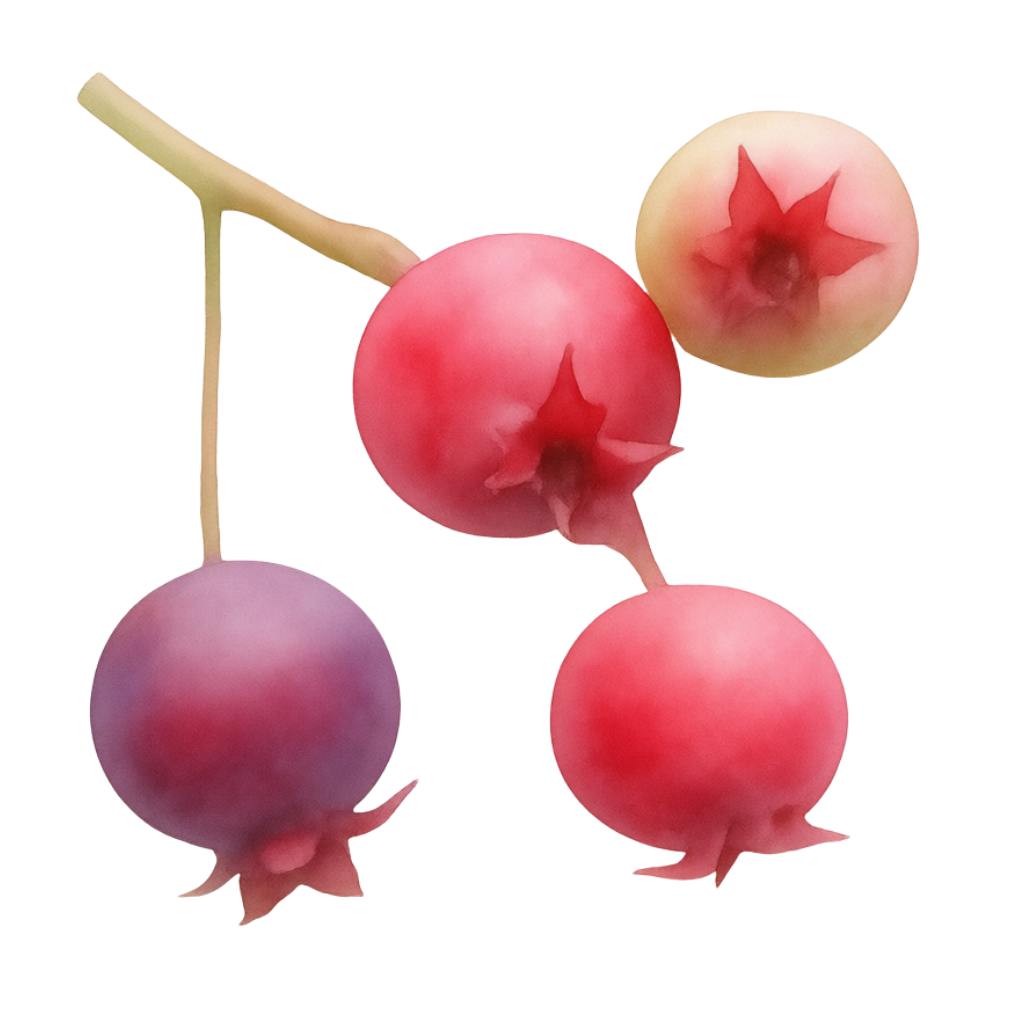
Downy Serviceberry
Amelanchier arboreaBotanical View
- Leaves are simple, alternate and deciduous, ovate to elliptic or obovate, about 4-8 cm (rarely to 10 cm) long and 2.5-4 cm wide, with pointed tips and finely serrated margins. Emerging young leaves are densely covered with soft, woolly (downy) hairs, especially on the underside, giving a grayish, pussy-willow-like effect; the hairs are shed as the leaves mature. New foliage often flushes purplish-brown before turning rich green in summer, then develops fiery fall color in shades of yellow, orange, apricot and red.
- The bark is smooth and gray when young, becoming increasingly furrowed with age as long, vertical splits and fissures develop; it is often streaked and ornamental in winter. The plant is frequently multi-stemmed; twigs and stems are smooth, ranging from coppery-brown to silvery-gray. The trunk is usually up to about 15 cm (6 in) in diameter, rarely reaching 40 cm (16 in).
- Amelanchier arborea regenerates mainly by seed but also sprouts from the root crown, and it resprouts from root crowns and stumps after fire, cutting or other top-kill. As a tree form it does not readily produce root suckers and does not colonize aggressively from the roots, in contrast to the shallow, rhizomatous root system of the clonal Saskatoon (A. alnifolia); its root system is comparatively deeper and more extensive. Precise rooting-depth data for the species are limited.
- Flowers are borne in pendulous (drooping) racemes 3-5 cm long, each carrying roughly 4-10 (up to about 14) flowers, produced in early spring before or as the leaves unfold. Individual flowers are perfect (bisexual), about 15-25 mm (0.6-1 in) across, with five white (occasionally pale pink) strap-shaped petals, and are slightly fragrant. Each flower gives rise to a small reddish-purple to dark purple-black pome containing about 4-10 seeds.
- Flowers are perfect (hermaphroditic). Amelanchier arborea is largely diploid (2n = 34) and sexually reproducing, but the genus is a classic apomictic complex in which polyploids reproduce through gametophytic (aposporous) apomixis, often forming clonal microspecies. Across Amelanchier, seed has been found to be roughly 2% apomictic in diploids, about 75% apomictic in triploids and about 97% apomictic in tetraploids; the shift to polyploid apomixis is accompanied by a breakdown of self-incompatibility toward self-compatibility. Consistent with this, downy serviceberry is generally reported as self-fertile, with a single tree able to set fruit.
- Insect-pollinated (entomophilous), chiefly by bees; the flowers also attract butterflies and other early-season pollinators. Because it is among the first woody plants to bloom in spring, it is an important early nectar and pollen source. It is also a larval host for butterflies such as the red-spotted purple and viceroy.
- Grows best on moist, well-drained, slightly acidic soils (tolerating acidic to neutral pH), including sandy, loam and clay textures. It is broadly adaptable, occurring from swampy lowlands to dry woods, sandy bluffs and rocky ridges, and tolerates occasional wet or dry conditions as well as urban sites, but performs poorly in permanently waterlogged soils, which promote root rot.
- Has medium moisture requirements and benefits from supplemental watering during establishment and drought; it does not tolerate persistently waterlogged soil. It is a low-maintenance plant with generally low fertility needs; no specific fertilizer regime is documented for the species.
- Propagated by seed, division and grafting, and also by root and stem cuttings; named selections are usually grafted or budded. Seed shows strong dormancy from a hard seed coat combined with embryo dormancy and requires roughly 2-6 months of cold, moist stratification (some protocols use warm stratification followed by cold); seed sown in fall or spring often does not germinate until the second spring. Passage of fruit through birds scarifies the seed and aids germination and dispersal; there are about 80,000 cleaned seeds per pound.
- Each pome contains about 4-10 seeds. Seedlings are variable, and because the genus combines widespread interspecific hybridization with apomixis in polyploids, populations produce many intermediate forms and clonal microspecies, making Amelanchier taxonomically difficult. Sexual (diploid) plants yield genetically variable seed, whereas apomictic polyploids produce largely clonal, maternal-type seed.
- Three botanical varieties are recognized: var. arborea, var. austromontana and var. alabamensis. Named horticultural cultivars of the pure species are few; most commercially grown ornamental serviceberries are hybrids, especially Amelanchier x grandiflora (A. arborea x A. laevis), which includes widely sold selections such as 'Autumn Brilliance', 'Robin Hill' and 'Cole's Select' bred for flower size, form and fall color.
- Amelanchier arborea itself has been little subjected to formal breeding; its fruit was historically gathered from the wild and used by Native Americans in cakes, breads and pemmican, and locally for pies, jams and wine. Ornamental improvement within the genus has centered on the hybrid A. x grandiflora (A. arborea x A. laevis), from which most modern landscape cultivars derive, while fruit-crop breeding has focused on Saskatoon (A. alnifolia), particularly in western Canada.