Back to Fruitpedia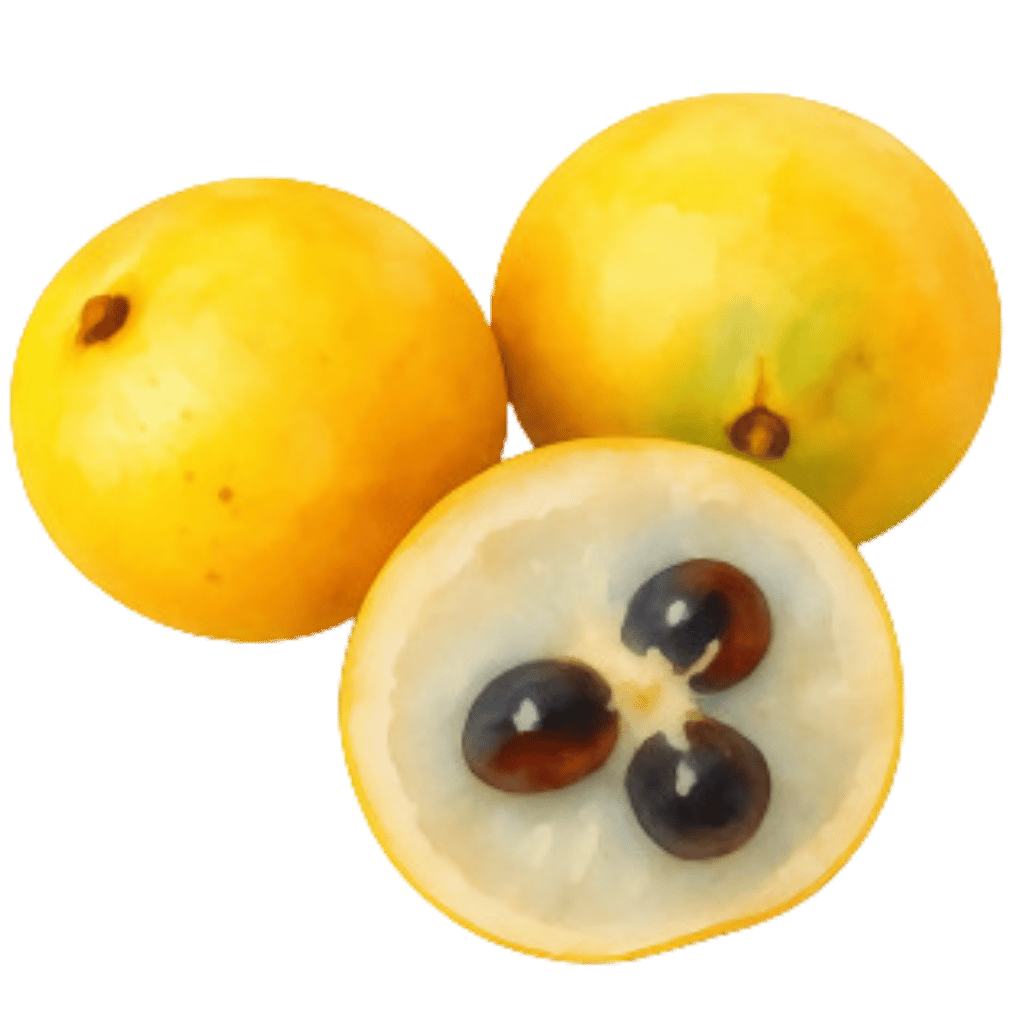
Curriola
Pouteria ramifloraBotanical View
- Leaves are simple, entire, alternate and spirally arranged, coriaceous (leathery), oblong to obovate/elliptic in shape, clustered toward the branch tips; young terminal shoots and leaf buds show a rust-colored (ferruginous) pubescence. As in other Sapotaceae, leaves exude milky latex when broken (Árvores do Bioma Cerrado species record; cross-checked against Colecionando Frutas, lower-confidence source, for approximate blade dimensions of roughly 7-16 cm long by 4-8 cm wide).
- The trunk is generally cylindrical and fairly straight, reported around 20-40 cm in diameter, with grayish, corky bark marked by deep, continuous longitudinal fissures; the whole plant, including stems, contains milky latex typical of Sapotaceae (Árvores do Bioma Cerrado; cross-checked with Cerradonline/EMBRAPA-CPAC-derived size figures).
- Flowers are ramiflorous — borne in axillary fascicles directly on older, leafless portions of the branches — typically clustered in groups, tetramerous (4-merous), small, greenish, and hairy on the pedicels, calyces, ovaries and styles; they emit a sweet, strong, pleasant fragrance detectable roughly one meter from a flowering tree. The ovary is superior with two locules, usually one ovule per locule (Lenza & Oliveira, Revista Brasileira de Botânica, SciELO).
- The species is functionally gynomonoecious: individual trees bear two flower morphs — hermaphrodite-looking flowers with four stamens included near stigma height (which do not set fruit) and smaller pistillate flowers with non-functional staminodes (which are the only flowers to produce fruit) — a system distinct from the dioecy reported for it in older literature. Pouteria ramiflora is self-incompatible: both manual self-pollination and spontaneous self-pollination initiate some fruit (about 2.55% initial set) but these abort completely within roughly three months. Natural fruit-set is low overall (about 6.63% in one study year and near 0% in another), and hand cross-pollination achieved only about 11.5% fruit set on pistillate flowers (Lenza & Oliveira, Revista Brasileira de Botânica, SciELO).
- Flowers are visited chiefly by small nectar-foraging insects: Lepidoptera (about 48% of visits), Diptera (about 28%), and Hymenoptera (about 20%, split between bees ~12% and wasps ~8%). Mean pollen viability in freshly opened flowers was about 93.5% (±4.0%), and mean nectar volume was about 0.16 µl (±0.03) at roughly 30.0% (±3.16) sugar concentration (Lenza & Oliveira, Revista Brasileira de Botânica, SciELO).
- In the wild the species is found across a range of Cerrado physiognomies (cerrado sensu stricto, cerradão, campo sujo, gallery-forest margins), which in the Cerrado biome are typically well-drained, often sandy-textured, acidic and naturally low-fertility (dystrophic) soils. In EMBRAPA's nursery protocol, seedlings are grown in "Substrate Type 3" (specific mix not detailed in the excerpted manual) (EMBRAPA Cerrados, Manual de Viveiro, 2016; habitat data from Árvores do Bioma Cerrado).
- Per EMBRAPA's nursery protocol, fertilization is generally unnecessary during seedling production; a specialist should be consulted only if seedlings show visible nutrient-deficiency symptoms. During the germination/seedling-emergence period, watering is recommended twice daily (early morning and late afternoon) (EMBRAPA Cerrados, Manual de Viveiro, 2016).
- Propagation is by seed. Seeds are recalcitrant, losing viability if dried, and keep only briefly even in humid cold storage. Ripe fruit is collected from the tree at the start of natural drop, or gathered from the ground shortly after falling (December-February); seeds are removed from the fruit and screened, discarding any showing fungal, insect or bacterial damage or that are empty/shriveled. Sound seeds are sown directly into bags or tubes with substrate, buried about 0.5-1 cm deep, and watered twice daily until emergence. Germination begins between 20 and 40 days after sowing, with a germination rate above 50%. Seedlings are raised in full sun and are ready for field planting about 12 months after sowing (EMBRAPA Cerrados, Manual de Viveiro, 2016).
- Each fruit typically contains a single seed. EMBRAPA's nursery records note markedly uneven seedling growth within a batch ("crescimento desigual das mudas") and a wide germination window (20-40 days), indicating notable variability in seed vigor and germination timing even under standard nursery conditions (EMBRAPA Cerrados, Manual de Viveiro, 2016).
- No named or registered cultivars of Pouteria ramiflora were found in the EMBRAPA, academic or institutional sources reviewed; the species is still predominantly wild-harvested/extractivist rather than formally cultivated, and EMBRAPA's own material treats it as a native species under nursery-propagation research rather than as a released cultivar.
- No formal genetic-improvement program, germplasm bank or cultivar-release history specific to Pouteria ramiflora was found. It has been characterized within EMBRAPA-CPAC's broader Cerrado native-species surveys (Almeida et al., Cerrado: espécies vegetais úteis, 1998) and included in EMBRAPA Cerrados' nursery/seedling-production research program for native Cerrado trees (Manual de Viveiro e Produção de Mudas, 2016), reflecting early-stage evaluation of propagation and reforestation potential rather than an established domestication or breeding history.