Back to Fruitpedia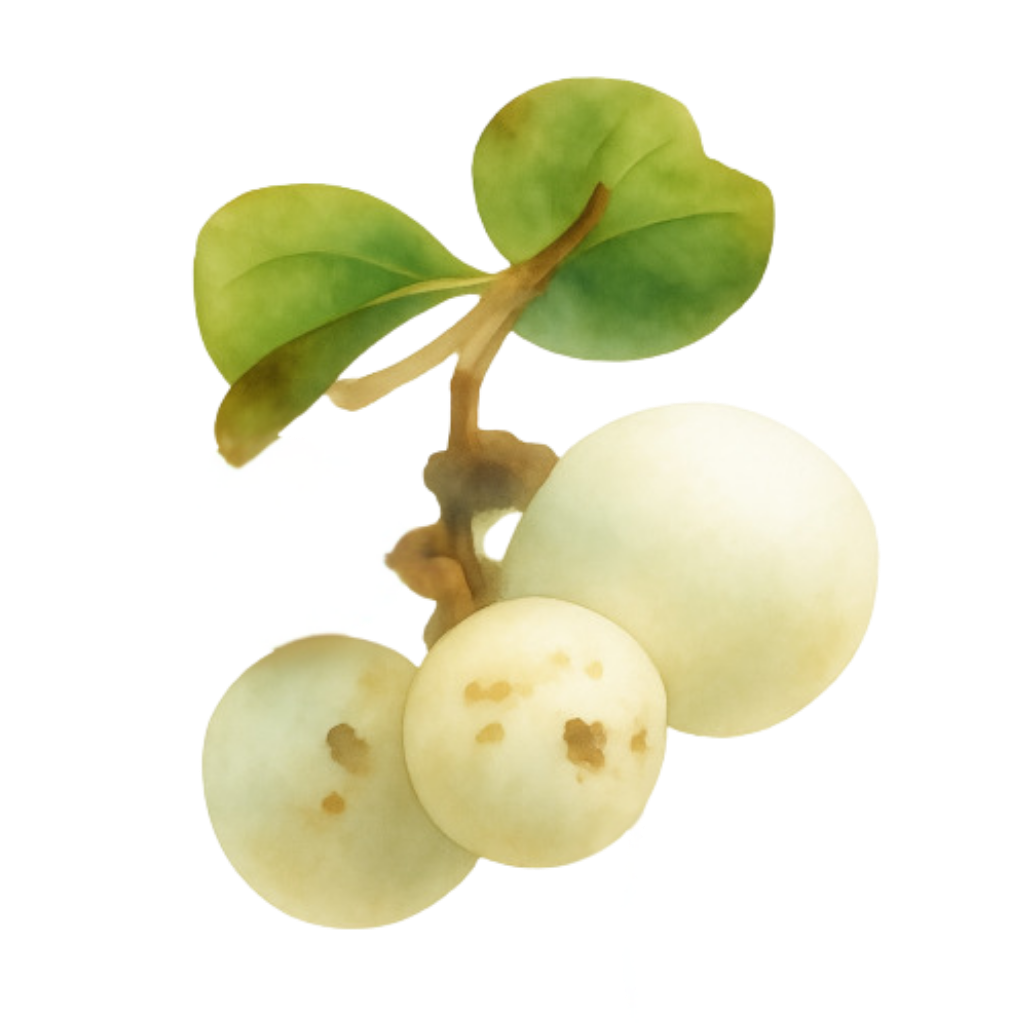
Creeping Snowberry
Gaultheria hispidulaBotanical View
- Leaves are alternate, simple and evergreen, small (about 5-10 mm, roughly 1/4 to 1/3 inch long), broadly elliptic to nearly round or ovate, entire-margined and barely pointed at the tip. The upper surface is dark green and smooth; the underside bears scattered brownish, stiff bristly (hispid) hairs that lie flat and point toward the leaf tip. Leaves are very short-petioled and closely set along the stems.
- Stems are slender, creeping and prostrate, woody at the base, and root freely at the nodes to form dense, sprawling mats over moss, logs and hummocks. They are clothed with brown to reddish, stiff bristly (hispid) hairs and scaly hairs; this bristliness gives the species its epithet, hispidula.
- The plant roots adventitiously at the stem nodes wherever the prostrate stems contact moss or damp substrate, allowing the mat to spread vegetatively. Root systems are shallow and fibrous, typical of the heath family, and, as in other Ericaceae, are associated with ericoid mycorrhizal fungi adapted to acidic, nutrient-poor, peaty soils.
- Flowers are borne singly (solitary) in the leaf axils rather than in showy clusters. Each hangs on a short, hairy, backward-curving (recurved) stalk along the undersides of the creeping stems, so the blooms are largely hidden beneath the foliage and easily overlooked.
- Flowers are bisexual (hermaphroditic), small (a few millimeters, about 1/16 to 1/8 inch across), bell-shaped and white to greenish-white, and 4-merous, with 4 sepals and 4 petals fused at the base and 8 short stamens that do not project beyond the corolla. The species is autogamous (self-fertile, ovules can be fertilized by pollen of the same flower) yet also insect-pollinated. It reproduces both sexually by seed and vegetatively by stems rooting at the nodes, the latter being the dominant mode of local spread.
- Insect-pollinated, chiefly by solitary bees, bumblebees, bee-flies (Bombyliidae) and hoverflies (Syrphidae); it is also capable of self-pollination. The berry-like fruits are eaten by animals such as chipmunks and deer mice, which disperse the seeds.
- Requires acidic, humus-rich, lime-free soils, from light sandy to medium loamy textures, that stay consistently moist to wet but not stagnant. It grows on Sphagnum peat, mossy hummocks and rotting logs, at a soil pH of roughly 4.0-6.5 (very acid to neutral); it will not thrive on alkaline or limy ground.
- Needs steady moisture in a humus-rich, lime-free medium and is intolerant of drought and of any lime or alkalinity. Like other ericaceous plants it is adapted to low-nutrient, acidic peaty conditions, so no heavy or lime-based fertilization is appropriate; keep the soil moist but not permanently waterlogged (a moist, humus-rich, non-boggy medium is preferred in cultivation).
- Propagated by seed, which needs a cold-stratification period (pre-chill about 4-10 weeks); seed is then surface-sown on lime-free compost in a shaded, moist frame or greenhouse, germinating in roughly 1-2 months at about 20°C. It is also propagated by half-ripe wood cuttings 3-6 cm long taken in July-August in a shaded frame, by division in spring before new growth, and by layering. In the wild it spreads mainly vegetatively through stems rooting at the nodes.
- The fruit is a small capsule enclosed by a persistent, fleshy white calyx (giving a berry-like appearance) and containing several small seeds. Detailed data on seed-to-seed or seedling variability are not documented in the available literature.
- No named cultivars or commercial breeding selections are established; it remains a wild species, and its wintergreen-flavored fruit is gathered from natural populations rather than from cultivated, improved forms.
- There is no formal breeding or cultivar-development history. The species has not been domesticated or improved through breeding programs; it is harvested from the wild for its edible, wintergreen-flavored berries rather than cultivated as a bred crop.