Back to Fruitpedia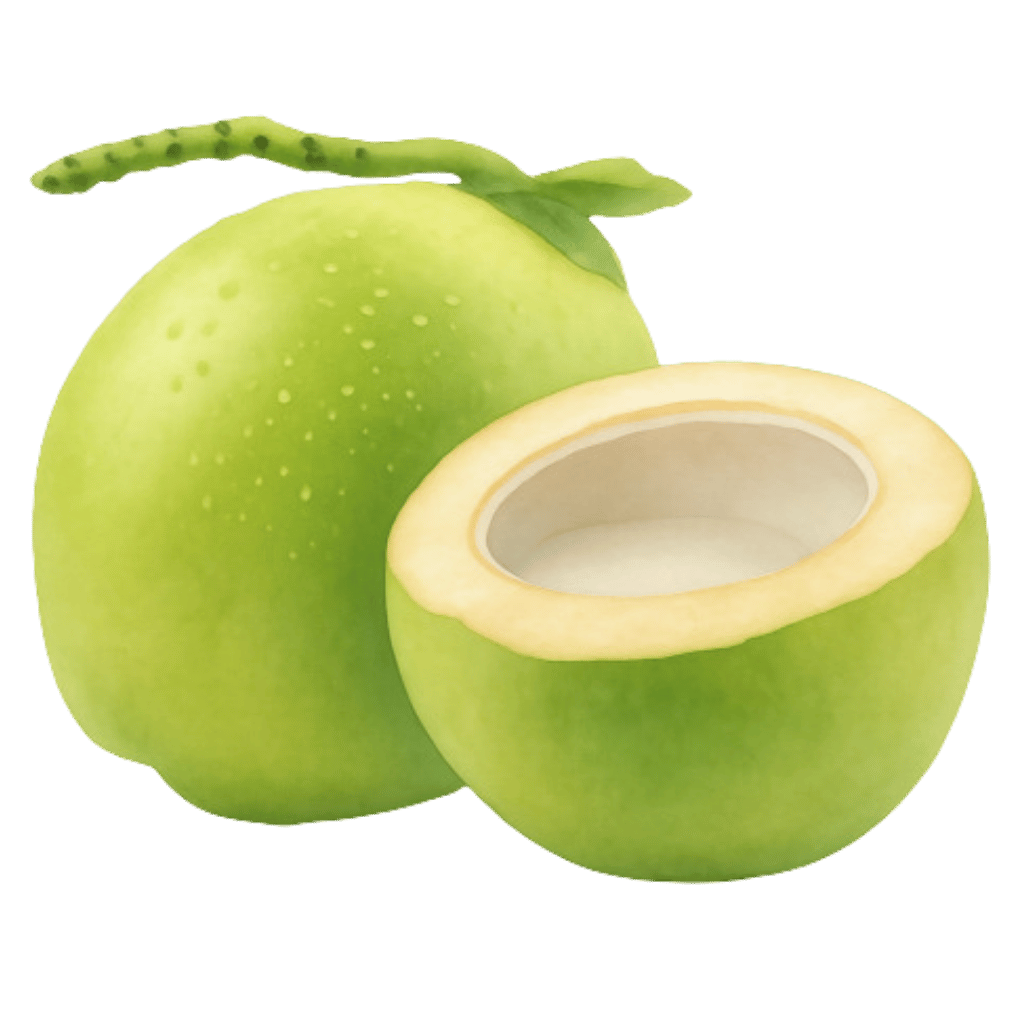
Coconut
Cocos nuciferaVarieties
Malayan Dwarf
Maypan
King Coconut
Macapuno
Nam Hom
6–8° BrixFiji Dwarf
Botanical View
- Leaves are large pinnate (feather-shaped) fronds, spirally arranged and clustered in a terminal crown of roughly 25-35 living leaves. Each frond is about 4.5-6(-7) m long, with the petiole making up roughly one-quarter of the length, and bears 200-250 linear-lanceolate leaflets (pinnae) about 50-120 cm long and 1.5-5 cm wide, arranged in a single plane. The leaf base forms a fibrous sheath that clasps the stem. A palm unfolds on the order of 12-14 new leaves per year (dwarfs somewhat more than talls).
- A single erect, unbranched columnar stem (stipe/trunk), often curved or leaning, light grey and ringed with conspicuous circular leaf scars. Diameter is typically 20-40 cm, with a swollen, bulbous base (bole) up to about 60 cm wide. The stem arises from one apical meristem, has no cambium and therefore no true secondary thickening, and does not increase appreciably in girth once formed.
- The root system is fibrous and adventitious (fasciculated), with no taproot. A mature palm bears roughly 2000-4000 primary roots that arise continuously from the base of the trunk. Most roots are concentrated in the upper ~1.5 m of soil; individual roots are normally about 6 m long and ~1 cm thick, but can extend up to 30 m under favourable soil conditions.
- The inflorescence is an axillary, branched spadix enclosed in bud by a large woody bract (spathe). When open it is about 1-2 m long and bears up to roughly 40 spike-like branches (rachillae). The palm is monoecious and protandrous: each rachilla carries numerous (about 200-300) small male flowers toward its tip and one to a few much larger female flowers near its base, so a single inflorescence has thousands of male flowers and only tens of female flowers.
- Monoecious, with both sexes borne on the same inflorescence, and protandrous — male flowers shed pollen before the female flowers on the same (and adjacent) inflorescences become receptive. This temporal separation makes tall cultivars predominantly allogamous (cross-pollinating and highly heterozygous), whereas dwarf cultivars are largely autogamous (self-pollinating) because their male and female phases overlap. Female receptivity begins about 3 weeks after spathe opening in talls versus about 1 week in dwarfs.
- Pollination is by both insects and wind. Insects — chiefly honeybees and other bees, wasps, flies and ants attracted to nectar in the freshly opened male flowers — are the main cross-pollinating agents, supplemented by wind-borne pollen. In self-pollinating dwarfs the overlap of male and female phases allows pollen transfer within the same palm.
- Tolerates a wide range of soils, from coarse sand to clay and lateritic soils, provided drainage and aeration are good; it grows poorly on waterlogged ground. It is notably salt-tolerant (halophytic), thriving on sandy coastal and saline soils, which suits its shoreline habitat. Optimum soil pH is about 5.5-7.
- Coconut is a heavy feeder with a comparatively high demand for potassium and chlorine, and it also responds to nitrogen and phosphorus; balanced NPK fertilisers, together with chloride (common salt) and micronutrients, are commonly applied in cultivation. In areas with pronounced dry seasons or rainfall well below the ~1500 mm optimum, supplementary irrigation markedly improves growth, flowering and nut yield.
- Propagation is essentially exclusively by seed, sowing the whole mature nut. The seed is recalcitrant (it cannot be dried or stored for long) and germinates while still attached to husk tissue. Selected seed-nuts are set in nursery beds where they germinate over roughly 8-16 weeks (about 2-4 months) before the shoot emerges, then vigorous seedlings are transplanted to the field. There is no natural vegetative propagation; clonal multiplication is only possible experimentally through in-vitro somatic embryogenesis.
- Seed and fruit are variable, especially in the cross-pollinating talls, whose seedlings segregate widely; self-pollinating dwarfs breed comparatively true. Two classic fruit morphotypes span much of the variation: the wild-type "niu kafa" (elongate, angular, thick husk, small cavity — adapted to sea dispersal) and the domesticated "niu vai" (rounded, thin husk, large cavity with abundant sweet endosperm-water). Nut size, husk thickness, kernel (copra) content and water volume vary between talls and dwarfs and among local ecotypes.
- Cultivars fall into two main groups. Tall types (var. typica) account for over 95% of cultivation: tall, hardy, late-bearing (5-7 years), cross-pollinating, with large nuts. Dwarf types (var. nana) are short, precocious (about 2 years), self-pollinating, with smaller nuts and often brightly coloured fruit (green, yellow, orange or red). Numerous named local ecotypes exist (e.g. West Coast Tall, Malayan Dwarf, Fiji Dwarf), and dwarf x tall F1 hybrids are widely bred to combine the precocity of dwarfs with the vigour and nut size of talls.
- Genetic evidence indicates coconut was domesticated independently at least twice, giving two strongly differentiated subpopulations corresponding to the Pacific basin (island Southeast Asia) and the Indo-Atlantic basin (southern margins of India), with admixture in the southwest Indian Ocean reflecting ancient Austronesian trade dispersal. Domestication traits — the dwarf habit, self-pollination and the rounded "niu vai" fruit — arose specifically in the Pacific lineage. Modern breeding focuses on tall x dwarf hybridisation to exploit heterosis for yield, precocity and disease tolerance, supported by international germplasm conservation (COGENT and coconut genebanks).