Back to Fruitpedia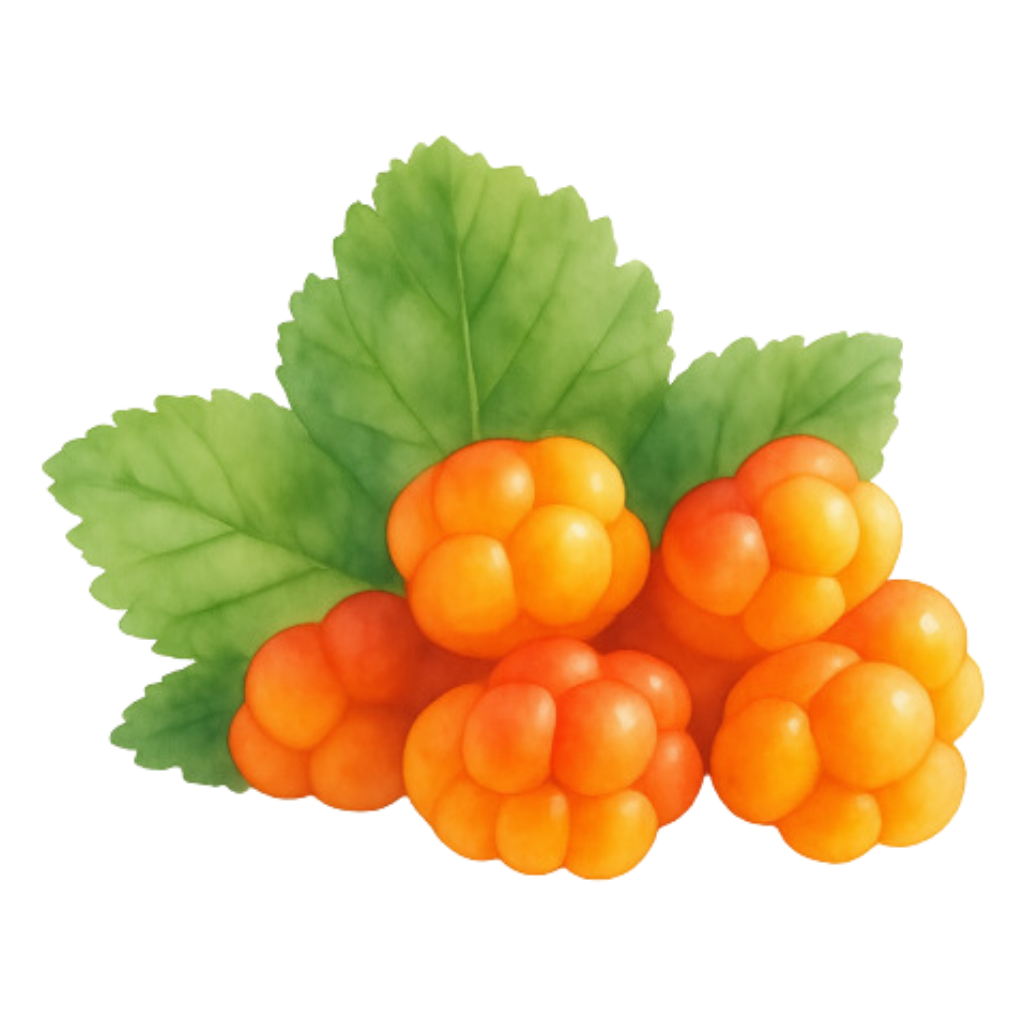
Cloudberry
Rubus chamaemorusVarieties
Fjellgull
Fjordgull
Apolto
Apollen
Nyby
Botanical View
- Leaves are simple (unusual for the genus Rubus, most of which have compound leaves), deciduous, alternate, and few in number (typically 1-3 per aerial stem). Blades are broadly reniform to orbicular or broadly ovate, roughly 2.5-9 cm long and wide, with a cordate (heart-shaped) base, 3-7 shallow, rounded lobes, and finely double-serrate to dentate margins. Petioles are 5-35 mm long and covered in long, silky hairs. The upper leaf surface is glabrous while the lower surface is hairy, especially along the veins. Stipules are broadly ovate to oblong, 3-6 mm long, and deciduous.
- Stems are unarmed (lacking the thorns/prickles typical of most Rubus species), arising singly and erect from the creeping rhizome, roughly 5-30 cm (0.5-3 dm) tall, unbranched, and only rarely woody at the very base. They are sparsely hairy and sparsely stipitate-glandular toward the upper portion, and each aerial stem bears just 1-3 leaves. The aerial stem is herbaceous and dies back annually; the plant perennates via the underground rhizome.
- The root system centers on slender, creeping, woody rhizomes roughly 1-3 mm wide that run horizontally and generally do not penetrate deep into the peat or soil profile, which allows the plant to survive surface disturbances such as fire (top-killing the aerial shoot while the shallow rhizome resprouts). The rhizome is the primary organ of vegetative spread, producing new aerial shoots and forming extensive single-sex clonal colonies over time. Rhizome segments used for transplanting naturally carry a very low density of fine roots, a factor associated with slow initial growth and elevated mortality after transplantation; fertilization at planting has been shown to substantially increase root length and root number within the first growing season.
- Flowers are borne solitary (one per stem), not in clusters or racemes as in most other Rubus species, roughly 2-3 cm in diameter, radially symmetrical, and strictly unisexual (male and female flowers occur only on separate plants). Each flower has 4-5 white, obovate petals (about 8-18 mm long, often with a notched/retuse tip) and 4-5 oblong, erect-to-spreading sepals (about 0.8-1.2 cm). Male flowers bear a central cluster of numerous (roughly 25-40) stamens with yellow-tipped anthers on long, linear filaments; female flowers instead bear a superior, apocarpous gynoecium of about 20-25 separate carpels/styles (green to yellowish), surrounded by a ring of short, sterile, white-tipped staminodes.
- Rubus chamaemorus is dioecious — individual plants bear either male or female flowers only, unlike most other Rubus species, which are hermaphroditic. Only female plants produce fruit, and only after successful pollination from a nearby male plant, so fruit set depends on both the local sex ratio and pollinator activity. Because the species also spreads extensively by clonal (vegetative) rhizome growth, wild populations often form large patches that are functionally a single sex, which can locally suppress fruit yield where male and female clones are not well interspersed. Naturally occurring hermaphroditic (self-fertile) individuals are rare but do occur, and one such wild clone found in Finland became the basis of the self-fertile cultivar 'Nyby'.
- The species is entomophilous (insect-pollinated) and, being dioecious, entirely dependent on pollinator-mediated pollen transfer from male to female plants for fruit production. A detailed pollination-ecology study recorded flower visitors from 43 insect families, with four families — Apidae (bumblebees, honeybees), Halictidae (sweat bees), Muscidae (flies), and Syrphidae (hoverflies) — accounting for about 87% of all visits. Flies and halictid bees showed high floral fidelity (about 95% of visits to cloudberry flowers) compared with bumblebees (about 65%). Apids and muscids produced significantly lower fruit set than halictids and syrphids, although differences in resulting fruit mass or seed set were not significant among pollinator groups. Natural insect pollination achieved 88.5-97.5% fruit set and 62.5-76.7% seed set across study years, whereas excluding insects from flowers dropped fruit set to only 12.8-18.4%, confirming pollinators are essential rather than supplementary. Managed honeybees have also been shown to be effective supplemental pollinators in commercial settings.
- Cloudberry is an obligate peatland/bog specialist, essentially confined to strongly acidic (pH commonly cited in the range of about 2.5-4.5, with field studies in Latvia measuring 2.68-4.25), nutrient-poor (oligotrophic) peat soils with very high organic-matter content (roughly 92-99%). It performs best in poorly decomposed, fibric peat (von Post humification classes H1-H3) rather than more decomposed, denser peat, and occupies plant communities such as pine-birch wetlands and raised Sphagnum bogs. Typical associated indicator species include Sphagnum mosses, bilberry (Vaccinium myrtillus), and bog cranberry (Oxycoccus palustris). The species tolerates a broad soil-moisture gradient from drier to wet ground but reaches greatest cover on consistently wet sites such as raised bogs, wet meadows, and freshwater marshes, and prefers partial sun rather than deep forest shade or fully open exposure.
- In agronomic trials on cutover/reclaimed peatlands, N-P-K fertilizer applied at the time rhizome segments are planted stimulates root production markedly: fertilized transplants developed roots two to four times longer and more numerous than unfertilized controls after one full growing season, though fertilization did not hasten the onset of rooting itself. Because wild-collected rhizome transplants naturally have very low root density, this initial root stimulation is considered important for reducing establishment mortality. Substrate quality also matters more than nutrient input alone: growth is consistently better in fibric, poorly decomposed peat (von Post H1-H3) than in more decomposed, denser peat. Cultivation guidance for cutover peatland restoration recommends planting rhizomes only two to three years after the site is rewetted/re-mossed, so that a fresh fibric peat/moss layer has re-formed and mulch-related negative effects have subsided. The species requires consistently moist, but not waterlogged, conditions typical of its native bog habitat; it does not tolerate drying out of the peat surface.
- Propagation is primarily vegetative, by division/transplantation of rhizome segments, which is both the plant's dominant natural means of spread (forming large single-sex clonal patches) and the standard method used in cultivation and peatland-restoration plantings. Sexual propagation by seed is also possible but slower to establish; seeds exhibit dormancy and require roughly 3-4 months of cold, moist stratification before they will germinate reliably, mimicking overwintering in the field.
- Rubus chamaemorus is octoploid, and recent whole-genome phylogenomic analysis indicates this polyploid genome arose from multiple, complex polyploidization events rather than a single simple doubling. Wild populations show natural variability in floral and reproductive traits — including pistil number per female flower, stamen number per male flower, flower size, and flowering density — which Nordic breeding programs used directly as clone-selection criteria. Because the species is dioecious, seed-grown offspring segregate by sex, and rare naturally occurring hermaphroditic individuals (self-fertile) have been found in wild populations, one of which was propagated into the cultivar 'Nyby'.
- Very few named cultivars exist, reflecting the species' recent and limited domestication. From Norway's breeding programme: dioecious pairs 'Fjordgull' (An 276, female) and 'Fjellgull' (If 542, female), pollinated by males 'Apollen' (An 30) and 'Apolto' (An 248), selected for pistil/stamen counts, flower abundance, and shoot density. From Finland: the self-fertile (hermaphrodite) cultivar 'Nyby', traced to a single hermaphrodite wild clone found in 1991 near Maalahti and commercially propagated since 2005, notable because it fruits without a separate pollenizer plant. Outside these releases, virtually all cloudberries sold and consumed are still wild-harvested rather than cultivated selections.
- Rubus chamaemorus was essentially undomesticated, wild-harvested only, until the late 20th century. Formal breeding began under the Nordic "Northernberries" project (from the mid-1990s), a collaboration of the Norwegian government with Finnish, Swedish, and Scottish partners aimed at domesticating high-value wild northern berries; before this programme there had been no prior plant breeding on the species. At the Norwegian Institute for Agricultural and Environmental Research, wild-collected clonal populations were grown for five years in framed peat beds inside plastic greenhouses and evaluated for yield-related floral traits (pistil number per female flower, stamen number per male flower, flower density, shoot number per m², establishment speed). This produced Norway's first released cultivar pairs: females 'Fjordgull' (An 276) and 'Fjellgull' (If 542) with pollenizer males 'Apollen' (An 30) and 'Apolto' (An 248). In parallel, Finland developed the cultivar 'Nyby' from a naturally occurring hermaphrodite (self-fertile) clone discovered in 1991 at Nyby, Petolahti, in Maalahti; 'Nyby' has been in commercial propagation since 2005 and removes the need to interplant separate male and female stock. Agronomic research on rhizome-transplant establishment, fertilization, and peat-substrate quality for cloudberry cultivation in cutover/reclaimed peatlands has continued at Université Laval (Quebec, Canada).