Back to Fruitpedia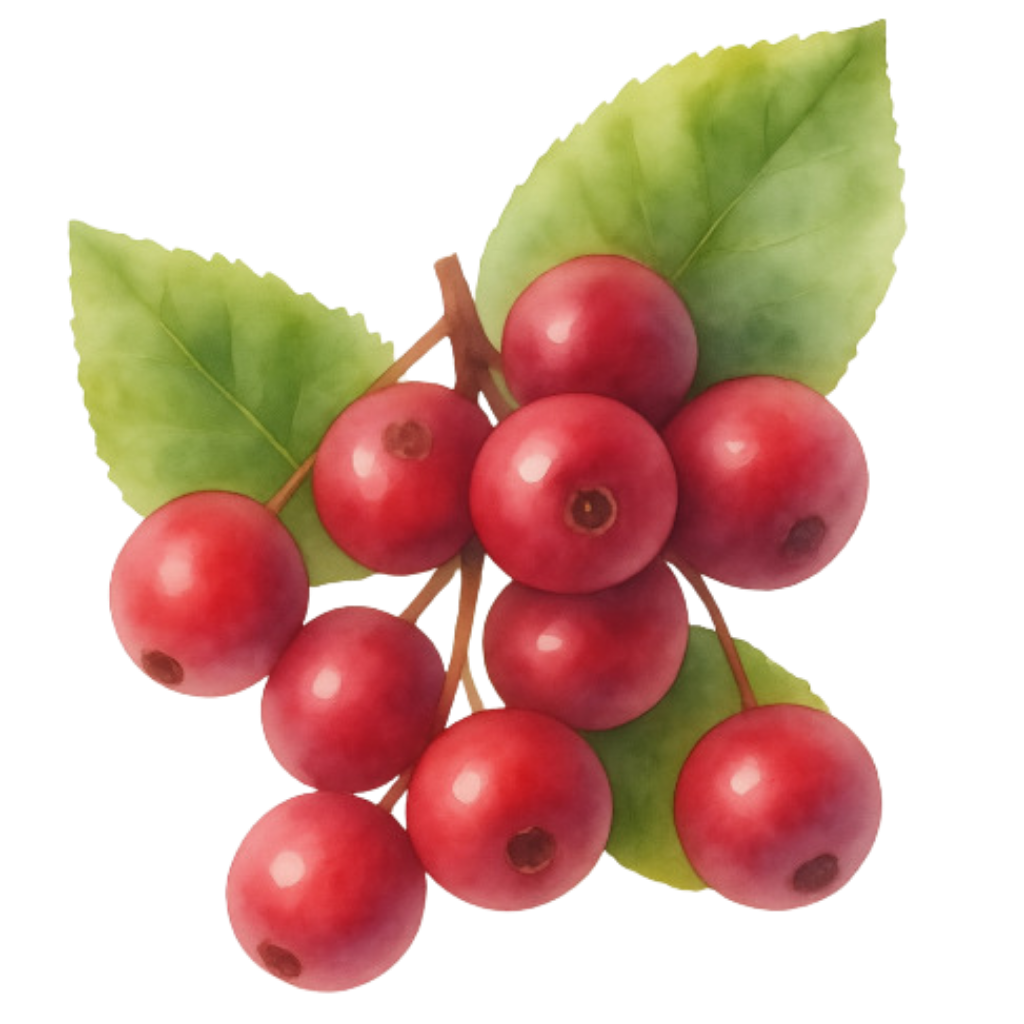
Chokecherry
Prunus virginianaVarieties
Canada Red
Schubert
Garrington
Boughen's Golden
Boughen's Chokeless
Maskinonge
Botanical View
- Leaves are simple, alternate, broadly oval to obovate or ovate to broadly elliptical, 1.5–5 inches long and 1–3 inches wide, rounded to slightly heart-shaped at the base with a short abrupt point at the tip, and finely toothed (serrate) margins; upper surface glabrous and shining dark green, lower surface paler with downy hairs in the vein axils; petioles about 0.5–0.75 inch long, typically bearing two or more small glands near the blade (Bean's Trees and Shrubs Online; USDA NRCS Plant Fact Sheet PRVID; NC State Extension Gardener Plant Toolbox). Crushed foliage emits a strong, bitter (cyanogenic) scent (NC State Extension).
- Typically a shrub in the wild, 2–15 ft high (occasionally to 30 ft on favorable sites), with numerous slender stems that either branch from the base or grow as a small tree with spreading main branches; young branchlets are grey and glabrous (Bean's Trees and Shrubs Online; USDA NRCS Plant Fact Sheet PRVID; USDA Forest Service FEIS). Bark on the western variety is described as smooth to scaly and dull red to gray (USDA NRCS Plant Fact Sheet, PRVID).
- The species develops an extensive root system combining a network of rhizomes with a deep primary root system established at intervals along those rhizomes; roots can extend laterally more than 35 feet (10.6 m) and vertically more than 6 feet (1.8 m), with rhizomes 0.4–0.8 inch in diameter (USDA Forest Service FEIS). This shallow, spreading root system produces underground runners (root sprouts) that allow the plant to form dense clonal thickets (USDA Forest Service FEIS; NC State Extension Gardener Plant Toolbox).
- Flowers are white, showy, and fragrant, borne in racemes on leafy shoots of the current season; racemes are reported as 2–5 inches long (USDA NRCS Plant Fact Sheet, PRVID) to 3–6 inches long (Bean's Trees and Shrubs Online). Individual flowers are under 1 inch across with 4–5 oval-to-orbicular, concave petals; the green sepals turn yellowish, giving the white flower a yellowish cast (NC State Extension Gardener Plant Toolbox). Flowers are "perfect" (hermaphroditic), each with both functional stamens and pistil (USDA Forest Service FEIS).
- Prunus virginiana bears perfect (hermaphroditic) flowers on the current season's leafy shoots and reproduces both sexually (by seed) and vegetatively via rhizome-borne root sprouts that form clonal thickets (USDA Forest Service FEIS). The species is self-incompatible: a study combining field pollination experiments with genetic (S-allele) analysis found that although S-allele diversity remained high even in fragmented populations, pollen limitation reduced fruit set in small, isolated habitat patches compared to continuous forest, indicating that adequate cross-pollen delivery — not just genetic diversity — is required for reproductive success (Annals of Botany, pollen-limitation study on P. virginiana).
- Flowers are insect-pollinated; documented visitors include mining bees (family Andrenidae), honeybees, mason bees, and bumblebees (University of Colorado Boulder, Arts & Sciences Magazine). Because the species is self-incompatible, effective cross-pollination by these insect visitors is necessary for fruit set (Annals of Botany, pollen-limitation study on P. virginiana).
- Tolerant of a wide range of soil orders, from Entisols to Mollisols, and textures from silt to sandy loam to clay; the species tolerates weakly saline soils but is intolerant of poor drainage and prolonged flooding, and occurs across a broad pH range from very acid to moderately alkaline (roughly pH 3.5–7.6) (USDA Forest Service FEIS). The western variety prefers deep, fertile loam soils but is also found on shallow soils or soils with more than 35% coarse fragments, including rocky talus slopes and shallow shale sites (USDA NRCS Plant Fact Sheet, PRVID). NC State Extension characterizes garden-culture preference as neutral pH (6.0–8.0), well-drained soil with moist to occasionally dry moisture conditions.
- Documented guidance is limited to establishment-stage water needs rather than a fertilization program: irrigation is recommended on sites receiving less than 14 inches (356 mm) of annual precipitation; established plants tolerate grazing/browsing removal of up to 50% of annual growth without loss of vigor; pruning or thinning is discouraged as the species performs better unmanaged (USDA NRCS Western Chokecherry Plant Fact Sheet, PRVID). No specific fertilizer rate or schedule was found in the government/extension sources reviewed.
- Seed dormancy is overcome by cold, moist stratification: USDA NRCS establishment guidance specifies stratification in moist sand or peat at low temperature for 90–160 days, with fall sowing of untreated seed or spring sowing of stratified seed in drill rows 8–12 inches apart, seed covered/drilled about ½ inch deep at roughly 25 seeds per foot of row; one-year-old bareroot stock can also be field-planted on deep, well-drained soils in sunny locations, with moist exposed mineral soil making the best seedbed (USDA NRCS Plant Fact Sheet, PRVID). USDA Forest Service FEIS reports a comparable requirement of 120–160 days of cool, moist stratification at 36–41°F, an additional after-ripening period in the presence of oxygen and moisture, and improved germination following heat treatment, consistent with fire-related scarification as a natural germination trigger. Vegetative propagation/spread also occurs naturally via an extensive rhizome network that produces root sprouts, forming clonal thickets (USDA Forest Service FEIS).
- Seed exhibits physiological dormancy requiring an after-ripening period in the presence of oxygen and moisture, overcome by cool, moist stratification of 90–160 days at about 36–41°F (USDA NRCS Plant Fact Sheet PRVID; USDA Forest Service FEIS); germination reportedly improves further with heat treatment, consistent with fire-related scarification as an adaptive trigger (USDA Forest Service FEIS). Fruit and seed traits vary by variety/form: ripe fruit color ranges from dark red or purple to nearly black across the three recognized varieties (common, western/demissa, black/melanocarpa), and rare white-fruited (f. leucocarpa) and yellow-fruited (xanthocarpa) forms are recorded in synonymy (Kew Science POWO; Bean's Trees and Shrubs Online; USDA Forest Service FEIS).
- No cultivars are "recommended" in the crop-improvement sense (USDA NRCS Western Chokecherry Plant Fact Sheet: "No cultivars are currently recommended"), but named horticultural/conservation selections exist: 'Schubert' / 'Canada Red' / 'Shubert Select' — purple-foliage ornamental tree form, hardy USDA zones 2–7, grown for spring white racemes and dark-purple fall fruit clusters, requires sucker removal to control spreading (Oregon State Univ. Landscape Plants Dept.). 'Colorow' Germplasm (var. melanocarpa) — USDA-NRCS conservation release, ~12 ft tall by 13.5 ft wide, flowering in May with fruit ripening mid-to-late August, distributed by the Upper Colorado Environmental Plant Center for conservation plantings (USDA NRCS). Taxonomically, three infraspecific varieties are recognized: var. virginiana (eastern), var. demissa (western/Rocky Mountain "western chokecherry"), and var. melanocarpa ("black chokecherry") (Kew Science POWO; USDA NRCS).
- Prunus virginiana has not undergone formal fruit-crop domestication or breeding comparable to cultivated Prunus fruits; planting stock is largely wild-collected or naturalized seed/bareroot material (USDA NRCS Plant Fact Sheet, PRVID). Known selections are ornamental or conservation-oriented rather than fruit-improvement programs: (1) 'Schubert' (marketed as 'Canada Red' / 'Shubert Select'), a purple-leaved ornamental selection introduced in 1943 by the Oscar H. Will & Co. nursery of Bismarck, North Dakota — leaves emerge green and mature to dark purple by early summer (Oregon State Univ. Landscape Plants; USDA NRCS). (2) 'Colorow' Germplasm (Prunus virginiana var. melanocarpa), a USDA-NRCS selected-class conservation release from the Upper Colorado Environmental Plant Center (Meeker, CO), originally collected in Rio Blanco County, Colorado, and released for wildlife habitat and erosion-control plantings rather than fruit production (USDA NRCS Plant Materials, Colorow Germplasm description). No dedicated fruit-breeding lineage was found in the sources reviewed.