Back to Fruitpedia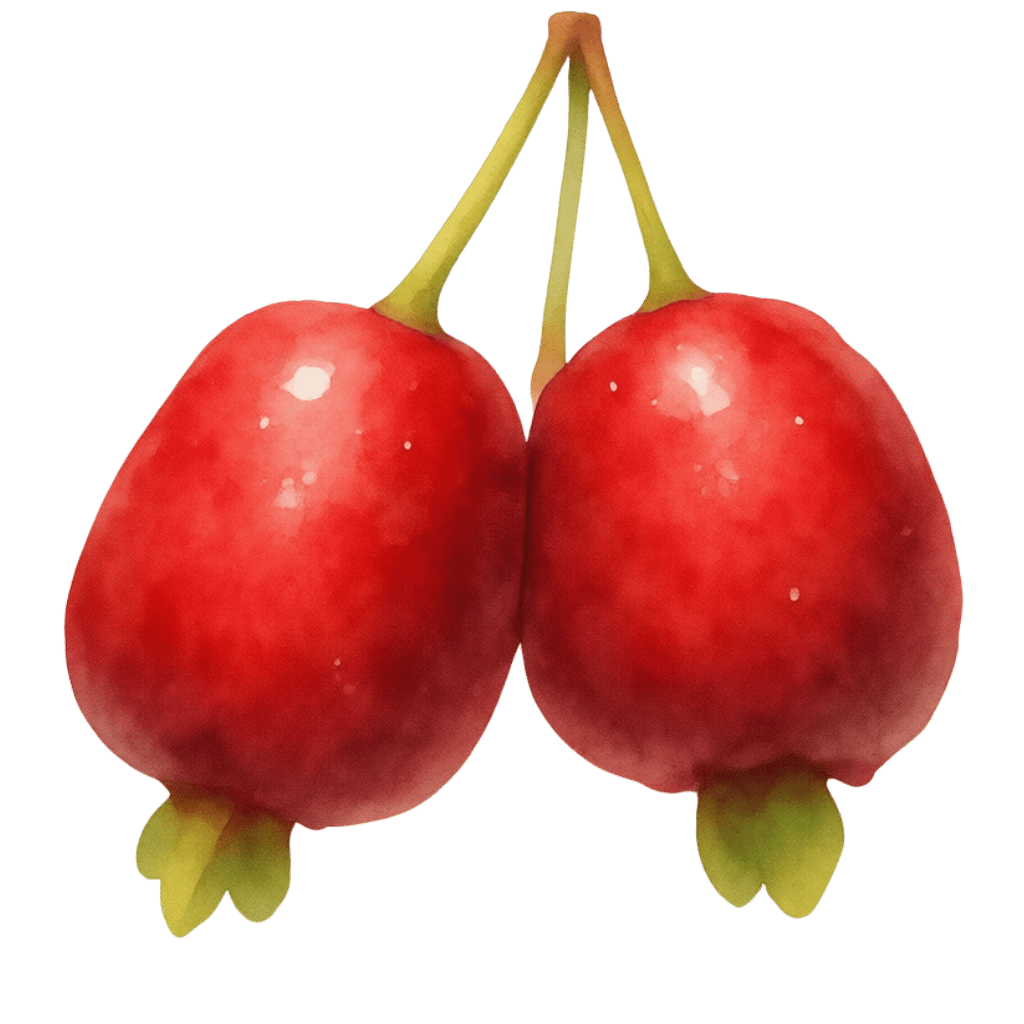
Rio Grande cherry
Eugenia involucrataBotanical View
- Leaves are simple, opposite, oval-oblong to elliptic-lanceolate, glabrous, coriaceous (leathery) and glossy dark green, about 5-9 cm long by 1-2 cm wide, with aromatic oil glands typical of Myrtaceae. The species is evergreen, and new leaf flush occurs together with flowering (around September in southern Brazil), following partial leaf fall in winter.
- The trunk is erect and more or less cylindrical, typically 30-40 cm in diameter, with smooth, flaking (descamante) bark that exposes patches of grey, brown, greenish or reddish tones as it peels. Branching is sympodial, irregular and variable, the trunk is short without strong apical dominance, and natural self-pruning is poor, so periodic training and pruning are needed to shape a well-formed crown.
- ""
- Flowers are solitary and axillary (not borne in clusters or racemes), long-pedunculate, white, with four petals and a center of numerous long stamens bearing yellow anthers, a typical Myrtaceae/Eugenia flower structure.
- Flowers are hermaphroditic (perfect). Fruit-set has been described as possible from self-pollination but improved by cross-pollination. A population-genomics study using SNP markers across seven Brazilian populations found an average fixation index near -0.04 (heterozygote excess), consistent with a predominantly outcrossing mating system rather than strict selfing. Cytological work on a Santa Catarina population found normal meiotic behavior (meiotic index above 95%) and pollen viability exceeding 95% in colorimetric tests, indicating high reproductive/cytological stability.
- Bumblebees (Bombus spp.) and honeybees (Apis mellifera) have been recorded visiting and pollinating the flowers.
- Grows best in fertile, deep, organic-matter-rich, well-drained soils, but is described as succeeding in a variety of soil types. It can be planted in full sun or partial shade, with partial shade generally favored during establishment.
- Periodic irrigation is recommended in the first years after planting, gradually reduced as the plant establishes, reflecting the species' drought intolerance at a young age. No standardized, research-validated fertilization protocol specific to E. involucrata was found in the government/university literature reviewed; general nursery/orchard practice for native Myrtaceae fruit trees (organic matter plus balanced NPK) is commonly extrapolated, but this has not been confirmed as species-specific guidance.
- Propagation is mainly by seed. Direct sowing into individual containers (rather than bare-root transplanting) gives the best nursery results. Germination is hypogeal/cryptocotylar, with emergence beginning 30-40 days after sowing; germination performance of natural seed lots is often described as low, although controlled trials with intact, high-quality seed reached 78-100%. Seeds are recalcitrant and desiccation-sensitive, which limits storage and long-term germplasm conservation. A fractionation technique developed at the Instituto de Botânica (São Paulo) - cutting the seed longitudinally through the hilum so each fragment retains at least half of the hilum, then germinating on vermiculite at 30 degrees C - allows more than one normal seedling to be produced per seed, increasing nursery propagation efficiency for this naturally low-seed-yield species. Vegetative propagation is also possible: air-layering (marcottage) works but is not recommended because the erect growth habit makes bending branches difficult and rooting takes about 6 months; stem cuttings from current-season shoots and basal sprouts treated with indole-3-butyric acid (3,000 mg/kg) or a commercial rooting product achieved 27.3% and 25.2% rooting, respectively.
- Fruits typically contain 1-3 seeds. Seeds are monoembryonic, with fused (concrescent) cotyledons lacking a clearly differentiated hypocotyl-radicle axis, and are exalbuminous, filling the entire cavity of the seed coat. They show marked recalcitrance and desiccation sensitivity, cannot be safely dried or stored long-term, and show no germination inhibition while still inside the fruit. Considerable natural variability in fruit and seed size has been reported among wild individuals, which underpins ongoing efforts to identify superior genotypes.
- No formally registered or commercially released cultivars of Eugenia involucrata currently exist. The species is still in an early stage of domestication and is propagated mainly from unselected, wild-collected seed. Participatory research involving growers and researchers has begun defining fruit-quality criteria and flagging genotypes of interest to guide future selection and conservation-through-use, but no named cultivars have resulted yet.
- There is no formal breeding program for this species. It persists mainly as scattered wild individuals and small living germplasm collections maintained by research institutions, urban afforestation plantings, and smallholder properties in states such as São Paulo and Minas Gerais, complicated by the recalcitrant, desiccation-sensitive seeds that limit ex situ seed-bank conservation. The first comprehensive population-genomics assessment (SNP genotyping of 62 accessions across seven populations) found generally low inbreeding (mean fixation index around -0.04) and moderate genetic differentiation among collections (PhiST around 0.23), establishing a genetic baseline described as supporting future conservation and breeding work on the species, which is regarded as having considerable economic potential as an emerging native crop.