Back to Fruitpedia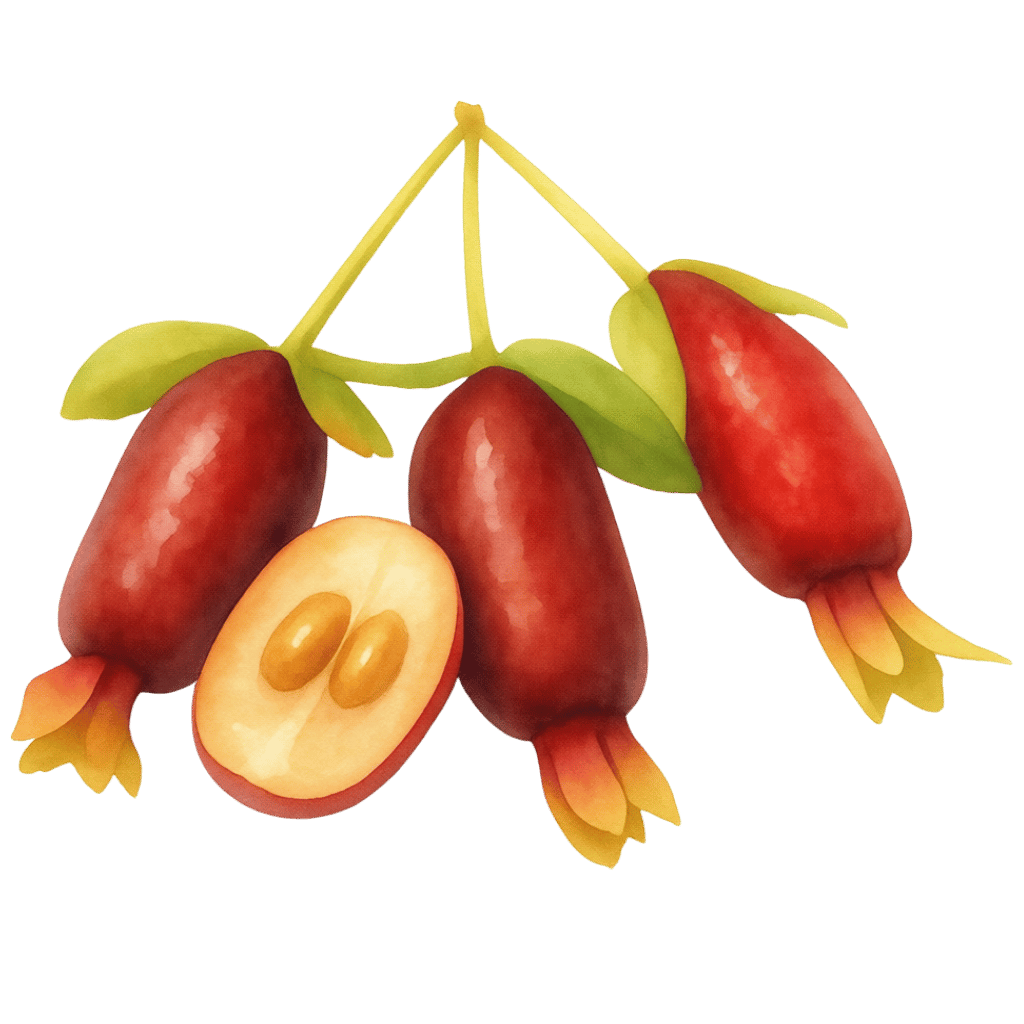
Savanna cherry
Eugenia calycinaBotanical View
- Leaves simple, petiolate (petiole ca. 3-7 x 2.5-3 mm), opposite, discolorous, blade ovate-elliptic to obovate-oblong, 4-8 x 1.5-3 cm, apex acute to slightly acuminate or retuse, base cuneate to attenuate, margin entire, coriaceous at maturity (Ferreira, 2014, UFG doctoral thesis). Anatomically the leaves are hypostomatic with anomocytic (rarely paracytic) stomata, a uniseriate epidermis under a thick, ornamented cuticle, dorsiventral mesophyll, abundant calcium-oxalate druse crystals in the palisade parenchyma, and subepidermal lipid-secreting cavities on both faces - traits shared with congeners such as E. dysenterica, E. brasiliensis, E. uniflora and E. pyriformis (Ferreira, 2014, UFG doctoral thesis). When dried, leaves turn brownish on both faces, a character used to separate E. calycina from the similar E. involucrata, whose leaves yellow only on the lower face (Arantes & Monteiro, 2002, Lundiana).
- A subshrub to small shrub. Reported heights range from about 0.4-0.6 m with a similarly sized crown in populations near Planaltina/Brasília (Silva et al., 1994, EMBRAPA-CPAC "Frutas do Cerrado"; Silva et al., 2001, Revista Brasileira de Fruticultura) up to about 2.0 m in populations studied in Goiás (Ferreira, 2014, UFG doctoral thesis). No dedicated stem/bark anatomical study of the species was found beyond the family-level Myrtaceae pattern of an exfoliating bark (súber) renewed each growing season (Souza & Lorenzi, 2012, cited in Ferreira, 2014).
- Root architecture has not been directly described, but nursery trials found that seedlings allocate proportionally more biomass to roots than to the shoot (shoot:root ratio below 1) regardless of the fruit-maturation stage the seed came from or the nursery substrate used, a pattern also seen in other Cerrado woody seedlings and interpreted as an early drought-survival strategy (Borges, 2008, MSc dissertation, UFU).
- Inflorescence a cyme reduced to a single flower (uniflorous cyme). Flowers are pedicellate, subtended near the apex of the pedicel by ovate, acuminate, cordate-based, membranous bracteoles 1-3 cm long; calyx dialysepalous with oblong sepals 8-14 mm long; corolla white, dialypetalous, petals obovate, 10-15 mm long (Ferreira, 2014, UFG doctoral thesis; photographic voucher in Borges, 2008, UFU MSc dissertation).
- Flowers are hermaphroditic and, as typical of Brazilian Myrtaceae in general, actinomorphic with numerous stamens; because Myrtaceae flowers are nectarless, pollen itself is the principal reward offered to floral visitors (Borges, 2008, UFU MSc dissertation, citing Nic Lughadha & Proença, 1996). No species-specific study of self-(in)compatibility, dichogamy or breeding system in E. calycina was located in the literature reviewed.
- No study documents pollinators of E. calycina specifically. Bees are reported as the principal pollinator guild of Myrtaceae in the Cerrado of central Brazil generally, exploiting the pollen reward of the hermaphroditic flowers (Proença & Gibbs, 1994; Oliveira & Gibbs, 2000; both cited in Borges, 2008, UFU MSc dissertation).
- Occurs on the typically acidic, dystrophic soils of the Cerrado biome, in campo sujo, cerrado sensu stricto, cerradão, campo cerrado and cerrado-vereda (palm-swamp) transition vegetation (Bülow, Carmona & Parente, 1994, Pesquisa Agropecuária Brasileira; Arantes, 1997, MSc thesis, UNESP, cited in Borges 2008). Comparing a cerrado stand with an adjoining vereda-border stand of the same population, Cardoso & Lomônaco (2003, Revista Brasileira de Botânica) found the cerrado soil significantly more clay-rich (p=0.034) while the vereda-border soil had significantly higher phosphorus (p=0.029); most other physicochemical soil properties did not differ significantly between the two microhabitats.
- No field fertilization or irrigation protocol exists for commercial cultivation, since the species is not commercially grown. In nursery trials, seedlings grown in commercial substrate (Bioplant®) amended with vermiculite or coconut husk (0-40%) plus a slow-release NPK fertilizer (Osmocote® 15-09-12 with micronutrients, 5 g/L substrate) showed similar growth (height, root length, stem diameter, leaf number) across all substrate mixes tested (Borges, 2008, UFU MSc dissertation).
- Propagated almost exclusively by seed, like most Myrtaceae, which root poorly from cuttings (Borges, 2008, UFU MSc dissertation). Seeds are recalcitrant: freshly harvested seed shows about 97% germination, with root emergence beginning around 10 days and shoot emergence around 16 days after sowing (full emergence spanning 8-20 days); germination capacity and speed decline rapidly in storage, and viability is lost within about 21 days if seeds are kept in paper bags. Keeping seed inside the intact fruit or in hermetically sealed packaging at about 10°C preserves roughly 50% viability after 28 days (Bülow, Carmona & Parente, 1994, Pesquisa Agropecuária Brasileira, EMBRAPA). In controlled nursery emergence trials, seedling emergence began about 21 days after sowing and stabilized by about 66 days (mean time to emergence 32-33 days); final emergence was high but slow (83.7-90.3%, less than one seedling/day), independent of the ripeness/color stage of the source fruit. Post-emergence seedling growth is slow, reaching only about 6-7 cm hypocotyl height after 210 days (Borges, 2008, UFU MSc dissertation).
- Most fruit (over 60%) contain a single seed, occasionally two, and rarely (about 2% of fruit) up to six. Seed width (8-14 mm) and length (7-14 mm) stay essentially constant across the green-to-dark-red ripening sequence even though the fruit itself enlarges as it ripens; the symmetrical, mesokurtic size distribution of both fruit and seed was interpreted as evidence of retained genetic variability suitable for future selection (Borges, 2008, UFU MSc dissertation and companion paper, Revista Brasileira de Fruticultura). Between subpopulations, seeds from vereda-border plants are significantly heavier than those from adjoining cerrado stands, while cerrado plants produce more seeds per fruit (Cardoso & Lomônaco, 2003, Revista Brasileira de Botânica). Physical seed integrity also affects germination: full, undamaged seed germinates better, while smaller or perforated seed shows reduced germination (Bülow, Carmona & Parente, 1994, EMBRAPA).
- No named cultivars have been developed. E. calycina remains an undomesticated, extractivist Cerrado fruit species; EMBRAPA-CPAC's native Cerrado-fruit domestication program prioritized seven other species (Annona crassiflora, Caryocar brasiliense, Dipteryx alata, Eugenia dysenterica, Hancornia speciosa, Hymenaea stigonocarpa and Mauritia flexuosa) for genetic-improvement research, and E. calycina was not among them despite being listed among more than 150 Cerrado species with recognized fruit potential (Fonseca & Ribeiro, EMBRAPA-CPAC, "Fruteiras nativas do Cerrado"). Later graduate research found that the size distribution of its fruit and seeds indicates genetic potential for future selection/breeding, but no cultivar or breeding line has yet resulted (Borges, 2008, UFU MSc dissertation).
- No formal breeding or domestication program has targeted E. calycina; it remains an extractivist, wild-harvested Cerrado fruit. It was documented among more than 150 Cerrado species with recognized fruit/economic potential surveyed by EMBRAPA-CPAC, but was not selected as one of the program's priority species for genetic-improvement research, unlike congener E. dysenterica (Fonseca & Ribeiro, EMBRAPA-CPAC, "Fruteiras nativas do Cerrado"). Only from the 2000s-2010s did dedicated graduate research begin characterizing its fruit/seed morphometry and pulp yield (Borges, 2008, MSc dissertation, UFU), its seed storage physiology (Bülow, Carmona & Parente, 1994, EMBRAPA/Pesquisa Agropecuária Brasileira), and its leaf anatomy and phytochemistry (Ferreira, 2014, PhD thesis, UFG), concluding that the symmetric size variability of its fruit and seeds indicates genetic potential for future selection, though no cultivar or breeding line has yet been produced.