Back to Fruitpedia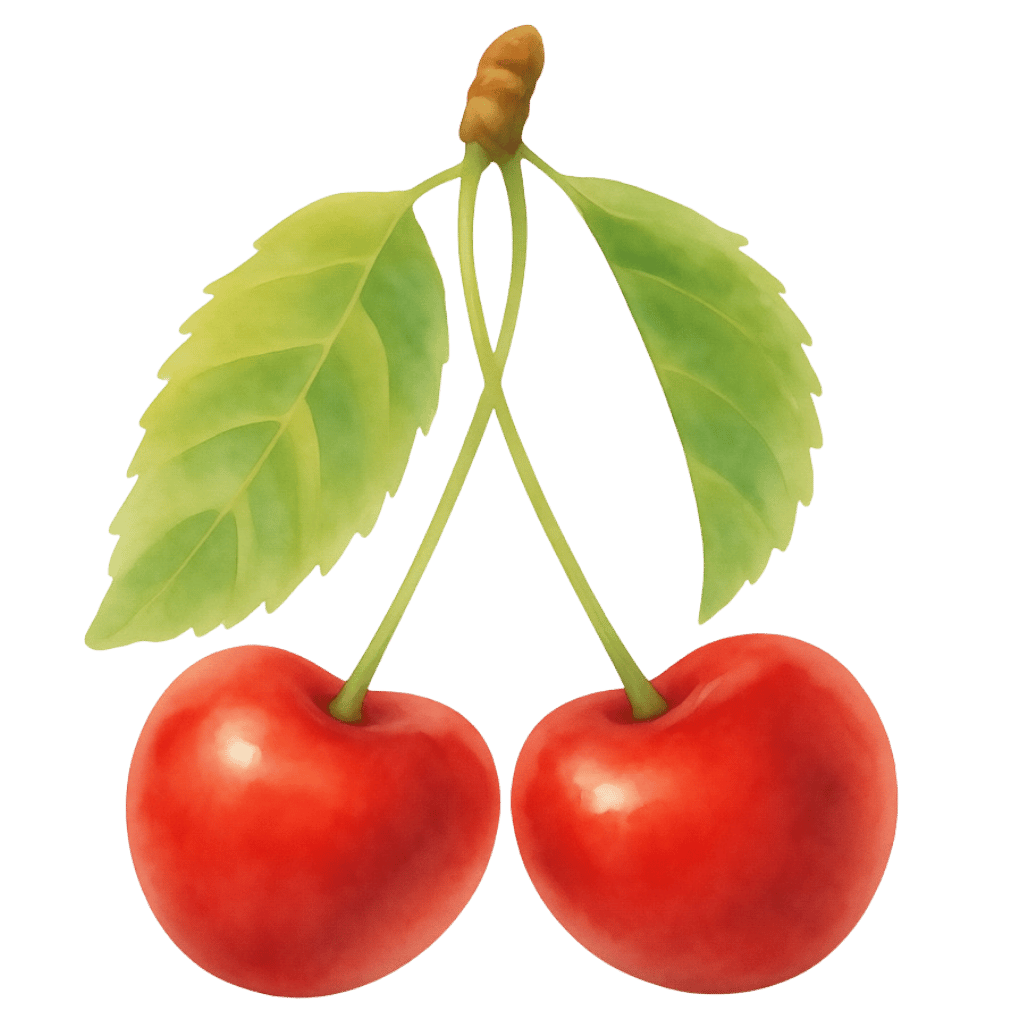
Cherry
Prunus aviumVarieties
Bing
Napoleon
Rainier
17–23° BrixVan
20–21° BrixStella
Sweetheart
Botanical View
- Leaves are alternate, simple, elliptic to obovate, 5-13 cm long, with finely serrate (toothed) margins and about eight pairs of lateral veins. The petiole is grooved and bears two small reddish or greenish glands (extrafloral nectaries) near the base of the blade. Leaves emerge together with the flowers in spring and turn red, orange or yellow in autumn.
- The trunk has smooth, glossy, gray-brown to reddish-brown bark marked with conspicuous horizontal lenticels; the bark peels in horizontal strips as the tree ages, and old wood becomes gray with horizontal ridging. Young twigs are reddish-brown and non-aromatic. The wood is reddish-brown and fine-grained, commercially valued for furniture and veneer.
- Prunus avium has a comparatively shallow, wide-spreading root system that can form a root "plate" near the surface and readily produces root suckers; it is sensitive to waterlogging and prone to root and crown rot in poorly drained soils. Commercial trees are almost always grafted onto rootstocks selected for vigor control and soil adaptation, including Mazzard (P. avium seedling, vigorous, broadly compatible), Mahaleb (P. mahaleb, better suited to sandy/calcareous, drier soils) and the dwarfing Gisela series.
- Flowers are white, 5-petaled, fragrant and hermaphroditic (perfect), about 2-3.5 cm across, borne in small, sessile to short-stalked umbel-like clusters (few-flowered corymbs) of roughly 2-6 flowers arising from spur buds on second-year and older wood, opening with or just before the leaves in spring.
- Flowers are hermaphroditic, but sexual reproduction is governed by a gametophytic self-incompatibility (GSI) system controlled by the multiallelic S-locus, which blocks fertilization by self pollen and by pollen sharing an S-allele with the recipient tree; wild-type P. avium is therefore self-incompatible and an obligate outcrosser. Certain bred cultivars (e.g., 'Stella') carry a mutant S4' allele that disables this block in the style, conferring self-fertility.
- Entomophilous (insect-pollinated). Honeybees (Apis mellifera) are the traditional managed pollinator in orchards, but wild bees and bumblebees are also effective visitors and studies in commercial sweet cherry orchards have found wild floral visitors can match or exceed honeybees in promoting fruit set.
- Prefers deep, fertile, well-drained, moisture-retentive loams and tolerates a range of textures from light sandy to heavy clay, but performs poorly in waterlogged or compacted ground. It tolerates mildly acidic to basic soils, with an optimal pH commonly cited around 6.0-7.0 (tolerant range roughly 5.5-7.5), and can do particularly well on calcareous/limestone soils.
- Trees need consistent soil moisture, especially during fruit development, but are sensitive to waterlogging and root rot, so drip or micro-sprinkler irrigation with good drainage is standard commercial practice. Fertilization is typically guided by soil and leaf tissue analysis, generally moderate in nitrogen, with attention to potassium and calcium, since calcium nutrition influences fruit firmness and resistance to rain-induced cracking.
- Commercial cultivars are propagated clonally by budding (chip- or T-budding) or grafting onto seedling or clonal rootstocks (Mazzard/P. avium, Mahaleb/P. mahaleb, or dwarfing Gisela-series), since seed does not reproduce cultivars true to type. Rootstocks and species material can be raised from seed, which requires about 2-3 months of cold stratification and can still germinate slowly and unevenly; semi-ripe (heel) or softwood cuttings and separation of root suckers are also used to increase rootstock or wild-type material.
- Because P. avium is an obligate outcrosser under its gametophytic self-incompatibility system, seed-grown offspring are highly heterozygous and do not come true to type; seedlings show wide variation in fruit size, flavor, ripening and tree vigor. This is why commercial sweet cherry production relies on clonally propagated (grafted) cultivars rather than seed-grown trees, with seedlings used mainly for rootstock production or breeding populations.
- Long history of clonal selection has produced numerous commercial sweet cherry cultivars, including 'Bing', 'Napoleon' (syn. 'Royal Ann'), 'Rainier', 'Lambert', 'Van', 'Lapins', 'Sweetheart' and 'Skeena'. A notable breeding milestone is 'Stella', the first widely grown self-fertile cultivar, crossed in 1956 by K. O. Lapins and released in 1968 by the Summerland (British Columbia, Canada) breeding program, which carries the self-compatible S4' allele; subsequent self-fertile releases from the same program include 'Sumleta' ('Sonata') and 'Sumnue' ('Cristalina').
- Sweet cherry was domesticated from wild P. avium populations native to the region south of the Caucasus and around the Caspian and Black Seas; wild fruit was consumed in Europe as early as roughly 4000-5000 BC, and cultivation is credited to the Greeks and, especially, the Romans, whose expansion helped spread the species across Europe. Systematic breeding began in the 19th century in France and England. In the 20th century, dedicated programs — notably at the Pacific Agri-Food Research Centre, Summerland, British Columbia (breeding since 1936) — used controlled crosses to develop 'Stella', the first commercially viable self-fertile sweet cherry cultivar (crossed 1956, released 1968), founding a lineage of modern self-fertile cultivars carrying the S4' self-compatibility allele.