Back to Fruitpedia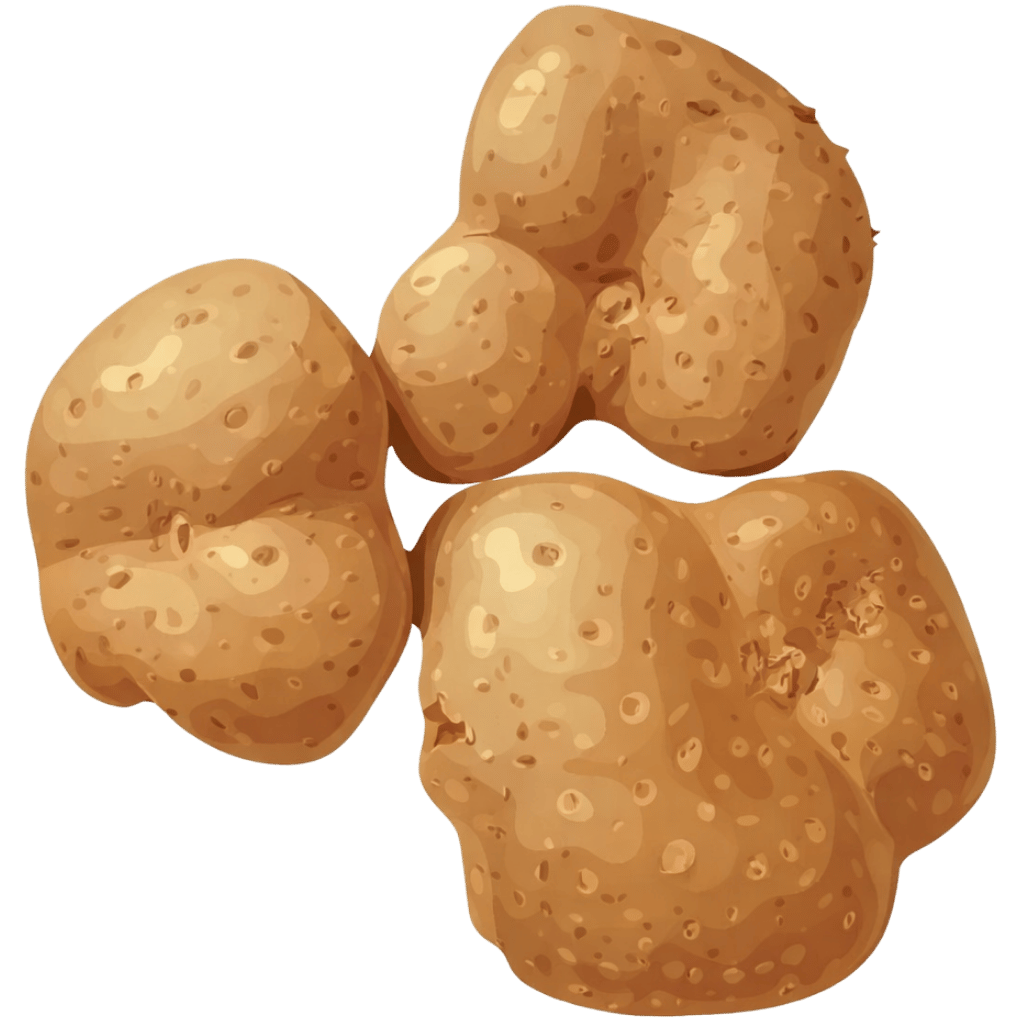
Air potato
Dioscorea bulbiferaBotanical View
- Leaves are alternate, simple, broadly ovate to cordate (heart-shaped) with an acuminate (tapering, pointed) apex and entire margins, glabrous (hairless) on both surfaces. Blade size is variable, commonly 5-25 cm long and wide, reported up to about 32 x 32 cm; 9-13 primary veins radiate from the leaf base in a conspicuous, ladder-like (reticulate) pattern that gives the leaf a quilted appearance. Petioles are nearly as long as the blade, with a clasping, sometimes winged base.
- Stems are slender, terete to slightly angled in cross-section, unarmed (no spines, no hairs), and twine counter-clockwise (to the left) around supports as they climb into tree canopies or over other vegetation. Growth can be rapid, with reports of vigorous vines extending several centimeters to a few tens of centimeters per day and reaching lengths of several meters up to about 20 m within a growing season in naturalized stands. The vine dies back seasonally and regrows from the underground tuber and surviving bulbils.
- The underground organ is typically a solitary, large tuber, globose to pear-shaped (pyriform), usually densely covered with short, rough feeder roots. In addition, and characteristic of the species, aerial tubers (bulbils) form at the leaf axils along the stem; these are rounded to flattened, commonly a few centimeters across (reports of up to roughly 15 cm/several inches in vigorous naturalized vines), grey-brown to tan in color, with a smooth or warty skin, and pale yellow flesh sometimes tinged with violet.
- Flowers are unisexual and borne in axillary spikes or spike-like panicles, with male and female flowers on separate plants. Male (staminate) inflorescences are the longer of the two, reported up to about 1 m, bearing up to roughly 100 small flowers; female (pistillate) inflorescences are shorter simple spikes (roughly 10-40 cm), bearing up to about 40-50 tiny flowers.
- The species is dioecious, with separate male and female individuals required for sexual reproduction. In several introduced/naturalized populations (e.g., in Florida), only female plants are known to occur, so flowering rarely leads to seed set there and spread occurs almost entirely through vegetative propagules (bulbils and tuber fragments).
- Pollination has been documented as occurring both by wind, in situations where male and female plants grow intermixed, and by small insects; thrips (Thysanoptera) have been reported as pollen vectors within the genus Dioscorea, with other small insects (e.g., beetles, flies, bees) also recorded visiting Dioscorea flowers. Because many naturalized stands of D. bulbifera flower rarely or lack one sex, direct pollinator observations for this species specifically remain limited.
- Grows best in fertile, well-drained soil rich in organic matter, preferably loamy; it does not tolerate waterlogged conditions. In the wild it is frequently found near moist sites such as pond and marsh margins, drainage canals, and floodplains, but the tuber itself requires adequately drained soil.
- Em ensaios de referência da Embrapa Semiárido (Petrolina-PE), a adubação de plantio consistiu de 10 m³/ha de esterco caprino associados a 400 kg/ha da fórmula NPK 06-24-12 (equivalente a cerca de 3 L de esterco e 120 g da fórmula por cova, metade incorporada na cova e o restante distribuído no sulco), com adubação de cobertura via fertirrigação de 250 kg/ha de sulfato de amônio, parcelada em três aplicações iguais (aos 45, 80 e 120 dias após o plantio). A irrigação foi feita por gotejamento (fitas com emissores a cada 20 cm, vazão de 1,3 L/hora), com lâmina inicial de cerca de 25 mm logo após o plantio e, nos períodos secos, de duas a três irrigações semanais de 5 a 10 mm, conforme o estádio de desenvolvimento da planta.
- Propagated vegetatively, chiefly by planting aerial bulbils or sections/whole pieces of the underground tuber. Aerial bulbils are particularly valued as planting material because, unlike underground tubers, they are largely free of soil-borne pests and pathogens (such as nematodes). Because flowering is inconsistent and, in many populations, only one sex is present, vegetative (clonal) propagation is the predominant means of increase and spread.
- Where sexual reproduction does occur, the fruit is a three-chambered (trilocular) capsule (roughly up to 2-2.5 cm) containing seeds with a wing along one side. However, seed set is uncommon in much of the species' range because populations are often single-sex or flower irregularly, so most standing genetic variation among cultivated/naturalized material arises from somatic variation carried through clonal propagation rather than from sexual recombination. Molecular studies using DArT-seq SNP markers on nearly 100 accessions found moderate genetic diversity structured into distinct clusters, consistent with independent domestication events followed by long-term vegetative propagation by growers.
- D. bulbifera has not been developed into widely recognized, named commercial cultivars to the extent of major yam crops such as D. rotundata or D. alata, and formal breeding investment in the species has historically been minimal. Broad regional landrace groupings are recognized: Asian-derived accessions/bulbils tend to be less angular, more spherical, and lower in toxicity, while African-derived landraces tend to be more angular and more toxic, consistent with separate domestication lineages. Recent genomic characterization (DArT-seq genotyping, including Brazilian farmer-maintained germplasm) has grouped accessions into distinct genetic clusters intended as a foundation for future crop-improvement work, but no widely released named cultivars were identified in the consulted sources.
- The species was domesticated independently in tropical/Island Southeast Asia and New Guinea and in Africa for its starchy tubers (both underground and aerial), paralleling the independent domestication histories documented for other yam species. It has long been used as food and, among some groups such as the Tiwi people of northern Australia (in the ceremonial "kulama" preparation), for ceremonial purposes requiring detoxifying processing. Formal crop-improvement/breeding programs have historically prioritized D. rotundata and D. alata; only recent studies (DArT-seq SNP genotyping of roughly 94 accessions) have begun to characterize D. bulbifera's genetic diversity and population structure, identifying about three main genetic clusters consistent with distinct domestication origins and subsequent long-term clonal propagation by farmers, laying groundwork for future breeding efforts.