Back to Fruitpedia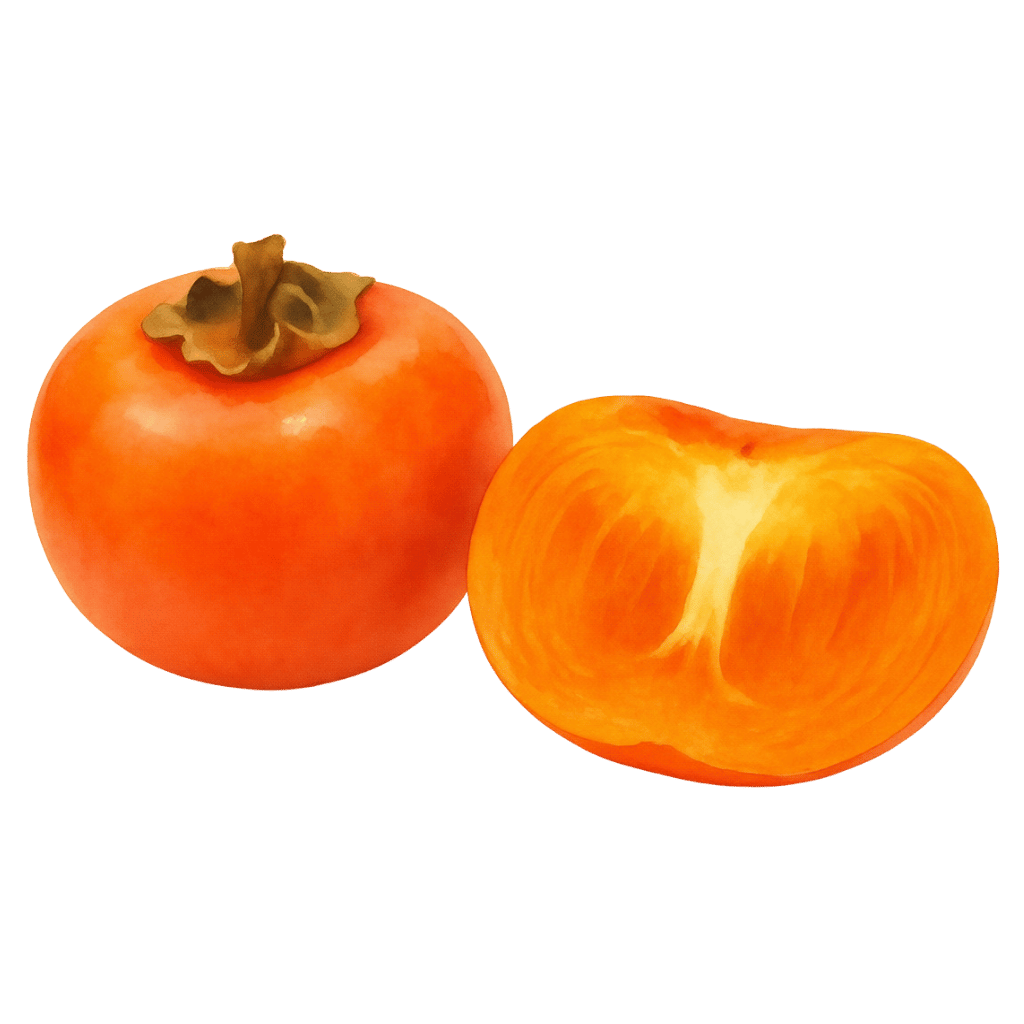
Persimmon
Diospyros kakiVarieties
Fuyu
14–18° BrixJiro
16–22° BrixRama Forte
19.8–21.6° BrixGiombo
19.9–20.6° BrixTaubaté
Hachiya
21–23.2° BrixBotanical View
- Leaves are simple, alternate, deciduous, obovate to elliptic-ovate in shape, about 7-15 cm long and up to 10 cm wide, with entire to slightly serrate margins and a glabrous (hairless) surface. New foliage emerges yellow-green and matures to a glossy dark green; in autumn the leaves turn yellow-orange to red before falling, providing ornamental seasonal interest.
- The trunk is often crooked or willowy, supporting a fairly open, round-topped canopy that rarely exceeds about 4.5-6 m in spread on unpruned trees. Bark is brownish-gray, deeply fissured, and breaks into small rectangular to square plates, a useful field identification trait. Young twigs are gray and may be smooth or finely pubescent, with inconspicuous lenticels.
- The root system is coarsely branched, and established trees are difficult to transplant; nursery practice is to move young trees balled-and-burlapped or grown in containers rather than bare-root once established. Commercially, trees are grown on seedling rootstocks (D. kaki, D. lotus, or D. virginiana) whose root architecture and vigor strongly influence the scion's drought tolerance, cold-hardiness, and orchard longevity.
- Flowers are small, bell-shaped (urceolate), 4-5 lobed, and inconspicuous, appearing after spring leaf emergence. Female flowers are cream-white, solitary, borne singly in leaf axils, and have a large, persistent, leafy calyx (which enlarges and remains attached at the fruit's base) with non-functional (aborted) stamens. Male flowers are smaller, pinkish, and borne in cymose clusters of three (occasionally more), with fertile stamens and a vestigial, non-functional ovary. Most commercial cultivars produce only female flowers, though a minority (e.g., 'Pomelo', and 'Mikado' late in its flowering period) can produce functional male flowers with viable pollen (>85-98% viability recorded).
- Diospyros kaki is fundamentally dioecious, but cultivated persimmon shows a genetically flexible sexual system: many clones/cultivars bear only female flowers, some can produce male or even hermaphrodite (perfect) flowers, and sex expression can vary between seasons and within a cultivar. Molecular work has linked the transition toward monoecy/andromonoecy to a sex-determining pseudogene (OGI) and its target (MeGI), whose methylation state governs male versus female flower development in hexaploid persimmon. Parthenocarpy is widespread: many cultivars (particularly PCNA types like 'Fuyu') set seedless fruit without pollination, while others produce more, and more heavily seeded, fruit when pollinated - pollination also drives astringency loss in "pollination-variant" cultivar types (PVA/PVNA).
- Because most orchard trees bear only female flowers, natural pollen sources are limited and many commercial plantings rely on parthenocarpic fruit set rather than pollination. Where pollination does occur, studies in Japanese orchards identified the bumblebee Bombus ardens ardens as the most effective floral visitor/pollinator of Oriental persimmon, with the honeybee Apis mellifera also visiting flowers and used commercially (hives introduced during bloom) for cultivars that benefit from pollination, though its effectiveness relative to bumblebees varies by region and is not observed in some areas.
- The tree tolerates a range of soil textures (sandy, loamy, or clay) but performs best in deep, fertile, well-drained soils, ideally an upland sandy loam with a friable clay subsoil; recommended soil pH is neutral to slightly acidic, around 6.0-7.0. Persimmon is notably sensitive to poor drainage and to soil salinity, and low-lying, frost-prone or waterlogged sites should be avoided.
- University of Florida extension guidance recommends a balanced fertilizer (e.g., 10-10-10 with micronutrients) split across the season - about 50% applied at dormancy (around March), with the remaining 50% split between early summer (June) and early autumn (September) - with total annual rates scaled up with tree age; heavy applications of quick-release nitrogen are avoided because they increase fruit drop. Newly planted trees need frequent irrigation (roughly 2-4 times weekly) until established; mature trees tolerate short drought but produce larger, better-quality fruit with regular moisture, while overwatering during bloom is avoided because it increases flower/fruit shedding. In Brazil's irrigated semi-arid Vale do São Francisco, EMBRAPA has trialed persimmon under irrigation as an alternative crop, evaluating cultivar adaptation, phenology, and pest/disease behavior under those conditions.
- Commercial cultivars are propagated clonally, almost always by grafting or budding (chip budding is considered the easiest method) onto seedling rootstocks of D. kaki, D. lotus, or D. virginiana, since cuttings of these species root poorly. D. virginiana rootstock confers greater cold-hardiness (used widely in the Americas) but can show graft-related decline over time; D. lotus is the traditional rootstock in Asia. Dwarfing rootstock selections (e.g., 'SH11', 'MKR1', 'FDR-1') have been developed to improve yield efficiency and tree size control. In vitro (micropropagation) methods exist but are limited by poor rooting of ex novo microcuttings and high transplant sensitivity.
- Because Diospyros kaki is a highly heterozygous hexaploid (2n=6x=90), seedling (seed-grown) trees are not true to type and show marked variability in vigor, form, and fruiting behavior compared with the parent cultivar; this is well documented for D. virginiana seedling rootstocks, which are notably non-uniform in both vegetative and reproductive growth. For this reason seed propagation is used mainly to raise rootstock seedlings (subsequently grafted with a known scion cultivar) rather than to reproduce fruiting cultivars directly.
- Cultivars are classified by their astringency-loss behavior into four types: PCA (pollination-constant astringent, e.g. 'Hachiya', 'Tanenashi'), PCNA (pollination-constant non-astringent, e.g. 'Fuyu', 'Jiro', 'Suruga', 'Gosho'), and the pollination-variant types PVA and PVNA, whose astringency depends on the presence of seeds/pollination. This classification and much of the underlying cultivar development originated from Japanese breeding programs built on germplasm from China. Cultivars important in Brazilian production include 'Rama Forte', 'Fuyu', 'Taubaté', 'Giombo', 'Pomelo', 'Mikado', 'Regina', 'Kaoru', 'Costata', and 'Okira'; cold-hardy selections used in temperate regions include 'Atome', 'Benigaki', 'Delicious', 'Eureka', 'Great Wall', and 'Okame'. 'Gailey', a male-flowering cultivar, is planted specifically as a pollinizer in orchards that benefit from pollination.
- Diospyros kaki originated in southern China, where it was cultivated for over two millennia; domestication is associated with the Qin and Han dynasties (from roughly the 3rd century BCE), with large-scale cultivation developing during the Tang and Song dynasties along the middle and lower Yellow River. The species spread to Japan by the Nara period (710-794 CE), where it became deeply integrated into agriculture and culture, and to Korea by medieval times. Extensive cultivar selection in Japan, building on Chinese germplasm, produced the major astringency-based cultivar groups (PCA, PCNA, PVA, PVNA) still used to classify persimmon cultivars today, including widely grown selections such as 'Hachiya' (PCA) and 'Fuyu' and 'Jiro' (PCNA). Contemporary breeding work continues on non-astringent types, dwarfing/disease-tolerant rootstocks, and interspecific hybrids with D. virginiana for improved cold- and salt-stress tolerance.