Back to Fruitpedia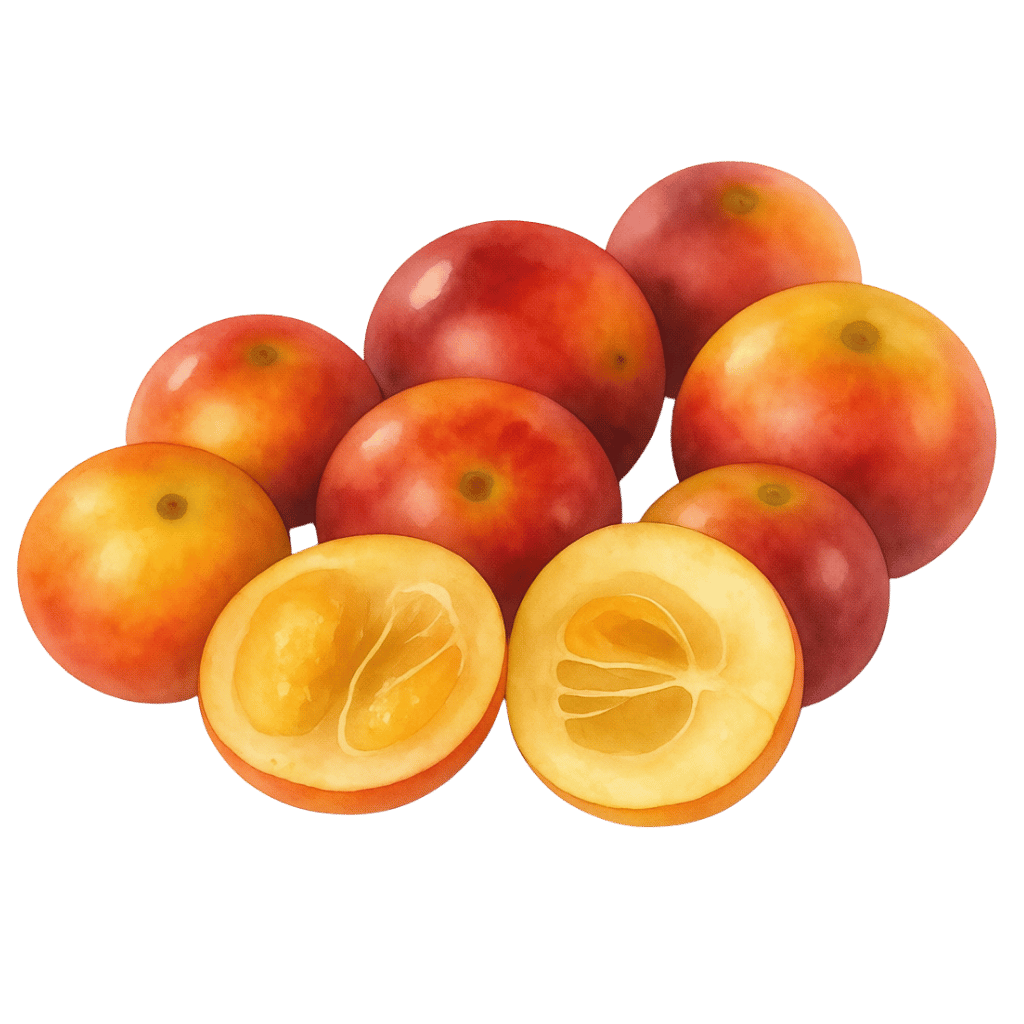
Camu-camu
Myrciaria dubiaVarieties
INIA 395 – Vitahuayo
Botanical View
- Leaves are simple, opposite, evergreen, and petiolate, with a lanceolate to elliptic blade; reported dimensions vary somewhat by population/region — roughly 6–11 cm long by 3–4 cm wide in Brazilian material (EMBRAPA) versus 3–12 cm long by 1.5–4.5 cm wide in Peruvian material (Castro et al.). The apex is pointed (acuminate) and the base rounded, often asymmetric; margins are entire; venation is faint, more visible on the abaxial (lower) leaf-base surface, with 18–20 pairs of lateral veins branching from the midrib. The petiole is cylindrical, 3–9 mm long and 1–2 mm in diameter. Source: EMBRAPA (2012); Castro, Maddox & Imán (2018); World Agroforestry Centre, Agroforestree Database 4.0.
- The trunk and branches are glabrous, cylindrical, and smooth, with light brown to reddish bark that peels/exfoliates naturally, especially during dry periods. Basal trunk diameter reaches about 14 cm. From the base, the plant branches into several secondary stems, which in turn branch into an open, vessel-like (cup-shaped) crown; commercial selection favors the conical (basal-branching) growth habit for higher fruit-bearing surface. Source: EMBRAPA (2012); Castro, Maddox & Imán (2018); World Agroforestry Centre, Agroforestree Database 4.0.
- The shrub is deeply rooted, with numerous fine absorbing (feeder) roots. In nursery propagation, seedlings develop a primary root that must be trimmed with pruning shears or a sharp knife once it reaches the length of the growing bag, to fit the root system to the container before field or graft-ready transplanting. In its natural riverbank/floodplain habitat the species tolerates 3–9 months of soil inundation per year and, like other Amazonian floodplain trees, is associated with adaptations to prolonged waterlogging (adventitious roots, aerenchyma formation, and hypertrophied lenticels) that allow root function under submergence. Source: EMBRAPA (2012); peer-reviewed literature on Amazonian floodplain tree root physiology (PMC/NCBI).
- Inflorescences are axillary, borne in two pairs along short racemes, with persistent rounded, ciliate bracts and bracteoles. Flowers are subsessile, arranged 1–12 (most commonly 4) per node, hermaphroditic, with an inferior ovary. The calyx is globular to sub-globular, about 2 mm long and wide, with 4 ovoid, non-persistent sepal lobes, glabrous. The corolla has 4 white, waxy, concave, glandular-ciliate petals, 3–4 mm long, alternating with the sepals and giving off a sweet fragrance. The androecium averages about 126.7 stamens (6–10 mm long, anthers 0.5–0.7 mm), and the single style is 8.6–11.6 mm long. Source: EMBRAPA (2012); Castro, Maddox & Imán (2018).
- Flowers are hermaphroditic and polyandrous. Reproduction is predominantly allogamous (outcrossing): the species shows marked protogyny, with the stigma emerging before the anthers during anthesis, which limits self-pollination (autogamy) within the same flower. However, geitonogamy — pollen transfer between different flowers of the same plant — occurs at a high rate, so full self-incompatibility is not achieved (described as facultative allogamy). Only an estimated 46% of flowers are successfully pollinated, and about 15% of set fruit abort before ripening. Source: EMBRAPA (2012), citing Maués & Couturier (2002); Castro, Maddox & Imán (2018).
- Anthesis occurs in the morning (roughly 5:00–7:00 a.m.), with flowers remaining receptive for about 4–5 hours; they produce nectar and a sweet aroma that attracts pollinators. Pollination is carried out mainly by bees, with a minor contribution from wind. In the Ucayali river basin (Peru), the stingless bees Melipona fuscopilosa and Trigona (Nannotrigona/Trigona) species have been identified as the main pollinators; reproductive-biology studies conducted in Brazil (Pará) likewise identified stingless bees (Meliponinae) as the principal flower visitors and legitimate pollinators of camu-camu. Source: EMBRAPA (2012), citing Maués & Couturier (2002); Castro, Maddox & Imán (2018).
- In its natural habitat, camu-camu grows on the margins of rivers and lakes, generally blackwater courses, in nutrient-rich, near-neutral-pH soils that remain flooded for 3–9 months of the year; the species develops well both under permanently drained conditions and under periodic inundation. Across its natural range, soil texture varies from clayey to sandy, with pH 4–5.6 and aluminum saturation from 0% to 38%; available phosphorus is typically low and potassium medium to high. More broadly, the species tolerates well-drained loamy oxisols and clay-rich floodplain soils as well as nutrient-poor sandy soils of blackwater rivers, and can thrive in acidic, low-fertility, and poorly drained soils. World Agroforestry Centre data favor soft, alluvial, clay-silt-textured soils of pH 5–6 in seasonally flooded areas. Source: EMBRAPA (2012); Castro, Maddox & Imán (2018); World Agroforestry Centre, Agroforestree Database 4.0.
- For upland (terra-firme) cultivation — a departure from the species' native flooded habitat — camu-camu is quite nutrient-demanding during growth. EMBRAPA recommends, where soil analysis is unavailable: at planting, mixing the topsoil in each pit with 1 kg dolomitic limestone, 5 L manure, and 200 g triple superphosphate (or an equivalent phosphorus source); 30–40 days after planting, applying 50 g urea and 30 g potassium chloride around each seedling, repeated every 3 months through the first year. From the second year on, annual maintenance fertilization (ideally guided by soil and leaf analysis) totals about 80 kg/ha nitrogen, 60 kg/ha phosphorus, and 80 kg/ha potassium, applied twice yearly (start and end of the rainy season): phosphorus applied once in open furrows within the canopy radius, nitrogen and potassium split into two topdressed applications. Because upland cultivation removes the natural riverine nutrient/water replenishment the species relies on in the wild, irrigation research remains comparatively limited; excessive fruit drop has been observed in drier months, and fertirrigation trials (e.g., potassium fertirrigation studies at Embrapa Roraima) are ongoing to refine water-and-nutrient management for upland orchards. Source: EMBRAPA (2012); Embrapa research news/publications on terra-firme camu-camu management.
- Camu-camu can be propagated both sexually (seed) and asexually (stem cuttings and grafting). Seed propagation is the easiest method and is widely used by growers because the species has a short juvenile phase (fruiting 2–3 years after planting); mother-plant selection for seed should prioritize productivity, cup-shaped (conical) architecture, and, where known, fruit ascorbic-acid and anthocyanin content. However, seed propagation is not recommended for commercial orchards because genetic segregation causes pronounced variation among seedling offspring — even from a single mother plant — in both yield and fruit quality; commercial plantings should instead use vegetative propagation from pre-selected, high-yielding, healthy mother plants. Cleft grafting (garfagem), using camu-camu itself as rootstock, is the most recommended vegetative method, achieving a 70–90% graft-take rate, with grafted seedlings ready for field planting 2–3 months after grafting; propagation by rooted stem cuttings is also used, though rooting percentages remain comparatively low. Seeds are recalcitrant (lose viability quickly on drying) and should ideally be sown immediately after extraction; germination is hypogeal, beginning around 27 days after sowing and stabilizing by about 97 days, ultimately exceeding 90%. Sowing substrate is typically 60% soil + 20% manure + 20% sawdust or ground coconut fiber (or 60% soil + 40% poultry litter). Source: EMBRAPA (2012); World Agroforestry Centre, Agroforestree Database 4.0 (germplasm/seed handling).
- Fruits contain 1–4 seeds, most commonly 2. Seeds are reniform (kidney-shaped) to ellipsoid and bilaterally flattened, exalbuminous (reserves stored in the cotyledons), with a thin brown seed coat covered in short, spiny-celled fibers/villi. Reported average dimensions differ somewhat between sources: EMBRAPA (Brazilian material) reports average seed weight ~0.78 g, length ~15.0 mm, width ~11.6 mm; Castro, Maddox & Imán (Peruvian material) report average fresh seed weight 440 ± 170 mg, length 13.5 ± 1.6 mm, width 4.8 ± 0.6 mm. Seed count per kilogram ranges from 1,800 to 2,300 depending on moisture content (40–57%). Because the species is predominantly outcrossing, seed-grown offspring show substantial variability in fruit size, yield, and vitamin C content relative to the mother plant — the main reason seed propagation is discouraged for commercial orchards in favor of vegetatively propagated (grafted) material. Source: EMBRAPA (2012); Castro, Maddox & Imán (2018).
- No internationally released, formally named commercial cultivars of camu-camu yet exist; the species remains at an early stage of domestication, with the large majority of cultivated area (an estimated 94% in Peru's Loreto region) still planted with unselected seed collected from wild populations. Peru's National Institute of Agrarian Innovation (INIA) has run a genetic-improvement program over roughly a decade that produced two improved seed populations, MD-014-INIA and MD-015-INIA, selected for fruit production exceeding 15 t/ha/year and high vitamin C content (over 2.0 g ascorbic acid per 100 g pulp); INIA also maintains an ex situ germplasm bank established in 1988 at San Roque-Iquitos, holding 43 wild accessions representing 8 major Loreto river basins, from which an elite selected mother plant designated "INIA-17" has reached yields up to 79.8 kg/plant/year. In Brazil, Embrapa Amazônia Oriental began its own genetic-improvement program in 2008, screening genotypes for fruit yield within its Active Germplasm Bank (Banco Ativo de Germoplasma, BAG); the best-performing plants have been cloned and are under evaluation on upland (terra-firme) sites, but no clone has yet been formally released as a recommended variety. Source: Castro, Maddox & Imán (2018); EMBRAPA (2012).
- Camu-camu domestication remains at an early stage. Historically, essentially all commercial supply came from wild-harvested fruit gathered by canoe from flooded riverbank populations in Peru's Loreto region (the world's largest producer/exporter), with harvest volumes and export tonnage fluctuating sharply year to year through the 1990s. In 1996 Peru launched the National Camu-Camu Program (Programa Nacional de Camu Camu) to promote domestication and reforestation with the crop, but many resulting plantations underperformed because implementation was rushed and promised technical support for site preparation was rarely delivered. Peru's National Institute of Agrarian Innovation (INIA) has maintained an ex situ germplasm collection since 1988 at San Roque, Iquitos — now 43 accessions from 8 major Loreto river basins — and ran a decade-long genetic-improvement program (mass selection from this germplasm) that produced the improved seed populations MD-014-INIA and MD-015-INIA. In Brazil, Embrapa Amazônia Oriental began its own genetic-improvement effort in 2008, screening its Active Germplasm Bank for high-yielding genotypes and cloning the best performers for evaluation under upland (terra-firme) conditions, since the crop is being adapted away from its native flooded habitat. As of the most recent literature reviewed, most growers worldwide still plant unselected, wild-origin seedlings or rely on simple on-farm mass selection, and no internationally released commercial cultivar exists. Source: Castro, Maddox & Imán (2018); EMBRAPA (2012).