Back to Fruitpedia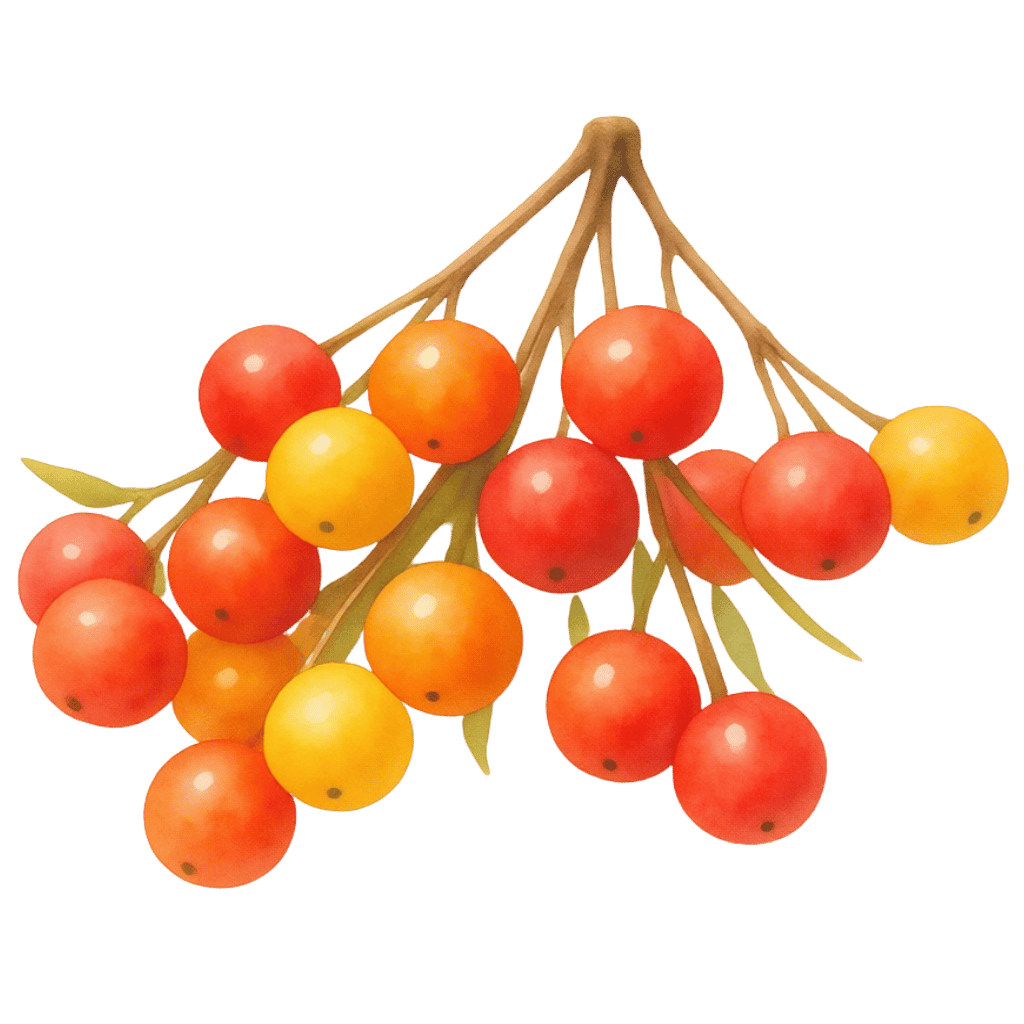
Cambui
Myrciaria tenellaBotanical View
- Leaves are simple, opposite, short-petiolate (petiole about 0.2 cm), with a small elliptic blade roughly 1–3 cm long by 0.5–0.7 cm wide (up to about 10–30 mm in some populations); the lamina is cartaceous to coriaceous and glabrous, with an acute-to-rounded apex, cuneate base, and slightly revolute margins. Secondary veins (about 13–17 pairs) and the marginal vein are inconspicuous on both faces, with no intramarginal vein present (Mazine et al., "Flora do estado do Rio de Janeiro: Myrciaria, Neomitranthes e Siphoneugena (Myrtaceae)," Rodriguésia, Instituto de Pesquisas Jardim Botânico do Rio de Janeiro; corroborated by Kew Plants of the World Online, Myrciaria tenella (DC.) O.Berg).
- The species is a densely branched shrub or small tree; a Rio de Janeiro population was recorded as a shrub about 1 m tall with rugose, glabrous branches (Mazine et al., "Flora do estado do Rio de Janeiro: Myrciaria, Neomitranthes e Siphoneugena (Myrtaceae)," Rodriguésia, Instituto de Pesquisas Jardim Botânico do Rio de Janeiro), while across its broader range it is described as reaching 1–6 m with a short, sometimes crooked trunk (Lorenzi, "Árvores Brasileiras," Instituto Plantarum).
- No source-specific description of the root system of Myrciaria tenella (architecture, depth, or rhizosphere associations) was found in EMBRAPA, university or published floristic literature reviewed.
- Inflorescences are glomerate (clustered glomerules) rather than elongate racemes, with four bracts and two free, deciduous bracteoles per flower cluster; flowers are sessile (no pedicel), with a pilose-lobed calyx bearing grey indumentum, a hypanthium about 2 mm long, no gland on the anther connective, and a bilocular ovary with 2 ovules per locule (Mazine et al., "Flora do estado do Rio de Janeiro: Myrciaria, Neomitranthes e Siphoneugena (Myrtaceae)," Rodriguésia, Instituto de Pesquisas Jardim Botânico do Rio de Janeiro; corroborated by Kew Plants of the World Online, Myrciaria tenella (DC.) O.Berg).
- No study specifically documenting the breeding/reproductive system (self-compatibility vs. self-incompatibility, dichogamy) of M. tenella was found. Flowers are structurally hermaphroditic, sessile, and borne in glomerate clusters with a bilocular, 2-ovules-per-locule ovary (Mazine et al., "Flora do estado do Rio de Janeiro: Myrciaria, Neomitranthes e Siphoneugena (Myrtaceae)," Rodriguésia). Fruit typically develop from a single fertilized ovule per locule, since most fruits mature with one seed and occasionally two (Berg, 1857, Flora Brasiliensis; Lorenzi, "Árvores Brasileiras," Instituto Plantarum; both cited in da Silva et al., 2012, Revista Agro@mbiente On-line, UFRR).
- Species-specific pollinator observations for M. tenella were not found, but a peer-reviewed review of pollination in Brazilian Myrtaceae found that bees are the principal floral visitors of the family, with stingless bees (Meliponinae) and bumblebees (Bombinae, both Apidae) most prominent; in the closely related Myrciaria dubia (camu-camu) and M. cauliflora (jabuticaba), stingless bees such as Nannotrigona, Trigona and Tetragonisca species visit specifically to collect pollen, since Myrciaria flowers offer pollen rather than nectar as the main reward (Proença & Gibbs-style review, "Polinização e dispersão de sementes em Myrtaceae do Brasil," Revista Brasileira de Botânica/SciELO). This genus-level pattern is a reasonable proxy but has not been confirmed directly for M. tenella.
- No dedicated soil-requirement study for M. tenella was found. Its documented habitats span sandy coastal restinga vegetation at low elevation and Dense Ombrophilous Forest in Rio de Janeiro state (Mazine et al., Rodriguésia) as well as altitude regions of Minas Gerais, Bahia and Rio Grande do Sul (Biasoto et al., EMBRAPA Semiárido), implying tolerance of a range of substrates from sandy coastal soils to rockier highland soils, but no explicit pH, drainage or fertility range has been published.
- No EMBRAPA, university or published fertilization/irrigation protocol for cambuí was found; the species is not under field cultivation but is harvested from wild, unmanaged populations, so agronomic fertigation data do not yet exist in the literature reviewed.
- Documented propagation is by seed, using published Brazilian tree/fruit floras (Lorenzi, "Árvores Brasileiras," Instituto Plantarum; Lorenzi et al., "Frutas Brasileiras e Exóticas Cultivadas," Instituto Plantarum) as the underlying references: seeds should be sown as soon as they are removed from ripe fruit, in semi-shaded nursery beds with a porous, organic-matter-rich substrate, since viability declines quickly after extraction; germination rates above 60% are typical, with sprouting beginning within about 30–40 days, and young seedlings develop slowly. No academic study of seed recalcitrance, dormancy class or vegetative propagation (cuttings/grafting) specific to M. tenella was located.
- Fruit and seed biometry of 200 fruits/seeds from eight native trees at EMBRAPA Tabuleiros Costeiros' Reserva do Caju field (Sergipe) showed high natural variability, expected because the species is unmanaged and native: seed diameter ranged 3.81–6.83 mm (mean 5.34–5.40 mm), width 4.54–8.16 mm (mean 6.52 mm), and thickness 3.83–7.39 mm (mean 5.08 mm); fruit diameter ranged 7.51–11.90 mm (mean 9.23 mm) and width 6.60–10.70 mm (mean 8.50 mm). Most fruits contain a single seed, though up to two occur in some fruits; seed coats are uniformly green with dark brown longitudinal stripes regardless of fruit skin color (da Silva, Rabbani, Costa & Clivati, 2012, "Fruit and seed biometry of cambuí (Myrciaria tenella O. Berg)," Revista Agro@mbiente On-line, Universidade Federal de Roraima/EMBRAPA Tabuleiros Costeiros).
- No formally registered or named commercial cultivars exist. Wild populations show naturally occurring fruit-color morphotypes informally studied as "accessions" — purple/violet, red and orange-yellow skinned forms with correspondingly colored pulp — that coexist even on the same tree. EMBRAPA Tabuleiros Costeiros/UFS compared purple, red and orange accessions from a natural population in Pirambú, Sergipe: fruit size and weight did not differ significantly between colors, but the purple accession had significantly higher soluble solids (16.3 °Brix) and vitamin C (170.2 mg/100 g) than the red and orange accessions (da Silva et al., EMBRAPA Tabuleiros Costeiros/Universidade Federal de Sergipe, XI CONNEPI/EMBRAPA publication). High RAPD-based genetic polymorphism in a Sergipe population further indicates broad untapped diversity for future cultivar selection (Pinheiro, Almeida & Silva, 2011, Scientia Plena).
- Cambuí has no formal breeding program or registered cultivars; it is still harvested from wild, unmanaged populations by extractivist communities in Sergipe, Bahia and elsewhere in the Northeast. The first genetic-diversity assessment, using RAPD markers on a natural population in Itaporanga d'Ajuda (Sergipe), found high polymorphism (53.6% with 18 primers), showing that RAPD markers are effective for characterizing this species and providing a basis for future germplasm conservation and selection programs (Pinheiro, Almeida & Silva, 2011, Scientia Plena, EMBRAPA Tabuleiros Costeiros/UFS). EMBRAPA Tabuleiros Costeiros maintains a living collection of native trees at the Reserva do Caju experimental field used for this and related characterization studies (Silva et al., 2012, Revista Agro@mbiente On-line; da Silva et al., EMBRAPA Tabuleiros Costeiros/UFS, physico-chemical characterization of three fruit-color accessions).