Back to Fruitpedia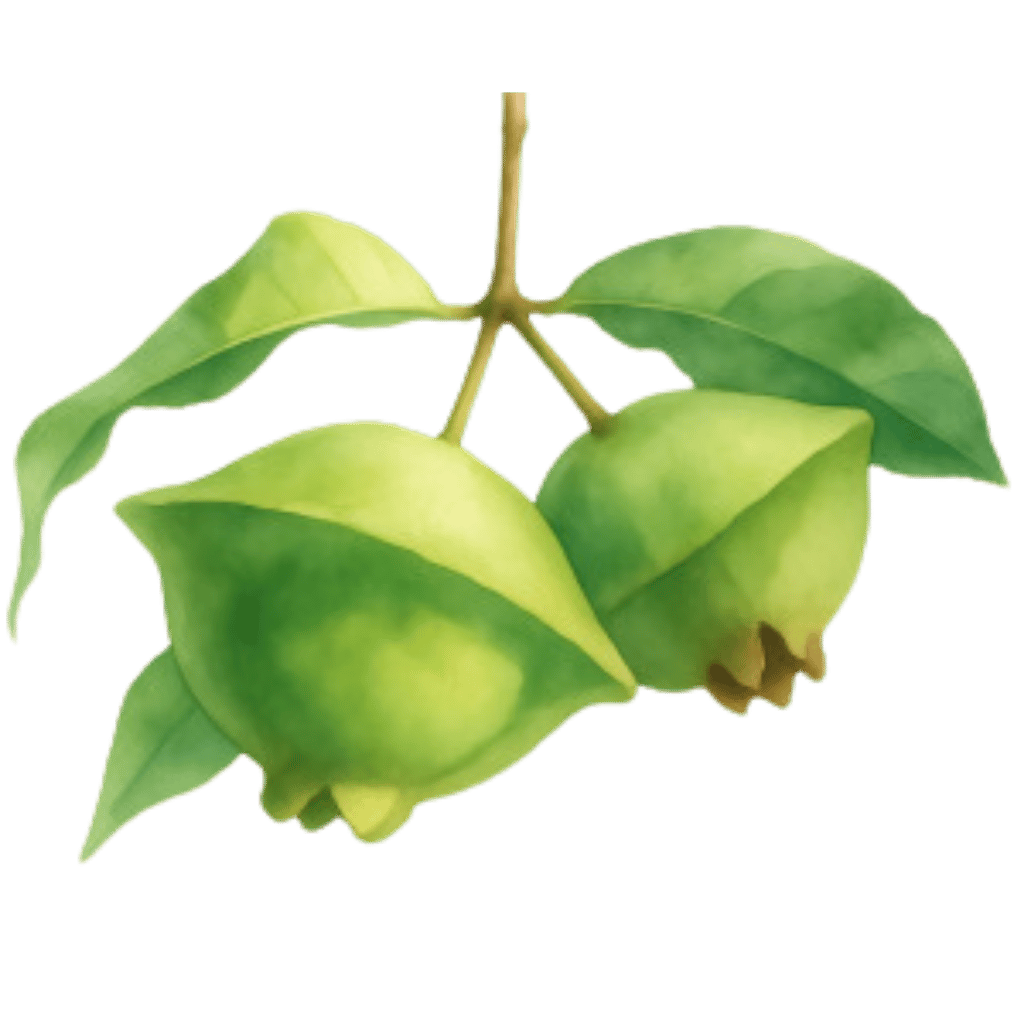
Cambuci
Campomanesia phaeaBotanical View
- Simple, opposite, glabrous, sub-coriaceous leaves, oval to obovate-oblong with a caudate (tail-like acuminate) tip, undulate margins and pinnate venation; blades roughly 6-10 cm long by 3-4 cm wide, on a short petiole of 3-4 mm. New branches and young leaves are pubescent and brownish before maturing to glabrous dark green.
- Short trunk (about 20-30 cm in diameter) with characteristic peeling/flaking (decorticating) bark that comes off in irregular patches, dark gray on the outer surface — a trait shared with other Campomanesia/Myrtaceae. Crown is pyramidal in young to medium-aged trees.
- Detailed root-system studies specific to C. phaea are scarce in the available literature. Cultivation sources note the species is sensitive to waterlogging and requires well-drained soil, and nursery guidance calls for large containers (25-40 L) to avoid restricting root development. Anatomical work on vegetative propagation (air-layering/cuttings) found high concentrations of phenolic compounds in stem tissue, proposed as a factor inhibiting adventitious root formation in cuttings and air-layers.
- Flowers are borne on the twigs (axillary), white, and open at night; anthesis lasts roughly 14 hours, beginning around 04:30 h. Flowers release a sweet floral scent (14 identified volatile compounds, mainly aliphatic and aromatic) that mediates attraction of nocturnal bee visitors (Cordeiro et al. 2017, Plant Biology).
- Flowers are hermaphroditic but self-incompatible, requiring cross-pollination between trees for fruit set; pollen is the only floral reward offered to visitors (no nectar reported) (Cordeiro et al. 2017).
- Effective pollination is carried out almost exclusively by nocturnal and crepuscular bees, described as the first documented scent-mediated nocturnal bee-pollination system for this plant-pollinator pair; recorded visiting bee species include Megalopta sodalis, Megommation insigne, Ptiloglossa latecalcarata and Zikanapis seabrai, with the diurnal Apis mellifera also visiting at lower effectiveness (Cordeiro et al. 2017, Plant Biology; related Embrapa nocturnal-bee pollination research).
- Grows best in deep, humid, well-drained soils with good natural fertility and moderate acidity (reported pH range approximately 5.0-6.6); sandy-loam textures with high organic-matter content are favored.
- Cultivation guidance recommends organic-matter fertilization roughly twice a year. Irrigation is critical during establishment: frequent/near-daily watering (except on rainy days) is recommended through the first year or two, tapering to supplemental irrigation only during dry spells once trees are established, since young cambuci trees tolerate drought poorly.
- Traditionally propagated by seed. Embrapa research (Pesquisa Agropecuária Brasileira) found vermiculite and filter paper were the best germination substrates at 25-30°C, and that seed viability is short-lived unless seeds are dried and stored cold: non-desiccated seeds kept in plastic bags at 8±2°C retained 100% germination after 240 days (83.8% when dried to ~3% moisture), whereas seeds stored at uncontrolled room temperature lost germinability entirely by 240 days. Vegetative propagation is difficult: cutting and air-layering (alporquia) trials produced no rooting, attributed in part to phenolic compounds in the tissue, while side-veneer/cleft grafting achieved only about 6% success but can be used to fix superior genotypes (Santoro, USP/ESALQ thesis; Marinho et al., vegetative propagation study). In vitro micropropagation has been established as an alternative for this endangered species: nodal segments on WPM medium with 3% sucrose, 0.2% Phytagel, 1.0 mg/L BAP at pH 4.5 gave the best shoot formation, though nodal explants show high contamination/oxidation, mitigated by collecting material in colder seasons, adding AgNO3, and subculturing at ~20-day intervals (Plant Cell, Tissue and Organ Culture, 2021).
- A morphological survey of 58 wild-collected accessions (SciELO/Bragantia) found substantial variability in fruit and seed traits: longitudinal fruit diameter 27-47 mm, transverse diameter 38-65 mm, fruit mass about 21-82 g; larger fruits did not necessarily contain more seeds, and thousand-seed weight was a better predictor of fruit mass than seed number, indicating considerable genetic variability among wild populations relevant to future selection/breeding.
- No formally registered/named cultivars were found in the reviewed government or academic literature. The species remains largely semi-wild/undomesticated; growers and collectors informally distinguish larger-fruited types (referred to as "guaçu") from the common form, but these are not formally described cultivars. Ex situ collections of 58 accessions gathered from across the Atlantic Forest/Serra do Mar have been propagated by seed and maintained at a seedling-production nucleus in São Bento do Sapucaí, SP, to support future genetic improvement, and Embrapa/UFLA/INCAPER/EPAMIG researchers have conducted molecular-marker genetic characterization (presented at the 61st Brazilian Congress of Genetics, 2015) to support germplasm banking.
- Cambuci has no history of formal plant breeding or registered cultivar development; it is essentially a wild/semi-domesticated Atlantic Forest species long used by indigenous and traditional communities (the name "cambuci" derives from Tupi-Guarani, referencing its pot-like fruit shape) and noted since early Portuguese colonial accounts. It was once abundant enough in the city of São Paulo to give its name to the traditional Cambuci neighborhood, but populations were severely reduced by exploitation of its wood and by urban/agricultural deforestation, leaving it rare in the wild today. Renewed commercial interest (juices, jellies, ice cream, liqueurs) since the early 2000s has driven ex situ conservation and incipient improvement efforts, including assembly of a 58-accession germplasm collection from across its native range, molecular-marker genetic characterization studies (Embrapa/UFLA/INCAPER/EPAMIG, 2015), and experimental grafting to fix superior genotypes, but no named cultivar has yet resulted from these efforts.