Back to Fruitpedia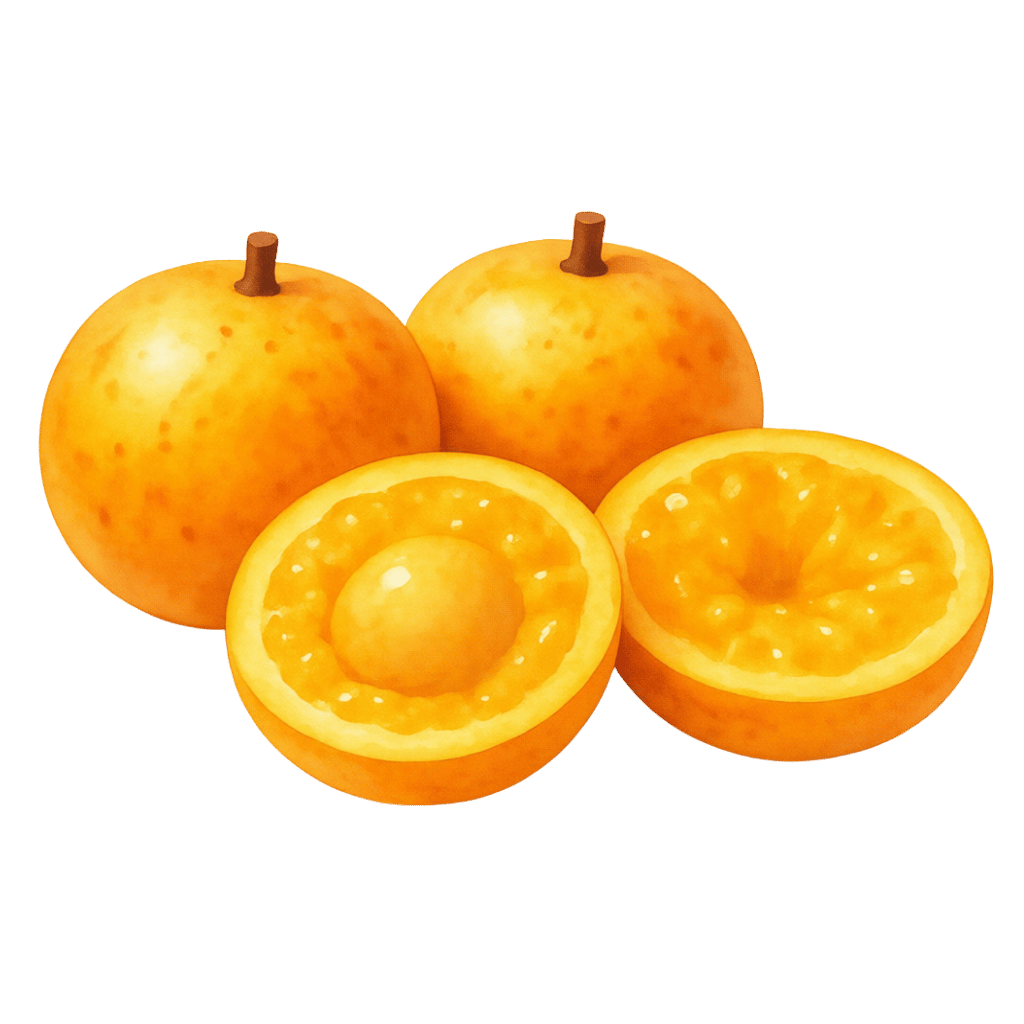
Cambuca
Plinia edulisBotanical View
- Leaves are simple, opposite, lanceolate to oblong-lanceolate, with an entire margin, acute to acuminate apex and cuneate to obtuse base; blades measure about 14-17 cm long by 4-6 cm wide with a 1.5-2.5 cm petiole (Ishikawa et al. 2008, Revista Brasileira de Ciencias Farmaceuticas). Venation is pinnate and brochidodromous, the lateral veins anastomosing 1-3 mm from the margin to form an inframarginal vein. Anatomically the leaf is hypostomatic (stomata confined to the lower/abaxial surface, anomocytic type), with a unilayered epidermis of polygonal cells, dorsiventral mesophyll, non-glandular lignified trichomes on both faces, and numerous translucent secretory (oil) cavities scattered through the lamina — together with circular idioblasts (2-4 per field) containing druses or prismatic crystals, typical of Myrtaceae foliage.
- The trunk is short relative to the crown, 25-40 cm in diameter, with thin, smooth, pale brownish-gray bark that peels to expose a coppery/orange-toned inner bark layer beneath (Useful Tropical Plants; colecionandofrutas.com.br). The petiole in cross-section is plano-convex, with a broad, crescent-shaped vascular bundle whose adaxial ends are deeply incurved, and prismatic crystals/druses are prominent in the cortical and medullary tissue (Ishikawa et al. 2008).
- Flowers are cauliflorous, borne directly on the trunk and older branches (as in the related jaboticabas), arising solitary or in small fascicles of about 2-8 flowers at nodes along the stem. Individual flowers are white, roughly 1.2 cm in diameter, with 5 fused sepals, 5 free petals, and a conspicuous cluster of numerous free stamens surrounding a single pistil (CNCFlora; colecionandofrutas.com.br; Useful Tropical Plants).
- Flowers are hermaphroditic (perfect/bisexual), the typical condition in Myrtaceae. No species-specific self-compatibility trial for P. edulis was located in the consulted literature. In the closely related "jaboticaba" congeners, breeding system is variable and morphology-dependent: Plinia trunciflora and P. jaboticaba are self-compatible, whereas P. cauliflora depends on pollinating insects because of greater stigma-anther separation (SciELO, Revista Brasileira de Fruticultura, pollen-viability/reproduction study). Whether P. edulis behaves like the self-compatible or the cross-pollination-dependent congeners has not been directly tested and remains unconfirmed.
- Bees are the reported floral visitors, consistent with the generalized bee-pollination syndrome documented for Myrtaceae in Brazil; the cauliflorous flowers are noted as a nectar and pollen source for both the introduced honeybee (Apis mellifera) and native stingless bees (Meliponini). Species-specific pollinator observation studies for P. edulis were not found; this reflects horticultural/apicultural reporting rather than a controlled pollination study.
- Prefers deep, fertile, humus-rich soil that is moist but well-drained, with a mildly acid to neutral reaction (roughly pH 5.0-6.5); tolerates both sandy and clay-loam textures. Grows best with some shade, particularly while young (PFAF; Useful Tropical Plants; colecionandofrutas.com.br).
- The species is described as having a high water requirement and a comparatively high need for iron (PFAF; Useful Tropical Plants). No published commercial fertirrigation schedule or fertilizer program specific to P. edulis was found, consistent with its status as a non-commercial, largely wild-harvested or dooryard tree rather than an orchard crop.
- Propagated chiefly from seed. Seeds are recalcitrant with short viability (reported germination-capacity loss within about 20 days of extraction) and so are sown promptly after removal from the fruit, generally directly into individual bags with an organic-clayey substrate; germination takes about 40-120 days. Seedlings are typically ready for field planting roughly 8-10 months after germination. Vegetative propagation (grafting/air-layering) is technically possible but is little used in practice because it is comparatively difficult and because the low density of known seed-bearing "matrix" trees in the wild limits large-scale seedling production; seed propagation, while producing some variability, remains the propagation method favored by growers because it best conserves desirable maternal traits.
- Each fruit generally contains one to two large, purple, recalcitrant seeds. Because the species is propagated almost entirely from seed rather than clonal (grafted) stock, seedling progeny show noticeable variability in vigor, fruit size, and time to first fruiting — informally cited as ranging from about 5 to 20 years depending on the seedling's genetic line and growing conditions — reflecting the absence of genetically uniform, selected planting stock.
- No formally bred or officially registered cultivars are documented for P. edulis. Brazilian growers and rare-fruit collectors informally distinguish two folk variants: "Cambuca Acu," with larger fruit (over 6 cm diameter), cream-colored young bark, and a longer juvenile period before fruiting, and "Cambuca Mirim," with smaller (under 5 cm), sweeter fruit, reddish young bark, and a comparatively shorter juvenile period. These are grower-recognized types rather than scientifically described or registered cultivars (colecionandofrutas.com.br).
- No formal genetic-improvement or breeding program for P. edulis was found in the consulted literature. Cultivated stock derives essentially from wild-collected seed or long-standing dooryard/backyard trees rather than controlled crosses, and germplasm banks are not documented for this species (in contrast to small institutional collections that exist for some jaboticaba congeners). The informally recognized "Acu" and "Mirim" variants arose through grower observation and selection of superior wild or planted individuals rather than deliberate breeding. Recent scientific reviews (e.g., Pazzini et al. 2025, Plant Foods for Human Nutrition) characterize P. edulis as an underexploited, genetically eroding native fruit tree that would benefit from ex situ germplasm conservation and formal breeding attention.