Back to Fruitpedia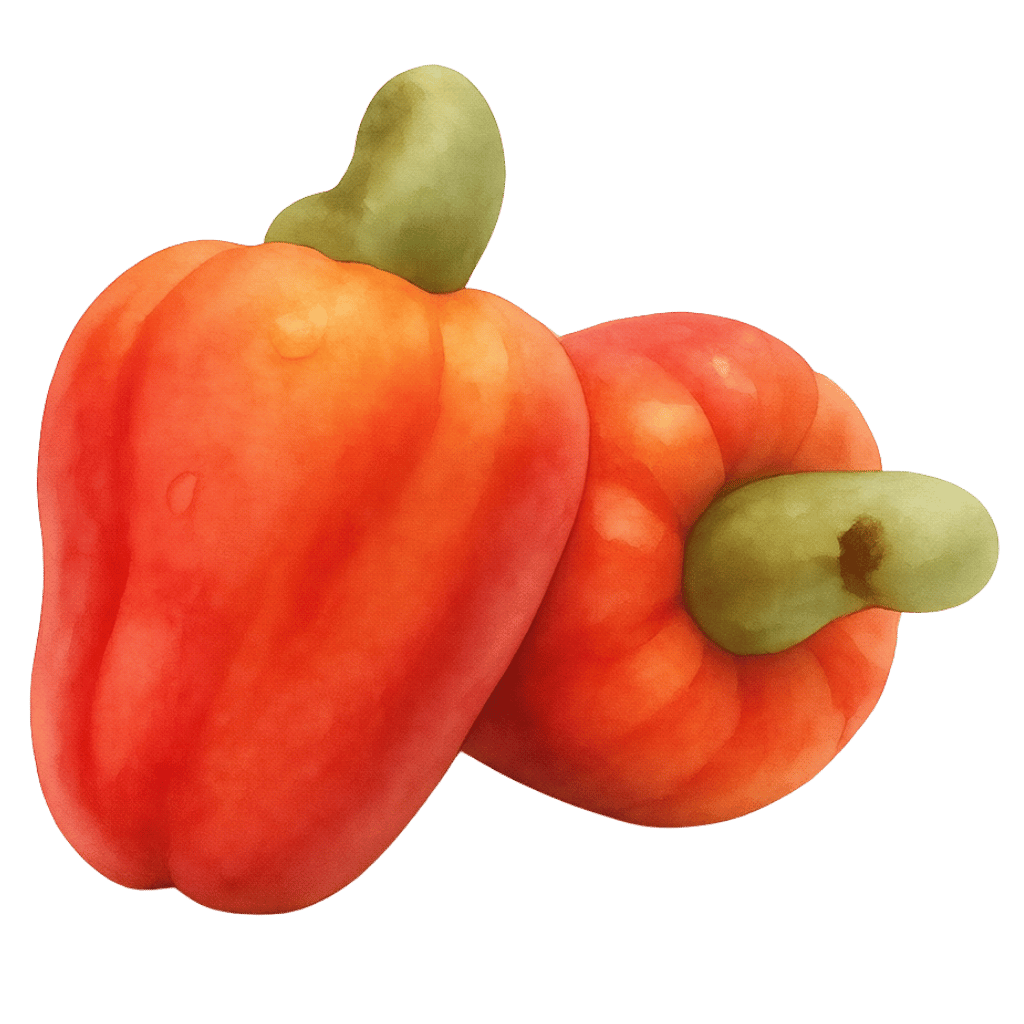
Cashew fruit
Anacardium occidentaleVarieties
CCP 76
10–12.5° BrixCCP 09
10–11.5° BrixBRS 189
11–13.3° BrixBRS 265
11–12.9° BrixBRS 226
Embrapa 51
Botanical View
- Leaves are simple (not compound), entire-margined, alternate, glabrous and subcoriaceous (leathery), borne on a short petiole and often clustered near branch tips. EMBRAPA describes blades of 10-20 cm long by 6-12 cm wide; CABI describes a similar obovate-to-oval shape of 10-20 cm x 5-10 cm. New leaves are pale green to reddish, maturing to dark green. (EMBRAPA Ageitec — Caju, "Folhas"; CABI Compendium, Anacardium occidentale)
- Common-type plants form a stout, often low-branched and twisted trunk, averaging 5-8 m tall (up to ~15 m) with canopy diameters of 12-14 m (up to ~20 m). Early-dwarf clones (e.g., CCP 06, CCP 76, CCP 09, CCP 1001), selected from the 1970s-80s onward, average about 4 m in height with a lower, more uniform canopy of 6-8 m in diameter, and reach commercial bearing much sooner than the common type. (EMBRAPA Ageitec — Caju, "Caule"; EMBRAPA Documentos 82, 2004)
- The root system combines a well-developed taproot that can extend beyond 10 m in depth with a dense lateral root network concentrated between 15 and 32 cm depth; roughly 82% of the roots effective in nutrient absorption occur within the top 30 cm of soil. In adult common-type trees, lateral roots can extend up to 20 m from the trunk. Field studies on the irrigated dwarf clone CCP 09 (10 years old) found an effective rooting depth of about 60 cm under irrigation. (EMBRAPA Ageitec — Caju, "Raízes"; root-system field study, Curu Experimental Field, EMBRAPA Agroindústria Tropical)
- The inflorescence is a terminal panicle, about 15-25 cm long, bearing a variable mixture of male (staminate) and hermaphrodite (bisexual) flowers; the proportion of each flower type varies widely both between plants and between panicles of the same plant. (EMBRAPA Ageitec — Caju, "Inflorescências"; CABI Compendium, Anacardium occidentale)
- Cashew is andromonoecious, producing both staminate (male) and hermaphrodite flowers on the same panicle. Each flower has 5 sepals, 5 petals, and 7-15 stamens (one large, fertile stamen plus 6-14 smaller, largely infertile ones); the ovary is simple but rudimentary/non-functional in staminate flowers. Flower opening follows a protandrous-leaning pattern: stigmas of hermaphrodite flowers are receptive as soon as the flower opens, while anther dehiscence in those same flowers is delayed by roughly 1-5 hours, and staminate flowers on a panicle tend to open before the hermaphrodite ones. The species is self-compatible but strongly favors outcrossing: controlled cross-pollination of emasculated flowers has produced fruit set around 80%, versus roughly 40% for self-pollination. This obligate-outcrossing habit underlies the species' very high heterozygosity. (EMBRAPA Ageitec — Caju, "Flores"; Wunnachit et al., Plant Reproduction, Springer; Falcão et al., Euphytica, Springer)
- Pollination is predominantly entomophilous. Insects, and honeybees (Apis mellifera) in particular, are identified as the major pollinators of cashew in commercial plantations, with wind playing only a minor, secondary role. (Freitas & Paxton, "The role of wind and insects in cashew (Anacardium occidentale) pollination in NE Brazil", Journal of Agricultural Science, Cambridge University Press)
- Embrapa's pedological aptitude criteria (management level "C", high technology) rate the best soils for cashew as deep (effective depth >200 cm), well-drained, gently sloping to flat (<10% declivity), with 15-30% clay content, free of surface rock and with low salinity/sodium content. These conditions correspond broadly to the deep, well-drained sandy-to-sandy-loam soils of the Brazilian coastal tablelands (tabuleiros costeiros) where cashew has traditionally been grown; shallow, poorly drained, saline/sodic, or steeply sloping soils are rated regular-to-unsuited. (EMBRAPA Boletim de Pesquisa 27, 2000, Tables 1, 3 and 4)
- Cashew is markedly responsive to irrigation and to high-input ("nível C") management, including soil correction (liming), fertilization, mechanized soil management and phytosanitary treatment. Under improved dwarf clones, expected nut yield is roughly 1.0 t/ha (plus ~10 t/ha of peduncle) in rainfed (sequeiro) cultivation versus about 3.8 t/ha of nuts (and ~30 t/ha of peduncle) under irrigation; some newer clones under evaluation have exceeded 1.5 t/ha of nuts even in rainfed regimes. Water-storage capacity of 125 mm was adopted as the reference soil water-holding capacity for cashew in regional water-balance modelling. (EMBRAPA Documentos 82, 2004; EMBRAPA Boletim de Pesquisa 27, 2000)
- Historically, cashew orchards throughout Brazil's Northeast were established by direct seeding, which — because of the species' high heterozygosity and obligate out-crossing — produced highly variable, late-bearing, low-yielding "common" stands. Since Embrapa's breeding program began (Campo Experimental de Pacajus, CE, 1956), commercial planting material has shifted to clonal propagation of selected dwarf genotypes, chiefly by grafting (enxertia) of scion wood onto seedling rootstock (e.g., clone CCP 1001 was obtained by grafting the CP 1001 mother plant); seedling rootstocks from clones such as CCP 06 are themselves widely used as graft rootstock. Seeds require scarification of the hard endocarp to germinate reliably. Micropropagation/tissue culture of mature cashew tissue remains difficult, being considered recalcitrant, with problems of phenolic exudation, contamination and poor rooting of microshoots. (EMBRAPA Documentos 82, 2004; EMBRAPA Ageitec — Caju, "Produção de mudas")
- Because cashew is self-compatible but strongly outcrossing, seed-grown populations are highly heterozygous, and seedling progeny show wide variability in vigor, time to first flowering, yield and nut/peduncle quality even from the same mother tree. This variability was historically responsible for the low, uneven productivity of seed-propagated "common" cashew orchards, and is the central reason Embrapa's breeding program moved to selecting elite individual genotypes and multiplying them clonally (by grafting) as registered commercial clones rather than releasing seed lines. (EMBRAPA Documentos 82, 2004)
- Embrapa's breeding program (Pacajus, CE) has released a series of registered dwarf-precocious clones: CCP 06 and CCP 76 (1983), and CCP 09 and CCP 1001 (1987) — all derived from an original 1956 seed introduction from Maranguape, CE, and selected/cloned from individual mother plants (CP 06, CP 76, CP 09, CP 1001). Later poly-cross and hybridization work produced EMBRAPA 50 and EMBRAPA 51 (released 1996, from a CP 06 dwarf x CP 07 common-type cross, recommended for rainfed cashew-nut production), BRS 189 (released 2000, from a CCP 1001 x CCP 76 cross, recommended for irrigated cultivation and the fresh-fruit/peduncle market), and BRS 226 ("Planalto", released 2002, selected from mother plant MAP-42 in Piauí, recommended for the semi-arid region and the almond/nut market). Other registered clones referenced in Embrapa's disease-reaction tables include BRS 253, BRS 265, BRS 274 ("Jacaju"), BRS 275 ("Dão"), and the FAGA 1 and FAGA 11 lines. Full clonal cycle from initial selection to regional commercial recommendation takes a minimum of 7-14 years. (EMBRAPA Documentos 82, 2004; EMBRAPA FFC19001, 2019)
- Embrapa's genetic-improvement program for early-dwarf cashew began in 1956 with the introduction of seed-derived dwarf-type plants (collected in Maranguape, CE) at the Campo Experimental de Pacajus, CE, followed by individual phenotypic selection with annual production control, cloning, and clonal evaluation. This simple but effective methodology produced Brazil's first commercial clones — CCP 06 and CCP 76 (released 1983) and CCP 09 and CCP 1001 (released 1987) — all descended from mother plants in the same original 1956 seed lot. The program's institutional home, the Centro Nacional de Pesquisa de Caju (CNPCa), was created by Embrapa in 1987 and broadened in 1993 into the Centro Nacional de Pesquisa de Agroindústria Tropical (CNPAT/Embrapa Agroindústria Tropical). From the 1990s, more advanced methods — poly-cross, within/between-progeny selection, and inter/intraspecific hybridization — yielded EMBRAPA 50 and EMBRAPA 51 (1996, from a cross between dwarf clone CP 06 and common-type mother plant CP 07), BRS 189 (2000, from a CCP 1001 x CCP 76 cross, aimed at the irrigated fresh-fruit market) and BRS 226/"Planalto" (2002, selected directly from mother plant MAP-42 on a farm in Pio IX, Piauí, for the semi-arid region). Selection targets have progressively emphasized drought tolerance and rainfed nut yields above 1.5 t/ha, low tree stature for manual harvest, peduncle quality (color, flavor, shelf life, tannin content) for the fresh-fruit and juice markets, and disease resistance. The full clonal breeding cycle, from initial selection to regional commercial recommendation, takes a minimum of 7 years for small-scale local release and up to 14 years for large-scale regional release. (EMBRAPA Documentos 82, "Clones de Cajueiro: Obtenção, Características e Perspectivas", Paiva & Barros, 2004)