Back to Fruitpedia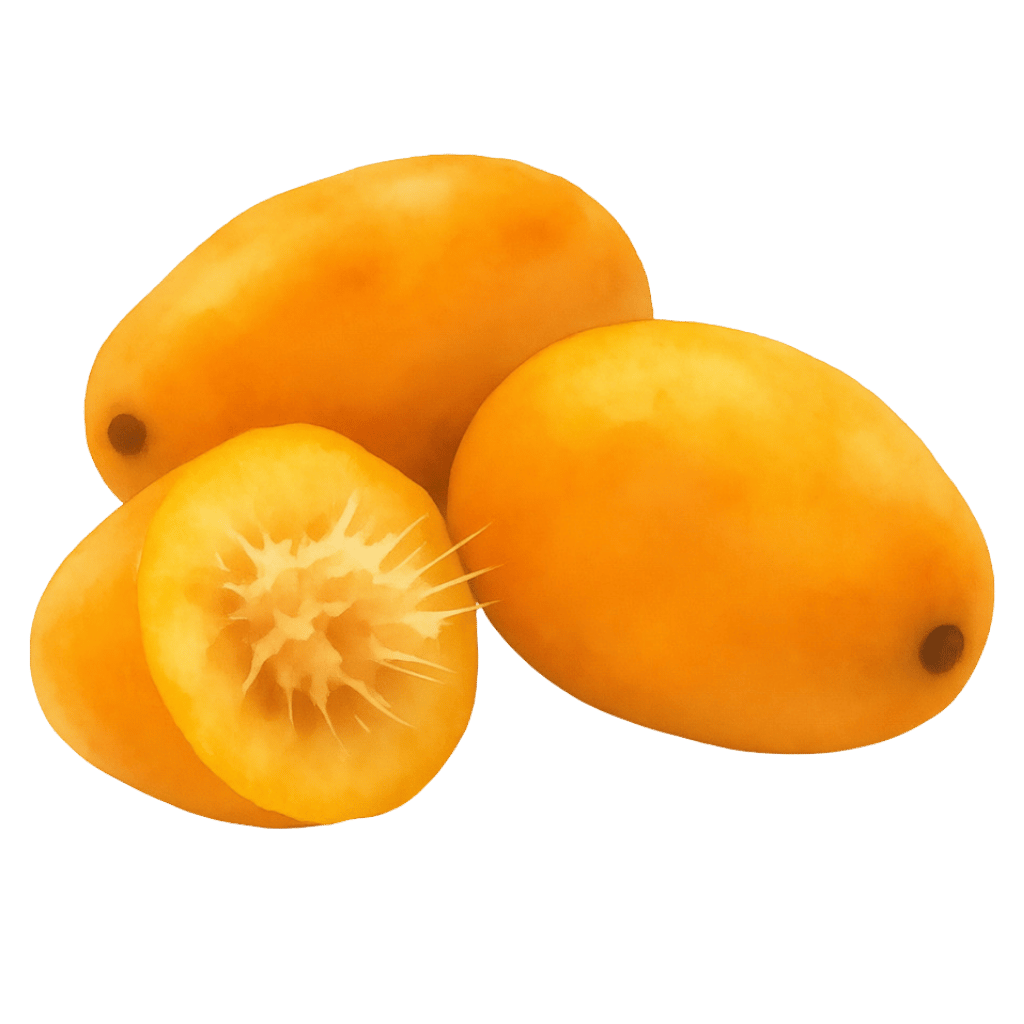
Hog plums
Spondias mombinBotanical View
- Leaves are compound, alternate, imparipinnate, with 5–11 pairs of leaflets, spirally arranged, petiolate, with a short petiolule (about 5 cm). Leaflets are opposite or alternate; the blade is oblong and chartaceous (papery), 5–11 cm long by 2–5 cm wide, with an entire margin, acute apex and an unequal, rounded base, glabrous on both faces. The midrib is slightly raised (prominulous) above and glabrous below, but prominent and hairy (with trichomes) beneath; venation is camptodromous-cladodromous with 16–18 pairs of secondary veins, prominulous on the lower face and prominent on the upper face. The rachis is 20–30 cm long and lacks glands. Leaf drop is concentrated in the dry season (deciduous habit). Source: Carvalho, P.E.R., "Cajá-da-Mata: Spondias mombin," Espécies Arbóreas Brasileiras, vol. 2, Embrapa Florestas.
- The trunk is straight, marked by multiform corky protrusions that from a distance resemble thorns or prickles. Bark reaches up to 50 mm thick: the outer bark is brownish-white to light gray, rough, with spine-like protuberances and lenticels, peeling off in thick plates; the inner bark is light pink, slightly bitter, without a distinct odor, and a small amount of nearly colorless latex accumulates at cut surfaces. Branching in adult trees is spreading and not very dense (even sparser in young trees), forming a roughly spherical crown proportionally similar in size to the trunk, with horizontal to ascending branches; the habit is generally irregular, without defined apical dominance, and the species does not self-prune well (requiring periodic training/pruning in cultivation). Wood is light (density about 0.41–0.51 g/cm³ at 12% moisture; basic density about 0.38 g/cm³), with sapwood not differentiated from heartwood, whitish-yellow in color with conspicuous vessels and rays, medium natural durability and easy workability. Source: Carvalho, P.E.R., "Cajá-da-Mata: Spondias mombin," Espécies Arbóreas Brasileiras, vol. 2, Embrapa Florestas.
- The Embrapa monograph notes that at the extremity of its roots the tree forms a tuber-like storage structure that was historically harvested in Ceará during severe droughts for flour production (per Braga, 1960). The species also regenerates via root suckers ("raízes gemíferas") in addition to stump sprouting. No further root system morphology (depth, architecture) was documented in the consulted sources. Source: Carvalho, P.E.R., "Cajá-da-Mata: Spondias mombin," Espécies Arbóreas Brasileiras, vol. 2, Embrapa Florestas.
- Inflorescences are male and female panicles borne in the axils of new leaves, 15–30 cm long; at fruiting they form pendulous infructescences up to 30 cm long bearing ovoid drupes 3–6 cm long, with a smooth, glabrous, pleasantly scented pericarp, edible yellow acidic pulp, and a fibrous, cork-woody endocarp with five one-seeded locules resembling a hard sponge. Source: Carvalho, P.E.R., "Cajá-da-Mata: Spondias mombin," Espécies Arbóreas Brasileiras, vol. 2, Embrapa Florestas (citing Souza et al. 1997; Pennington & Sarukhán 1998).
- Sources disagree on the precise sexual system. Little & Dixon describe it as polygamous, while Pennington & Sarukhán (1998) describe it as dioecious; Mitchell and Daly (1995) instead describe the flowers as hermaphroditic but protandrous, with pollen released before the ovary matures. Structurally, male flowers are actinomorphic, 6–8 mm in diameter, with cream-green petals; female flowers are 8–9 mm in diameter and similar in appearance but have pollen-less anthers and a well-developed ovary. More recent genetic/reproductive-biology research (SNP-marker study, 2024) characterizes the species as andromonoecious (bearing both staminate and hermaphrodite flowers on the same plant), functionally allogamous with self-incompatibility tendencies, and exhibiting protandrous dichogamy (temporal separation of male and female function) that favors outcrossing. Source: Carvalho, P.E.R., "Cajá-da-Mata: Spondias mombin," Espécies Arbóreas Brasileiras, vol. 2, Embrapa Florestas; "High genetic structure of Spondias mombin in Brazil revealed with SNP markers," Genetics and Molecular Biology/SciELO Brasil.
- Pollination is essentially carried out by bees, notably the European/Africanized honeybee (Apis mellifera); the flowers are melliferous and are also a pollen source for beekeeping. Source: Carvalho, P.E.R., "Cajá-da-Mata: Spondias mombin," Espécies Arbóreas Brasileiras, vol. 2, Embrapa Florestas (citing Silva & Absy 2000; Pott & Pott 1994).
- The Embrapa monograph states only that the species occurs naturally on moist/humid terrain ("terrenos úmidos"); no further detail on soil texture, drainage, pH or fertility preference was found in the consulted sources. Source: Carvalho, P.E.R., "Cajá-da-Mata: Spondias mombin," Espécies Arbóreas Brasileiras, vol. 2, Embrapa Florestas.
- No specific fertilization or irrigation protocol was found in the consulted government/university sources for this species; it is documented as occurring naturally on moist terrain and being heliophilous, but no cultivation fertigation regime is described. Unknown from sources reviewed.
- Propagation is mainly by seed. Seeds show recalcitrant storage behavior with viability under 3 months, average about 255 seeds per kilogram, and require no pre-germinative treatment; germination is hypogeal/cryptocotylar, with emergence beginning 25–240 days after sowing and around 50% germination in trials. Seedlings are typically raised one seed per polyethylene bag (minimum 20 cm height × 7 cm diameter) or in large polypropylene tubes. Vegetative propagation via 30 cm stem cuttings taken from leafless adult plants in sandy substrate showed good sprouting/budding capacity for sub-woody and woody cuttings, but no rooting occurred during the observation period (Pereira et al. 1996). The species also regenerates spontaneously via stump sprouting and root suckers, and in Embrapa germplasm banks accessions are commonly propagated by grafting onto Spondias tuberosa (umbuzeiro) rootstock. Source: Carvalho, P.E.R., "Cajá-da-Mata: Spondias mombin," Espécies Arbóreas Brasileiras, vol. 2, Embrapa Florestas; Embrapa, "Bancos genéticos de cajá, umbu e espécies afins."
- Seeds are large, white, corky (suberose) and wrinkled/rugose. They show recalcitrant storage behavior (cannot tolerate desiccation/cold storage well), with viability falling below 3 months; there are about 255 seeds per kilogram. Germination trials show wide variability in emergence timing (25–240 days after sowing) with roughly 50% germination achieved. Source: Carvalho, P.E.R., "Cajá-da-Mata: Spondias mombin," Espécies Arbóreas Brasileiras, vol. 2, Embrapa Florestas (citing Lorenzi 1992; Carvalho 1976; Reis et al. 1980).
- No formally released commercial cultivar was identified in the consulted government/research sources; the species is still described as being in a "domestication phase." Embrapa's active germplasm banks (BAGs) conserve numerous S. mombin accessions (Bahia, Piauí, Ceará, Pará) used for characterization and pre-breeding rather than as named cultivars. A notable natural variant is the group known as "cajazeiras anãs de Teresina" (CAT) — nine dwarf-habit genotypes (2.80–6.10 m tall, crown diameter 4.75–10.65 m) found within a 990-tree seed-derived commercial planting in Teresina, Piauí, and now conserved on-farm; they show weak apical dominance and are hypothesized to be natural hybrids between S. mombin and S. tuberosa (umbu). These dwarf genotypes are being evaluated for use in breeding programs to reduce cajá tree stature, or as rootstock/interstock. Source: Embrapa, "Bancos genéticos de cajá, umbu e espécies afins" (A arca de Noé das frutas nativas brasileiras, cap. 10).
- Spondias mombin remains only semi-domesticated; genetic-structure studies note that indigenous cultivation and dispersal in Amazonia predates European contact (1492) (Genetics and Molecular Biology/SciELO, SNP study, 2024). Embrapa maintains five genetic banks covering the Spondias genus (Bahia, Pernambuco, Ceará, Piauí, Pará), holding roughly 210 accessions of the genus, of which more than 100 are S. mombin/taperebá (banks at Embrapa Mandioca e Fruticultura, Embrapa Meio-Norte [38 accessions], Embrapa Agroindústria Tropical [12 accessions] and Embrapa Amazônia Oriental/"Banco Genético de Taperebá" [29 accessions]). These banks support pre-breeding work (morphoagronomic and molecular characterization, e.g., ISSR and SNP markers, plus field evaluation of disease occurrence) aimed at eventually indicating superior genotypes as commercial cultivars or breeding parents; no cultivar had been formally released as of the consulted sources. SNP-marker research found high genetic structure among Brazilian populations (FST > 0.25 between biomes) correlated with geographic distance (isolation-by-distance across Amazon, Atlantic Forest and Cerrado populations), information used to guide conservation and future breeding strategy. Source: Embrapa, "Bancos genéticos de cajá, umbu e espécies afins" (A arca de Noé das frutas nativas brasileiras, cap. 10); "High genetic structure of Spondias mombin in Brazil revealed with SNP markers," Genetics and Molecular Biology/SciELO Brasil.