Back to Fruitpedia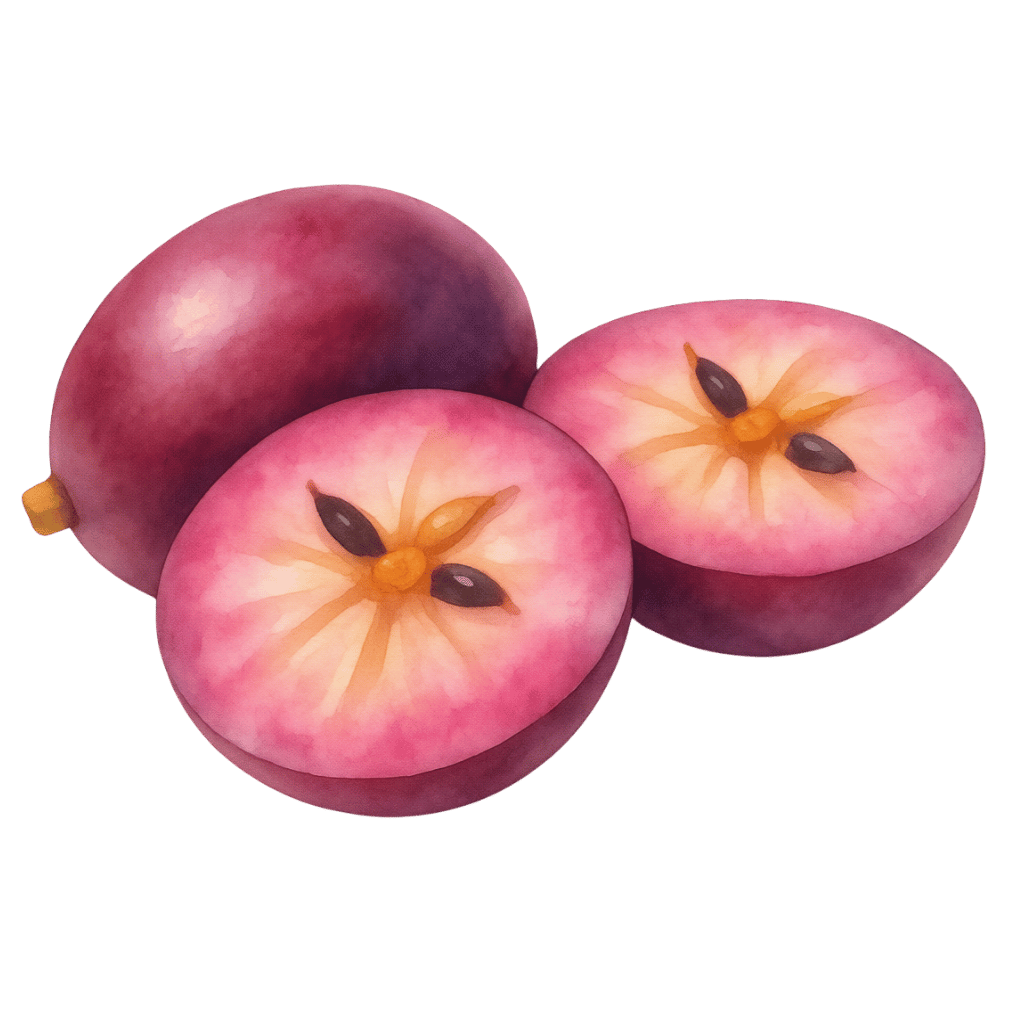
Caimito
Chrysophyllum cainitoVarieties
Haitian Star
Blanco Star
Lò Rèn Vĩnh Kim
14–17° BrixTứ Quý
Bơ Hồng
≥17° BrixMiCA
13–15.5° BrixBotanical View
- Leaves are alternate, nearly evergreen, elliptic to oblong-elliptic, 5-15 cm (2-6 in) long and about 3.8-5.8 cm wide, slightly leathery. The upper surface is rich green and glossy (glabrous at maturity); the lower surface is coated with silky, golden-brown pubescence at maturity (silvery when young), giving a satin-like sheen that is the basis of the alternate common name "golden-leaf tree." Petioles are short (about 1.3-1.6 cm), reddish-brown and hairy; margins are entire (untoothed) and slightly thickened. (Morton 1987; Crane & Balerdi, UF/IFAS EDIS HS1069; World Agroforestry Centre species profile)
- The bole is usually straight and cylindrical but often fluted or spurred at the base, with small or absent buttresses; young branchlets are brown-hairy. Bark is rough, irregularly fissured, and brown on the outside; the inner bark is fibrous, mottled orange-white to yellow-white, and exudes white latex when cut. Wood (sapwood and heartwood) is reddish-brown to dark brown, fine- to medium-textured, with fairly straight grain and a specific gravity of about 0.70. (World Agroforestry Centre, AgroforesTree Database species profile; Morton 1987)
- Specific root-system anatomy (taproot depth, branching architecture) is not well documented in the literature reviewed. Field observations note that lateral roots of mature trees extend well beyond the drip-line of the canopy, and the trunk base is often fluted/spurred with small or absent buttress roots. Trees are sensitive to poor drainage and over-irrigation, which promotes root rot, and are described as intolerant of flooding - indicating a root system that does not tolerate prolonged waterlogging despite lateral spread. (Crane & Balerdi, UF/IFAS EDIS HS1069; World Agroforestry Centre species profile; Morton 1987)
- Flowers are small and inconspicuous, borne in fascicled clusters in the leaf axils (and sometimes along older wood), with a tubular, 5-lobed corolla and 5-6 sepals; stamens number 4-8. Flower color is described as greenish-yellow, yellow, or purplish-white to cream. Flowers can be unisexual or bisexual within the same inflorescence/tree, consistent with the polygamous flowering habit reported for the species. (Morton 1987; Crane & Balerdi, UF/IFAS EDIS HS1069; World Agroforestry Centre species profile; Petersen et al. 2012)
- Within Chrysophyllum, sexual expression ranges from structurally hermaphroditic to dioecious, monoecious, andromonoecious, and polygamous, and functional behavior can diverge from floral structure due to dichogamy, self-incompatibility, or pollen sterility. In C. cainito, anthesis of 2-3 flowers per inflorescence occurs early each day, with stigmas becoming receptive some hours later - a temporal separation of male and female function (dichogamy) suggesting mechanisms that promote outcrossing. The precise breeding system has not been fully resolved, but flowers are considered likely self-fertile while natural populations show an outcrossing genetic signature typical of many neotropical trees; cultivated and wild populations show comparable levels of genetic diversity, with no strong domestication bottleneck detected. (Petersen, Parker & Potter 2012, American Journal of Botany; Petersen, Parker & Potter 2014, Ecology and Evolution)
- Small bees are the documented pollinators, specifically stingless bees of the genus Tetragonisca, which visit the small cream-colored flowers; bees and flies more broadly are cited as the main floral visitors/pollinators of the species. (Petersen, Parker & Potter 2012, American Journal of Botany)
- Caimito is not particular about soil type, growing in deep, rich earth, clay loam, sand, or calcareous/limestone soils, including low- and high-pH sandy soils and high-pH, rocky, calcareous soils (e.g., south Florida "rockland"), provided drainage is good; it does not tolerate flooding or waterlogged conditions. Alkaline/high-pH soils predispose trees to iron deficiency (chlorosis). (Morton 1987; Crane & Balerdi, UF/IFAS EDIS HS1069)
- Young trees are commonly fertilized every 1-2 months in the first year (starting around 114 g/0.25 lb per application, increasing toward 455 g/1 lb), then 3-4 times per year thereafter in amounts scaled to tree size (not exceeding about 9 kg/20 lb per tree per year). NPK mixes with 6-10% N, 6-10% P2O5, 6-10% K2O and 4-6% Mg suit young trees; for bearing trees, potash is increased (9-15% K2O) and phosphate reduced (2-4%). Foliar micronutrient sprays (copper, zinc, manganese, boron) are recommended 3-4 times per year (spring-summer) for the first 4-5 years, and iron chelate soil drenches correct iron deficiency in alkaline/high-pH soils. Newly planted trees need frequent watering (every other day for about a week, then 1-2 times weekly for a couple of months); established young trees (first 3 years) should be watered about twice weekly during prolonged dry spells; irrigation is reduced going into the dry season to help induce flowering. Over-watering via automated sprinkler systems can cause decline through root rot. (Crane & Balerdi, UF/IFAS EDIS HS1069)
- Propagation is by seed, grafting, budding, or air-layering (marcottage). Seeds germinate readily and retain viability for several months (one source reports about 70% germination in 14-40 days); seedling trees typically begin bearing in 5-10 years. Vegetatively propagated trees (grafted, budded, or air-layered) fruit much sooner, generally in 1-2 years; cuttings of mature wood can also root. Grafting caimito onto satinleaf (Chrysophyllum oliviforme) rootstock is reported to produce slow-growing, dwarfed trees. (Morton 1987; Crane & Balerdi, UF/IFAS EDIS HS1069; World Agroforestry Centre species profile)
- Fruits typically contain multiple seeds embedded in gelatinous, rubbery seed cells arranged radially; seed counts of about 6-11 per fruit are most commonly reported (with figures as low as 3-5 also cited), and seeds are flattened, ovate to oval, pointed, hard, and roughly 2 cm long. Seed number and size vary among fruits/genotypes and are part of a broader "domestication syndrome" of fruit and seed traits distinguishing cultivated from wild trees. Population-genetic work using ten microsatellite markers (118 alleles total) found that cultivated trees retain genetic diversity comparable to wild source populations, indicating no major genetic bottleneck occurred during early domestication, even as northward human-mediated spread was accompanied by reduced genotypic/phenotypic diversity. (Morton 1987; Crane & Balerdi, UF/IFAS EDIS HS1069; World Agroforestry Centre species profile; Petersen, Parker & Potter 2014, Ecology and Evolution)
- The species is only lightly improved through formal breeding. Two broad fruit-color types are recognized - purple-skinned and green ("golden"/yellow-green)-skinned - though pronounced, consistent varietal differentiation beyond peel color is not well documented. Named selections are few; in Florida, 'Haitian Star' (purple peel, introduced 1953) and 'Blanco Star' (green peel) are grown, both reportedly capable of setting fruit without cross-pollination. Germplasm/genetic-resource collections (e.g., at CATIE in Costa Rica) maintain and morphologically characterize caimito accessions for conservation and potential breeding use, but no widely standardized international cultivar registry exists. (Morton 1987; Crane & Balerdi, UF/IFAS EDIS HS1069)
- C. cainito is considered a semi-domesticated neotropical fruit tree. Phylogeographic and population-genetic research (microsatellite and haplotype analysis across its range) found greater genetic diversity among Panamanian populations than in the Greater Antilles, supporting a Panamanian (southern Mesoamerican) center of domestication, with subsequent human-mediated dispersal northward into Mesoamerica and the Caribbean; that northward spread was accompanied by reductions in genotypic and phenotypic diversity, while cultivated trees overall retained diversity comparable to wild source populations, indicating domestication drew from a broad, genetically diverse founder gene pool rather than a narrow bottleneck event. Historically, the species (or its cultivation) was already noted by Spanish explorers growing in Peru in the 1500s, and it was later deliberately introduced to Hawaii (1901) and Florida (around 1887), then distributed more widely through the tropics (Asia, Africa) during the 20th century. Formal breeding programs are minimal; the few named selections (e.g., 'Haitian Star', 'Blanco Star') originated as selected seedlings rather than through structured breeding, and institutional germplasm collections (e.g., CATIE, Costa Rica) exist mainly for characterization and conservation. (Morton 1987; Petersen, Parker & Potter 2012, American Journal of Botany; Petersen, Parker & Potter 2014, Ecology and Evolution)