Back to Fruitpedia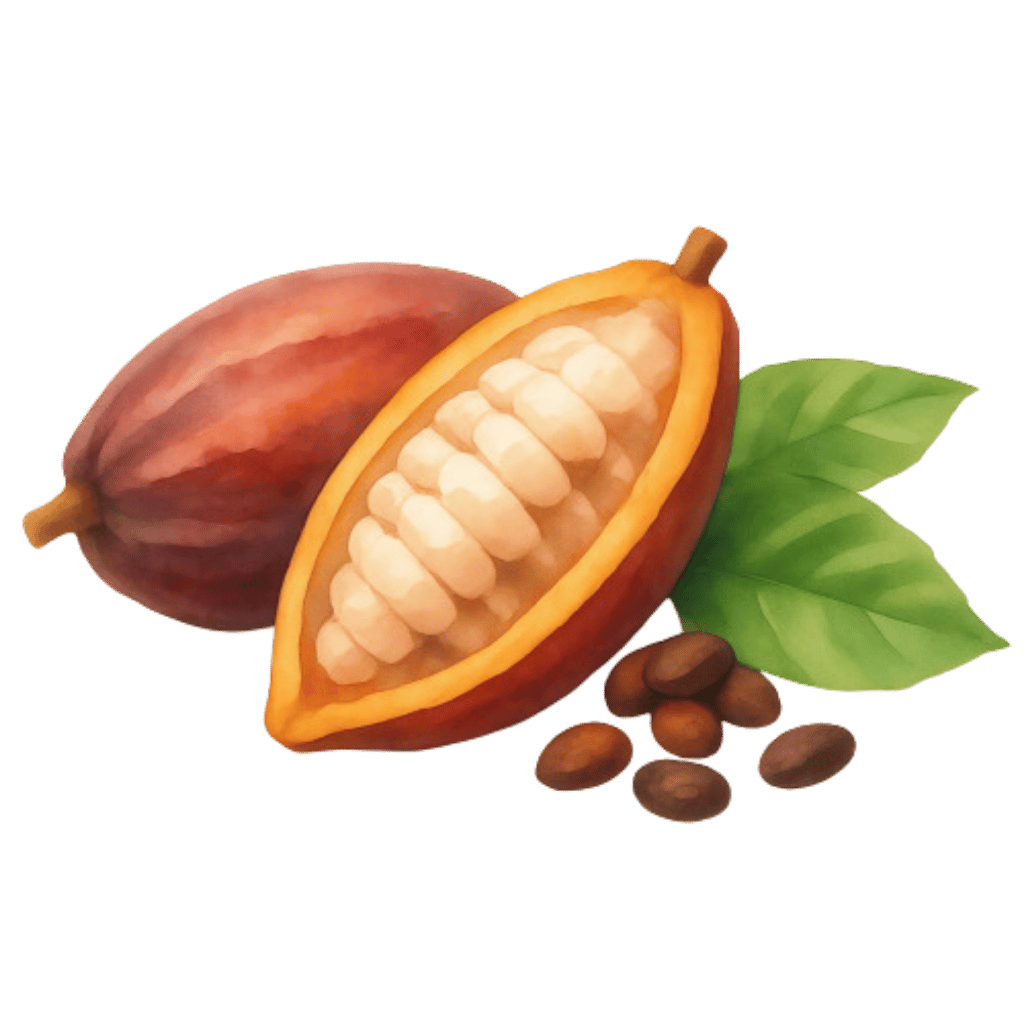
Cocoa
Theobroma cacaoVarieties
Criollo
Forastero
Trinitario
Nacional (Arriba)
CCN-51
Catongo
Botanical View
- Leaves are simple, alternate, and dimorphic depending on the type of shoot: leaves on vertical "chupon" (water) shoots follow a 5/8 phyllotaxy, while those on the horizontal "fan" branches follow a 1/2 phyllotaxy. The blade is elliptic-oblong to obovate-oblong, 10-45 cm long, generally smooth (occasionally hairy), rounded to obtuse at the base and pointed at the apex, with an entire margin. Young flush leaves are soft, pendant and reddish or pinkish before hardening and turning dark green. The petiole bears two swollen joints (pulvini), one at the base and one at the point of leaf insertion, allowing leaf orientation movements; two small, early-deciduous stipules occur at each node.
- The main trunk is short and, in unpruned trees, generally undivided up to a point ("jorquette") where it branches into a whorl of typically five plagiotropic (horizontally growing) "fan" branches; new vertical, orthotropic "chupon" (water) shoots can subsequently arise from the trunk or branches to renew the canopy, giving the species a characteristic dimorphic branching habit. Flowers and fruits are borne directly on the trunk and older woody branches (cauliflory), emerging from swollen floral cushions.
- Cacao develops a taproot system with a well-defined main taproot together with a dense mat of superficial, laterally spreading feeder roots concentrated mainly in the top 20-30 cm of soil. Deep, well-drained soil is required for good taproot development; where the water table is shallow (as in low-lying/floodplain "várzea" soils), the root system becomes restricted to a few centimeters of depth, leaving the plant vulnerable to water deficit in dry periods, while a permanently high water table causes poor aeration, impaired root respiration and reduced nutrient uptake.
- Cacao is cauliflorous, producing small dichasial-cyme inflorescences directly from cushion-like structures on the trunk and older branches rather than on young shoots. The primary peduncle is very short and often lignified; individual flower pedicels are 1-4 cm long. Flowers are small (roughly 1-1.5 cm across), with 5 triangular whitish-to-reddish sepals, 5 petals fused at the base into a cup-like structure with yellowish, spathulate hood-like ligules, 5 fertile stamens alternating with 5 sterile staminodes (the two whorls united into a short tube), paired anthers, and a superior, 5-locular ovary bearing a single style ending in 5 sticky stigmatic surfaces.
- Cacao has a complex genetic self-incompatibility system and is predominantly an out-breeding (allogamous) species, although some cultivated types (notably Criollo) are self-compatible. Following successful pollination and fertilization (occurring within roughly 24-36 hours), the sepals, petals and staminodes drop and the stamens and pistil wither; the young pod ("cherelle") then develops first by elongation and then by increase in width, with high rates of early pod abortion ("cherelle wilt") typical of the species.
- Cacao is naturally cross-pollinated (allogamous) and pollination efficiency in the wild and on farms is generally low — often only a few percent of flowers are pollinated and even fewer set mature pods. The principal natural pollinators are tiny midges of the family Ceratopogonidae (genus Forcipomyia), with thrips, aphids and ants also recorded as flower visitors contributing to pollination.
- Cacao performs best on deep (effective depth of at least 80 cm, more if a high water table or compaction is absent), well-drained soils of medium to clayey texture with good water-holding capacity, high nutrient content and organic-matter-rich topsoil, free of iron concretions. Soil reaction should be moderately acidic, roughly pH 5.5-6.5. Purely sandy soils are unsuitable owing to their low moisture and nutrient retention, while shallow soils and sites with a permanently high or fluctuating water table are also inadequate unless drained, since they restrict rooting depth and cause moisture stress or poor aeration.
- Cacao consumes large quantities of water and is highly sensitive to soil moisture deficit; where rainfall or its distribution is inadequate, supplemental irrigation is required, and nursery seedlings need regular watering. Soil acidity is corrected by liming with dolomitic limestone, broadcast and incorporated at least two months before fertilizer application, to neutralize aluminum and supply calcium and magnesium. Amazonian latosols used for cacao are generally acidic and poor in nutrients, with phosphorus most limiting, followed by potassium, nitrogen, calcium and magnesium; fertilizer rates are based on soil analysis (an indicative NPK formulation historically used in the Brazilian Amazon was 30-90-90), applied in increasing amounts as the planting ages (EMBRAPA-affiliated IPEAN/ACAR-Pará circular, 1973).
- Cacao is propagated both by seed and vegetatively. Seed is recalcitrant (desiccation-sensitive) and cannot be dried or stored for long periods without loss of viability, so seedlings are typically raised promptly in nursery bags of good topsoil under partial shade (a rustic slatted shelter, "ripado," in Amazonian practice) for about 4-6 months before field planting. For genetic uniformity, disease resistance and earlier, more predictable yields, selected clones are also propagated vegetatively by rooted cuttings or by grafting/budding onto seedling rootstock.
- Each pod contains roughly 20-40 (occasionally up to about 60) ovoid to flattened seeds ("beans") arranged around a central axial placenta and embedded in sweet, mucilaginous pulp. Cotyledon color varies from whitish/pale (typical of Criollo) to deep purple (typical of Forastero), reflecting the wide genetic variability produced by the species' outcrossing breeding system. Seeds are recalcitrant: they tolerate only limited desiccation (viability drops sharply below about 25-36% moisture content, and no seeds survive desiccation to roughly 20-26% moisture content) and are damaged by storage temperatures between about 4-15 °C, with best storage performance near 15-30 °C for short periods.
- Traditional classification recognizes three cacao groups: Criollo (Central American/Mesoamerican origin, thin pericarp, white to pale seeds, fine "flavor cocoa" aroma, but low vigor and yield and high disease susceptibility), Forastero (Amazonian origin, robust, purple seeds, the source of most bulk/commercial cocoa, including the widely planted Amelonado type), and Trinitario (a natural Criollo x Amelonado Forastero hybrid from Trinidad, combining fair quality with better vigor). Modern population-genomic studies (Communications Biology, 2018) resolve cultivated and wild germplasm into about ten genetic clusters — Amelonado, Contamana, Criollo, Curaray, Guiana, Iquitos, Marañón, Nacional, Nanay and Purús — reflecting the crop's broader Amazonian diversity beyond the classic three-group model. In Brazil, hybrid clones combining SCA 6, SCA 12 and IMC 67 with local germplasm are used commercially for improved precocity, yield, bean size and witches'-broom resistance.
- Theobroma cacao was domesticated independently in two centers: Mesoamerica, where the Olmec and later Maya cultivated the thin-shelled, pale-seeded "Criollo" type over 1,500-3,000 years ago (documented by domestication genetics studies published in Heredity), and the Upper Amazon basin, source of the hardier, purple-seeded "Forastero" populations. Cacao cultivation was introduced to the Brazilian Amazon under the Portuguese "Carta Régia" of 1679, reaching the state of Pará from 1740 onward (IPEAN/ACAR-Pará circular, 1973). In 18th-century Trinidad, natural hybridization between Criollo and Amelonado Forastero produced the vigorous, good-quality "Trinitario" group. From the 1950s, Upper Amazon Forastero germplasm collected during 1930s-40s expeditions (yielding the SCA, ICS and IMC clone series) was incorporated into breeding programs. Brazilian research institutes (IPEAN, CEPLAC) developed hybrids combining clones SCA 6, SCA 12 and IMC 67 with local varieties to improve precocity, productivity, bean size and disease resistance, particularly to witches'-broom.