Back to Fruitpedia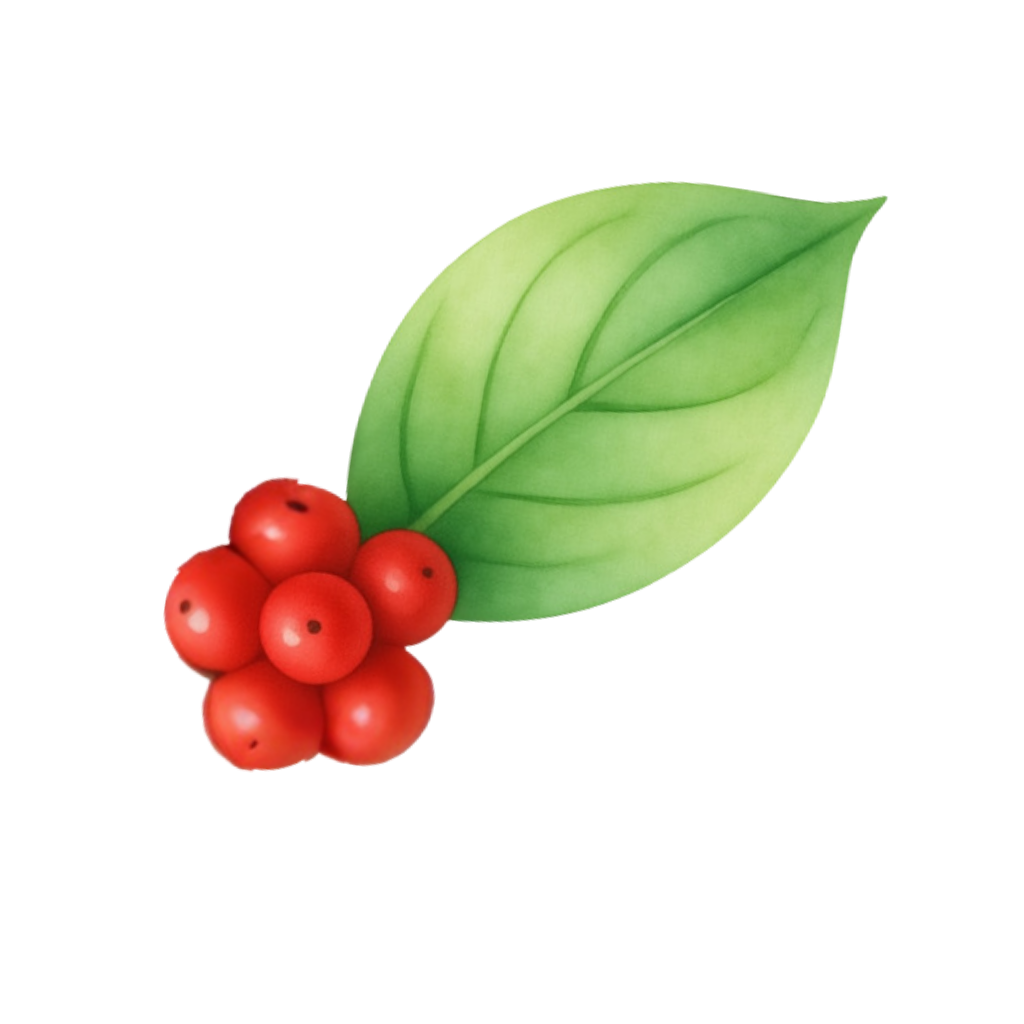
Bunchberry
Cornus canadensisBotanical View
- Leaves are simple, entire (toothless) and appear in a whorl of about 4-6 crowded at the stem tip, looking whorled because the internodes are compressed (technically opposite, with two larger leaves and several smaller ones from axillary buds). Blades are broadly elliptic to obovate or somewhat diamond-shaped, roughly 3.5-7 cm long and 1.5-2.5 cm wide, glossy dark green, with a cuneate (wedge) base, an abruptly acuminate tip, and 2-3 pairs of arcuate (curving, parallel, dogwood-type) veins; petioles are very short (about 2-3 mm). In autumn the veins redden and the foliage turns red.
- Above-ground stems are slender, erect, herbaceous and unbranched, arising individually from the underground rhizome and typically 10-20 cm tall. Each shoot carries the terminal leaf cluster and a single terminal inflorescence, sometimes with a lower pair of reduced scale-like leaves along the stem.
- The plant arises from slender, creeping, somewhat woody underground rhizomes (runners) set about 2.5-7.5 cm deep in the soil, which sucker and spread indefinitely to form clonal colonies and dense mats; fibrous roots develop along the rhizome. Nitrogen fixation and specific mycorrhizal associations are not documented for the species.
- The conspicuous "flower" is actually a compact terminal umbel-like cyme of about 15-50 tiny greenish-white to purplish flowers, subtended by four (occasionally more) petal-like white, sometimes pinkish, bracts roughly 0.8-1.5 cm long that together mimic a single 2-3 cm flower. Individual flowers are 4-merous with minute reflexed petals, four short stamens (about 1 mm), and an inferior ovary. The head matures into a tight cluster of bright red, berry-like drupes about 5 mm across, each usually containing one or two hard ellipsoid stones (seeds).
- Reproduces both sexually by seed and clonally by spreading rhizomes, with vegetative spread accounting for most local increase. Flowers are hermaphroditic (perfect), and the species is largely self-incompatible/self-sterile, functioning as an obligate outcrosser that requires cross-pollination. Where its range overlaps that of the bog species Cornus suecica (Alaska, Labrador, Greenland), the two hybridize to produce plants of intermediate character.
- Pollinated by a broad range of insects in a generalist, outcrossing system; recorded visitors include bumblebees (considered a major pollinator), solitary bees, beeflies, syrphid (hover) flies, and beetles such as long-horned beetles. The flower has an explosive, catapult pollination mechanism: one petal acts as a trigger, and when a sufficiently heavy insect touches it the four petals flip open and release the spring-loaded stamens, which fling pollen upward onto the visitor. It is among the fastest known plant movements, with stamens accelerating at roughly 24,000 m/s and the action completing in under half a millisecond, launching pollen at up to about 7.5 m/s. The weight-triggered design excludes small, ineffective visitors such as ants.
- Prefers cool, consistently moist but well-drained soils that are high in organic matter (humus-rich) and acidic to neutral in pH; it is not suited to alkaline soils and is intolerant of dry soils. It tolerates light, medium or heavy textures given adequate moisture, and is characteristic of moist coniferous woodland, mossy ground and rotting stumps.
- Requires steady soil moisture and cool, humus-rich conditions and is intolerant of drought, so it should not be allowed to dry out. No specific fertilizer regime is documented; it grows in soils of good to moderate fertility, and an organic, leaf-mould-rich woodland soil is generally sufficient without added feeding.
- Propagated by seed, by division, and by cuttings, in addition to natural spread by rhizomes. Seed should be cleaned of the fruit pulp (which contains germination inhibitors) and ideally sown fresh; stored seed needs about 3-4 months of cold, moist stratification (sometimes warm-then-cold cycling and/or scarification), and germination is often slow and erratic, taking 18 months or more. Division of small pieces from the edge of a clump in spring is possible but plants resent disturbance; softwood/basal cuttings taken from below ground level in July-August root in a 1:1 sand/peat mix.
- Seedlings are genetically variable because the species is an obligate outcrosser; each drupe yields one or two stones. In zones of overlap with Cornus suecica, cross-pollination produces offspring of intermediate (hybrid) characteristics. Germination is notably difficult and non-uniform, with longer cold stratification giving more uniform emergence.
- No significant named horticultural cultivars are in general commercial use; the plant is grown as the wild (straight) species, typically from wild-collected or nursery-propagated wild-type stock rather than from bred selections.
- The species has no formal breeding or domestication history; horticultural material is essentially wild-type, propagated from wild-collected seed, division or cuttings rather than from bred selections. Natural hybridization with Cornus suecica occurs where their ranges overlap, giving intermediate plants.