Back to Fruitpedia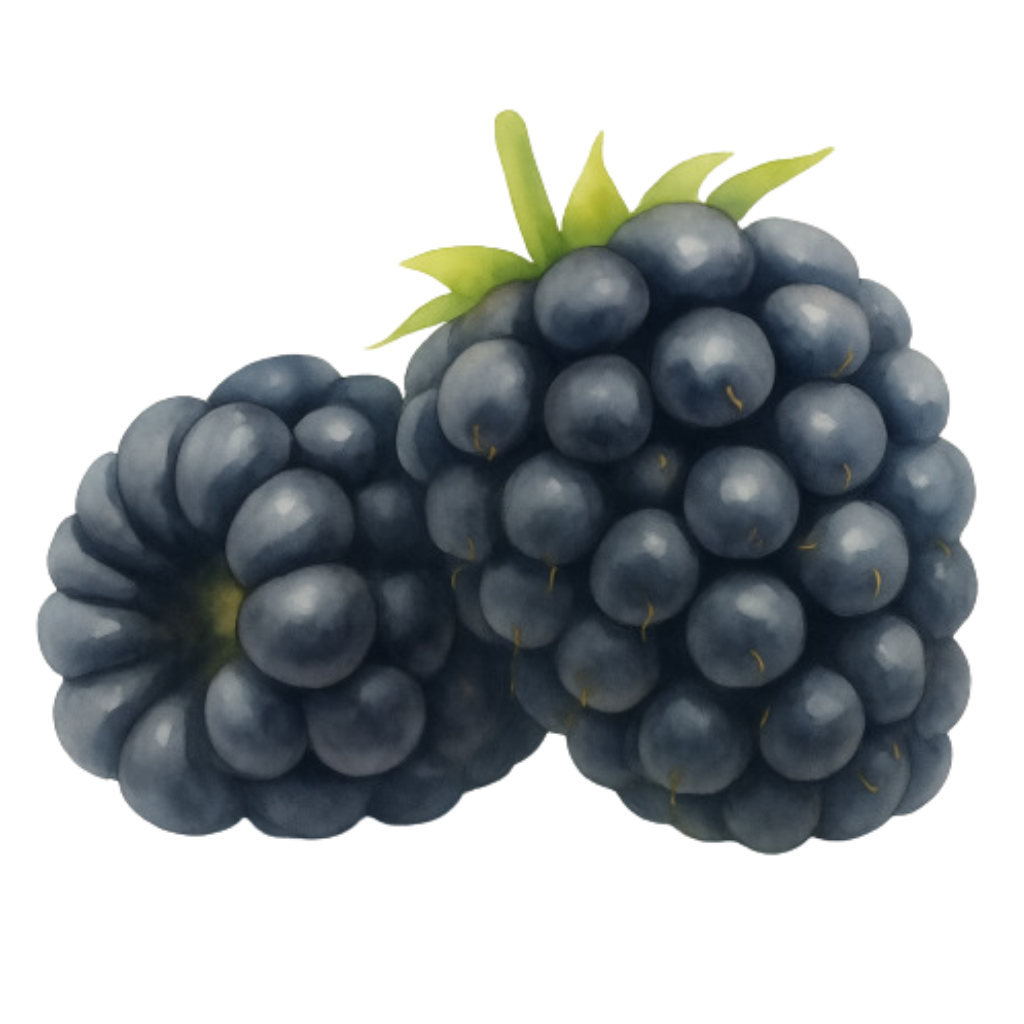
Black Raspberry
Rubus occidentalisVarieties
Jewel
Bristol
Cumberland
Munger
Allen
Mac Black
Botanical View
- Leaves are alternate and pinnately compound. First-year (primocane) canes typically bear leaves with 5 leaflets; flowering (floricane) branches bear 3-parted leaves. Leaflets are ovate with doubly serrate (irregularly toothed) margins and a pointed tip; the terminal leaflet is short-stalked and the lateral leaflets are usually sessile. The upper surface is light to medium green while the underside is markedly paler, whitish, and covered with soft tomentose (fuzzy) hairs. Petioles and leaf rachises carry small hooked prickles.
- Canes (stems) are biennial and typically arching, up to about 1.8 m long. First-year primocanes are unbranched, green to blue-green and conspicuously glaucous, coated with a whitish waxy bloom that gives the "blackcap" its bluish look; they later turn purplish-red. Second-year floricanes develop a darker reddish-brown bark and lose the bloom, branching into fruiting laterals. Canes are armed with sparse, stout, curved (hooked) prickles that are long and thin but broad-based. Tips of primocanes bend to the ground and root, propagating the plant.
- The plant has a perennial crown and root system from which biennial canes arise; roots and crown persist while individual canes live two years, fruit, and die. Roots are relatively shallow, forming a plate near the soil surface, though they can extend to roughly 1–1.2 m (up to ~4 ft) deep. Unlike red raspberry, black raspberry spreads little by underground suckers; new plants form mainly at rooted cane tips (tip layering). New shoots arise from the crown area.
- Flowers are borne in short, dense clusters (corymb-like racemes) at the tips and upper axils of second-year canes. Each flower is small and white with five narrow petals that are shorter than the five long, slender, tapering sepals (sepals about 6–8 mm, more than twice the petal length). Flowers are perfect (hermaphrodite), with numerous stamens (roughly 60–120) in whorls surrounding many spirally arranged pistils on a central receptacle. The fruit is an aggregate of drupelets that separates from the receptacle when ripe.
- Sexual reproduction is by hermaphroditic (perfect) flowers; the species is self-fertile and largely self-pollinating (autogamous). However, floral morphology (outer stigmas reaching the anthers more readily than inner ones) means complete self-pollination is limited, so insect visitation improves the completeness of drupelet set and fruit size. The plant also reproduces vegetatively and clonally through tip layering, where rooting cane tips establish new plants.
- Pollinated by insects, chiefly bees (including honey bees, bumble bees, and solitary/wild bees) attracted to the nectar of the white flowers; the flowers are noted for attracting pollinators and other wildlife. Although self-fertile, bee visitation enhances fruit set and berry quality.
- Adapts to light (sandy), medium (loamy), and heavy (clay) soils but requires good drainage; grows best in organically rich, moist but well-drained soil. Tolerates mildly acid, neutral, and mildly alkaline conditions, with an optimum pH around 6.0–6.8 (slightly acidic).
- Prefers fertile, organically rich soil and benefits from consistent moisture, especially during flowering and fruit development—roughly 25–40 mm (1–1.5 in) of water per week during fruit swell. Well-drained soil is essential to avoid root disease. Specific fertilizer regimes vary by grower and region.
- Propagated primarily by tip layering: the arching primocane tips are bent to the ground in mid- to late summer (July–August) and their tips covered with soil, where they root and can be transplanted in autumn. Also propagated by suckers/division (early spring or before autumn leaf-fall) and by softwood/half-ripe cuttings (July–August in a frame). Seed propagation is possible—best sown in early autumn in a cold frame; stored seed benefits from about one month of cold stratification at ~3 °C. Cultivars are propagated vegetatively to stay true to type.
- Because the species is self-fertile and largely self-pollinating, seedlings are relatively uniform, but seed-grown plants are not reliably true-to-type and show some genetic variability; named cultivars are therefore propagated clonally (tip layering) rather than from seed. Seed also requires cold stratification for germination.
- Numerous cultivars have been named. 'Munger' (introduced in the 1890s) is the classic mid-season cultivar and long the leading commercial variety in the U.S. Pacific Northwest. Other cultivars include 'Bristol', 'Cumberland', 'Jewel', 'Allen', 'Blackhawk', 'Black Pearl', 'Mac Black', 'Dundee', 'Haut', and 'Huron', among others. Crosses with red raspberry (R. idaeus/R. strigosus) yield purple raspberries such as 'Brandywine', 'Royalty', and 'Estate'.
- Black raspberry entered cultivation in North America in the 19th century, with dozens of cultivars named around the late 1800s and early 1900s ('Munger', introduced c. 1890s, becoming the dominant commercial type). Active breeding continued into about the 1960s, then largely lapsed, leaving only a handful of widely grown cultivars and a narrow genetic base. R. occidentalis has been extensively used to breed purple raspberries with red raspberry. Renewed interest—driven by the fruit's anthocyanin/health profile—has spurred modern breeding and genomic work, including a reference genome and genetic-linkage mapping (e.g., the Ag4 gene for aphid resistance).