Back to Fruitpedia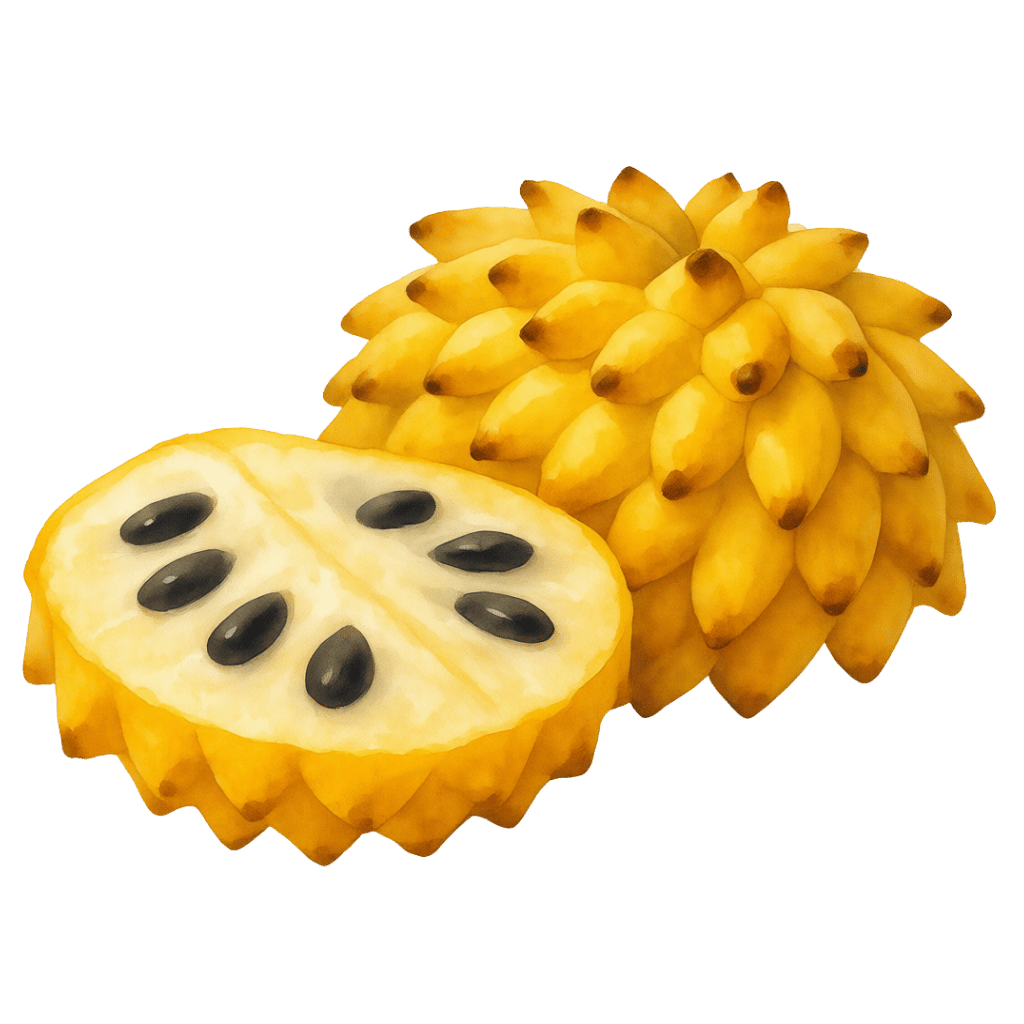
Biriba
Annona mucosaBotanical View
- Leaves are alternate, short-petioled, narrowly elliptic to oblong (about 8-20 cm long, 3.5-6 cm wide, with some sources reporting ranges to 25 cm long), thin and papery (chartaceous), with an acuminate to cuspidate tip; dark green above and paler beneath, with fine pubescence on the lower surface and, on young growth, sparse rust-colored (ferruginous) silky hairs. Anatomically the blade is dorsiventral and hypostomatic, with paracytic stomata (about 104 stomata/mm² reported in one anatomical study) and simple, multicellular trichomes on both faces; the palisade parenchyma is a single layer of triangular cells above 3-4 strata of spongy mesophyll.
- Young branches are sparsely covered in rust-colored (ferruginous), silky hairs. Untrained trees grow with a naturally upright, vertical habit and a conical crown. In primary growth, the stem anatomy shows a uniseriate (single-layered) epidermis with a cuticle, a cortex of five to six collenchyma cell layers, a cortical parenchyma of only two to three layers of flattened cells, and a eustelic arrangement of open collateral vascular bundles disposed circularly around the pith.
- In seedlings, the primary root is cylindrical and axial and grows slowly (reaching only about 1.93 cm by 28 days after sowing in one anatomical study), with secondary cylindrical roots emerging roughly four days later. Anatomically, the root has a single-layered (unistratified) epidermis, a single-layered exodermis, and an endodermis bearing Casparian strips that form an apoplastic barrier regulating water and ion movement; internally, a medulla of large isodiametric parenchyma cells is surrounded by a vascular system of open collateral bundles.
- Flowers are solitary or borne in small inflorescences of one to three flowers, green to yellowish-white, actinomorphic (radially symmetrical) and bisexual; the outer petals are oblong, about 2 cm long, and densely grey-tomentose (velvety-hairy).
- Flowers are bisexual (perfect) and exhibit protogynous dichogamy, in which the female-receptive phase precedes the male (pollen-shedding) phase within the same flower. This temporal separation of sexual function discourages self-pollination within a flower and functionally promotes cross-pollination between trees/flowers.
- Small beetles -- particularly nitidulid (sap) beetles -- and ants are considered the most likely effective pollinators, attracted during the female flower phase by a distinctly sweet, yeasty floral odor. Because natural pollinator visitation is often limited, hand pollination during the female phase markedly increases fruit set in cultivation.
- Grows best in fertile, well-drained, loamy soils with high organic-matter content and an acidic-to-neutral pH of about 5-7. On calcareous soils (pH 7 or higher), iron deficiency (chlorosis) commonly develops and requires correction with chelated iron and foliar micronutrient applications.
- No region-specific Brazilian fertilization protocol was located; the best-documented recommendations (University of Florida IFAS) suggest a balanced, slow-release fertilizer (e.g., an N-P-K-Mg formulation such as 6-6-6-2) applied about three times a year from March through October, with chelated iron (EDDHA form) applied three to four times a year on high-pH/calcareous soils to prevent iron-deficiency chlorosis, plus periodic foliar micronutrient sprays (zinc, magnesium, manganese, molybdenum, boron). Biribá prefers evenly distributed rainfall year-round and tolerates only short drought during cooler months; supplemental irrigation is recommended during extended hot, dry periods, since prolonged drought under heat causes partial defoliation and reduced flowering/fruit set. The species is not salt-tolerant and is sensitive to high boron/chloride levels, and it tolerates only brief (1-3 day) soil saturation, not prolonged waterlogging.
- Primarily propagated by seed: seed is removed from ripe fruit, washed free of pulp, and sown in well-drained medium at about 25-30°C, germinating in three to five weeks; seed remains viable for one to two years, with germination percentage declining with storage time and, in practice, germination that can be slow and non-uniform. Where uniform fruit quality is desired, scions are grafted onto biribá, soursop (Annona muricata), or Annona glabra (araticum-do-brejo/pond apple) seedling rootstock; biribá is not graft-compatible with sugar apple (Annona squamosa). Propagation by stem cuttings or air-layering is unreliable (poor rooting/establishment) and is not recommended.
- Fruit phenotype (epicarp texture, from smooth to fruit with small or large carpel protrusions) varies considerably among biribá populations/seedling trees across Brazilian Amazonia -- for example, populations near Manaus are dominated by small-protrusion fruit while those in the upper Solimões region (western Amazonia) are dominated by large-protrusion, larger fruit (up to about 4 kg, versus around 100 g at the small end). A genomic study found this phenotypic variation is not associated with differences in chromosome number or genome size: domesticated Brazilian populations are consistently hexaploid (2n=6x=42; mean genome size about 5.31 pg 2C in that study, versus about 4.77 pg reported in a separate cytometric study of biribazeiro seedlings), while wild Peruvian populations are tetraploid (2n=4x=28); the researchers concluded that human selection, not ploidy/genomic change, drives the observed fruit-size and phenotype variability. Separately, seed-grown populations show variable, sometimes slow and non-uniform germination, and seed viability declines with storage (retained for roughly one to two years).
- No formally recognized cultivars of biribá currently exist. Growers informally distinguish two fruit types by epicarp texture: smooth-skinned fruit and spiculate fruit (bearing soft, pointed conical protuberances); spiculate forms tend to run larger, while pulp flavor is relatively consistent between the two types.
- No formal breeding program or registered cultivars exist for biribá. A 2023 population-genomic study found that the species' hexaploid genome (Brazilian populations, 2n=6x=42) originated when its lineage diverged in the Pliocene, roughly 3.4 million years ago, well before humans arrived in the Americas -- so polyploidy long predates domestication. Selection by pre-Columbian and later cultivating communities (from Mesoamerica to southern Brazil) subsequently shaped fruit size and surface phenotype without changing ploidy or genome size: e.g., populations near Manaus are dominated by small-protrusion fruit while upper Solimões (western Amazonia) populations are dominated by large-protrusion, larger fruit. The authors conclude human selection, not genomic change, is the main force behind fruit-size variation, and suggest this standing phenotypic diversity could support future cultivar breeding for yield consistency and fruit uniformity.