Back to Fruitpedia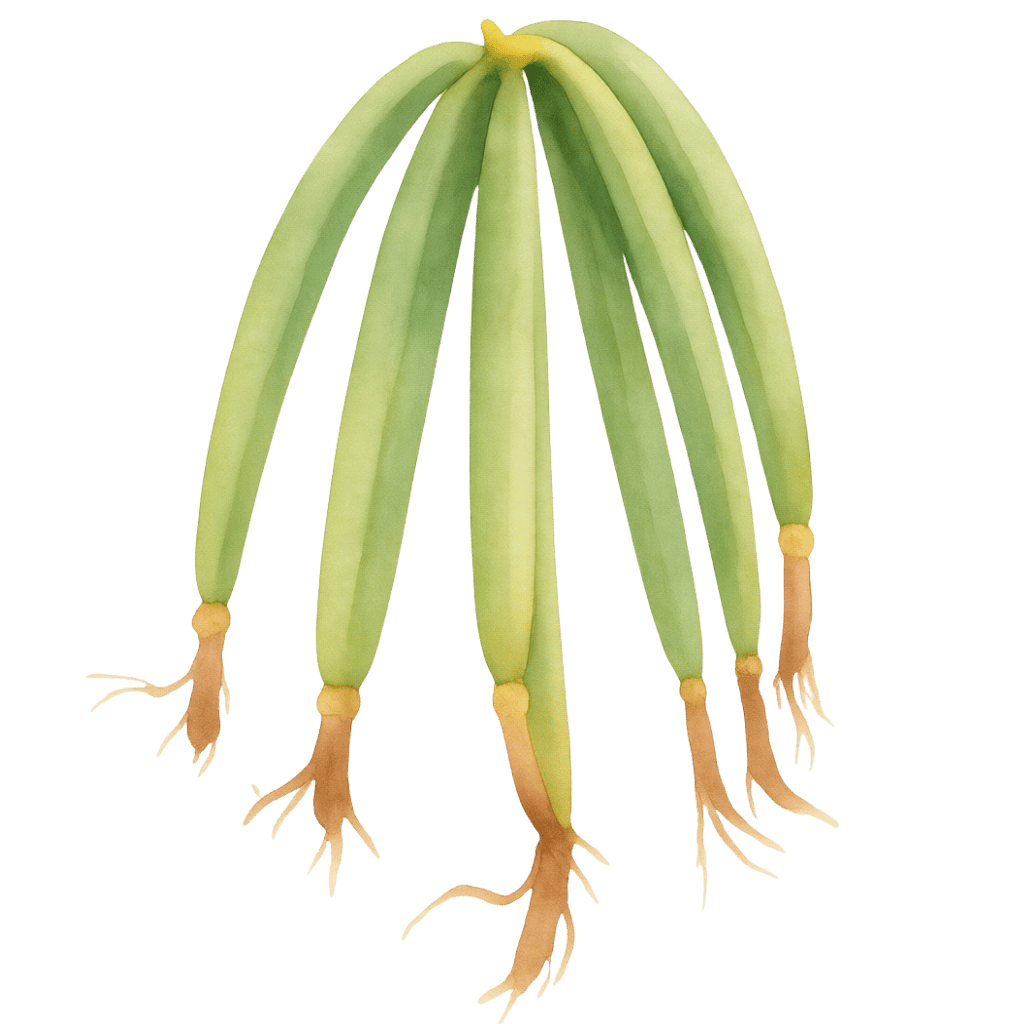
Vanilla
Vanilla planifoliaVarieties
Handa
Classique
Mexique
Grosse Vanille
Variegata
Aiguille
Botanical View
- Leaves are alternate, succulent, glossy bright green, sessile or short-petioled, lanceolate to oval with a pointed tip, borne singly at each node opposite an aerial root. Mature leaves measure roughly 8-25 cm long by 2-8 cm wide, are thick and somewhat leathery, and persist about 3-4 years if undamaged. Occasional variegated leaf forms exist but are grown only as ornamentals, not for commercial vanilla production.
- The stem is fleshy, cylindrical, green, jointed (nodose) and photosynthetic, functioning as a water-storage organ typical of orchids. It climbs by twining and by adventitious aerial roots produced at each node, thickening with age; flowering generally begins once stem diameter reaches about 6-13 mm. In cultivation the vine is periodically looped down and pruned to keep it within reach for hand pollination and harvest.
- Vanilla planifolia produces two distinct root types from the same nodes as the leaves: nonbranching aerial (adventitious) roots that emerge opposite each leaf and serve for climbing and adhesion to the support/host tree, and branched terrestrial roots at the base of the vine that anchor the plant and absorb water and nutrients, commonly forming associations with mycorrhizal fungi. The root system as a whole is notably superficial, which makes the plant sensitive to waterlogging and to competition from deep-rooted companion crops.
- Flowers are borne in axillary racemes (clusters) of roughly 15-30 buds that open in succession, typically only one or a few flowers per raceme opening on a given day. Individual flowers are large (about 5-10 cm across), fragrant, with waxy cream-green sepals and cream-to-yellow-green petals; the third petal is modified into a trumpet-shaped labellum enclosing the fused reproductive column (gynostemium) bearing the pollinia and stigma. Each flower opens for a single day, from around the early morning until it closes/wilts by early afternoon; a full raceme's flowering sequence spans about 30 days.
- The gynostemium fuses male (pollinia) and female (stigma) structures, separated by a flap of tissue called the rostellum that physically blocks self-pollination (autogamy) in most cultivated material; many Mexican accessions are also functionally self-incompatible, with a large proportion of self-pollinated fruit aborting within months. Because of this barrier and the general absence of effective natural pollinators outside limited areas, nearly all commercial fruit set depends on hand pollination: the rostellum is lifted with a thin stick (traditionally a toothpick or bamboo splinter) and the pollinia are pressed onto the stigma. The technique was first shown feasible experimentally by the botanist Charles Morren in the 1830s and made practical for commercial use by Edmond Albius on Reunion Island in 1841, a method still used essentially unchanged today; a skilled worker can hand-pollinate roughly 200 flowers per day within the receptive window (~06:00-12:00/13:00).
- The identity of Vanilla planifolia's natural pollinator(s) remains unresolved. A Mesoamerican stingless bee (Melipona, historically cited as M. beecheii) was proposed as pollinator following 19th-century observations, but this bee is absent from most vanilla-growing regions, and even where present, controlled studies (e.g., in the Yucatan) recorded no visits to open flowers by Melipona or orchid bees (Euglossa spp.), with natural fruit set around 1-5% versus ~70% for hand pollination. Flowers appear to offer no nectar reward and rely on deceptive floral cues (including UV-fluorescent guides on the labellum and column) rather than nutritional reward; large orchid/euglossine bees (e.g., Eulaema meriana) and, occasionally, hummingbirds have been suspected as effective pollinators in parts of the native range, but no pollinator has been confirmed for commercially grown material. Because natural pollination is unreliable, virtually all commercial fruit production relies on manual pollination.
- Vanilla is grown on light, well-drained soils rich in organic matter, generally with a near-neutral pH (approximately 6-7). Good drainage is essential, since the shallow, superficial root system and epiphytic-type aerial roots are highly susceptible to waterlogging and root rot; in many production systems the vine is not planted directly in mineral soil at all but grown over a thick organic mulch layer (composted bark, leaf litter, or similar material) that is renewed periodically.
- Nutrition is traditionally supplied by the slow decomposition of organic mulch/manure rather than mineral fertilizer. In the Amazonian smallholder system documented by Embrapa, growers apply organic cattle manure (about 1.2 kg/plant) plus cacao-hull mulch (about 1.5 kg/plant) as the main nutrient source; renewal of the organic mulch layer every 6-12 months is also reported as standard practice in other production regions. Established vines are typically maintained on natural rainfall, with supplemental irrigation reserved for newly planted cuttings and dry periods; overwatering or poor drainage strongly favors Fusarium root and stem rot, so irrigation is applied conservatively.
- Vanilla planifolia is propagated almost exclusively by vegetative stem cuttings rather than by seed, because natural seed germination is extremely poor. Cuttings ranging from about 30 cm up to 1 m or more in length are used, with a minimum of two nodes (one node buried); longer cuttings (around 1 m) flower sooner (roughly 2-3 years) than short cuttings (roughly 3-4 years). Cut ends are commonly allowed to callus/heal for one to two days before planting, and the cutting's cut base is buried at planting depth of around two nodes. In vitro (tissue-culture) micropropagation is also used commercially, producing plants that need about 3-4 years to reach flowering maturity after hardening.
- Fruits contain thousands of minute, black seeds whose outer seed coat becomes progressively lignified and enriched in phenolic compounds as the seed matures, forming a thick, hardened envelope that strongly inhibits germination. Under natural field conditions, germination is under an estimated 0.1%, largely because of an obligate or near-obligate dependence on specific mycorrhizal fungi for symbiotic germination. In vitro (asymbiotic) germination is possible but is highly sensitive to seed maturity: success is highest when immature seed is collected around 45 days after pollination, before lignification of the seed coat becomes extensive; because of this very low and unpredictable germination, seed propagation is not used commercially.
- Commercially grown Vanilla planifolia is represented mainly by regional landraces/local selections rather than formally registered cultivars — for example the "Mansa" types selected in Mexico, and the "Planifolia mexicana" stock introduced into the Brazilian Amazon (Tome-Acu) from Mexico via the former Inatam institute. Madagascar/Reunion production (the "Bourbon" vanilla trade type) is likewise a regionally selected planifolia stock rather than a distinct botanical cultivar. Only one patented ornamental cultivar, 'Handa,' has been formally registered, alongside naturally occurring variegated-leaf forms grown solely as ornamentals. Separately, Fusarium-tolerant interspecific hybrids involving V. planifolia (e.g., the Madagascar "Vaitsy" type, likely V. planifolia x V. pompona) and higher-vanillin V. planifolia x V. tahitensis hybrids have been developed, though these are grown as distinct hybrid types rather than pure planifolia cultivars.
- Vanilla planifolia was domesticated in the Gulf lowlands of Mexico (the Totonacapan/Papantla region of Veracruz and Puebla) by Mesoamerican peoples — the Totonac and later the Aztec — with cultivation and use documented from at least the 12th century onward; genomic studies indicate cultivated Mexican V. planifolia carries high heterozygosity reflecting at least two separate historical hybridization/domestication events, along with instances of natural polyploidy. The species could not be cultivated commercially outside its native range until the mechanism of hand pollination was understood: experimental artificial pollination was first demonstrated by the Belgian botanist Charles Morren in the mid-1830s, and a practical technique suitable for plantation-scale use was developed in 1841 by Edmond Albius on Reunion Island, enabling the subsequent spread of vanilla cultivation to Madagascar, the Indian Ocean islands, Indonesia and other tropical regions. Formal breeding of V. planifolia remains limited compared to most other crops; modern efforts focus mainly on interspecific hybridization (with V. pompona and V. tahitensis) to improve Fusarium resistance and vanillin yield, alongside genomic characterization of existing landraces.