Back to Fruitpedia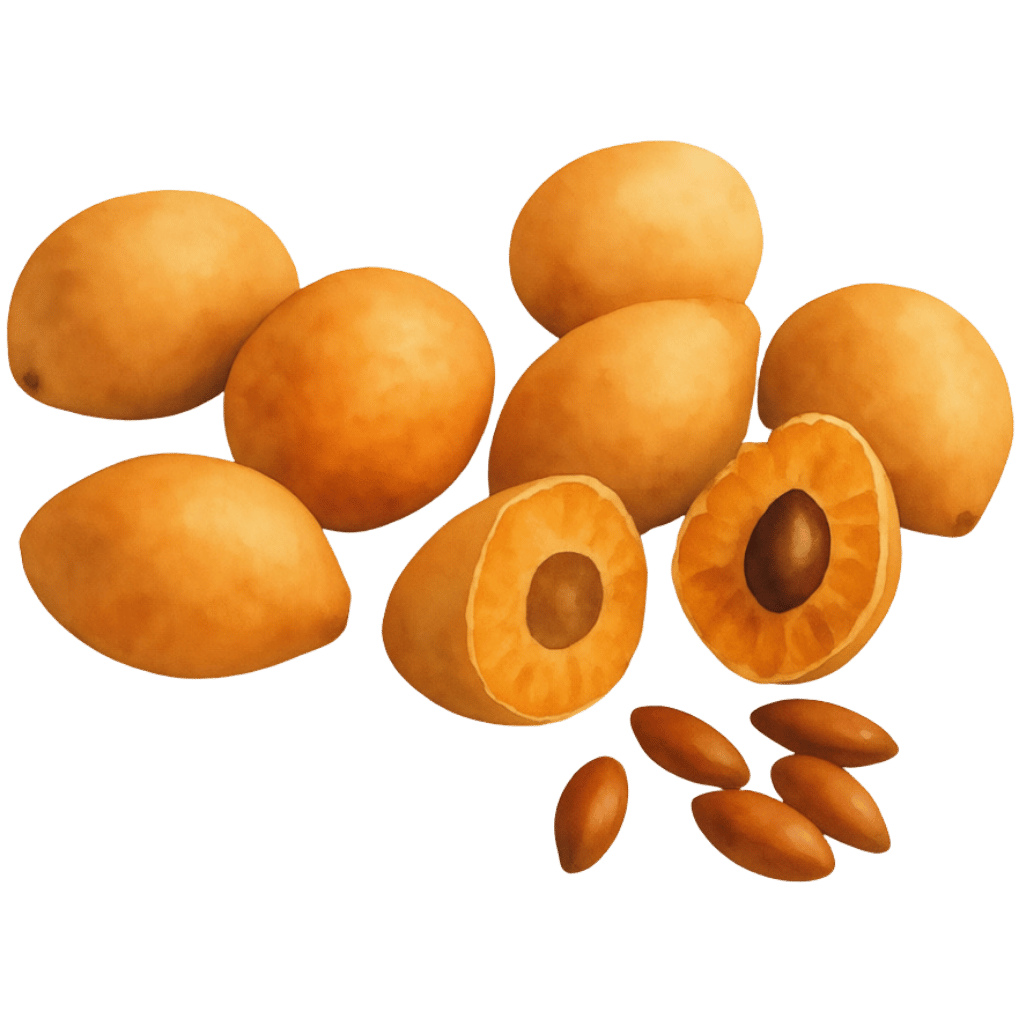
Baru
Dipteryx alataBotanical View
- Leaves are alternate, compound, imparipinnate (odd-pinnate), petiolate, lacking stipules, with a winged rachis (the source of the epithet "alata"). Leaflets number 7-12 (about 4-7 pairs plus a terminal leaflet), alternate or sub-opposite, sub-sessile or borne on petiolules to about 2 mm long. The leaflet blade is oblong (rarely suborbicular), roughly 4-13 cm long by 2-6.5 cm wide (some sources cite 6-12 x 3.5-5 cm), leathery (cartaceous) with minute translucent dots, apex obtuse to abruptly acuminate, base unequal, rounded to truncate or subcordate; the midrib is flat on the upper surface and numerous ascending secondary veins are equally prominent on both leaf faces. Foliage is glabrous overall, with only the twigs, rachis, petioles and sepal margins finely puberulent (minutely hairy).
- The trunk is usually short and often tortuous, with irregular dichotomous branching and a low, wide crown; the clear bole is typically no more than about 5 m long. Bark thickness reaches up to 15 mm: the outer bark is rough, scaly and light gray to cream-colored, flaking off in irregular plates that expose cream-colored patches beneath, while the inner bark is whitish. The wood is very dense (about 0.90-1.20 g/cm3 at 15% moisture content, sometimes cited near 1.1 g/cm3), compact and highly durable, with strong natural resistance to fungal decay and termite attack, although its average service life in direct ground contact is under 9 years.
- Seedlings develop a pronounced primary (tap) root, with markedly greater root development observed by around 12 months of age -- a strategy shared by many Cerrado species that allows rapid anchorage and access to deeper, moister soil layers as protection against the long dry season. Roots form symbiotic associations with nitrogen-fixing Rhizobium bacteria. Some progenies also show significant dependency on mycorrhizal associations, indicating that arbuscular mycorrhizae contribute meaningfully to seedling establishment and nutrient uptake, a factor suggested for consideration in genotype selection.
- Flowers are borne in a bracteate terminal panicle (also formed in the axils of upper leaves) up to about 20 cm long, containing roughly 200 to 1,000 small flowers. Bracts are valvate, bearing translucent dots, and are caducous (shed) before the flowers open (anthesis).
- Flowers are hermaphroditic, about 0.8 cm long, short-pedicellate; the petaloid, whitish calyx has three small teeth and two larger oblong ciliate teeth (carmine-marked) that mimic a standard petal; the papilionaceous corolla is white, with a suborbicular emarginate standard and free, long-clawed, elliptical wing and keel petals; there are 10 subequal, monadelphous (fused-filament) stamens with rimose oval anthers; the ovary is superior, unilocular, shortly stipitate and linear, with a single parietal ovule inserted near its apex. The species is allogamous (an obligate/predominant outcrosser via cross-pollination). The fruit is a one-seeded, indehiscent drupe (occasionally polyembryonic).
- Pollinated mainly by bees and other small insects. A dedicated survey of flower visitors recorded 34 bee species across 32 genera and 5 families, with Apidae (about 70%) and Andrenidae (about 12%) the most represented; however, the specific effective pollinator(s) among these visitors were not conclusively identified.
- Occurs naturally on well-drained Cerrado soils of medium chemical fertility (mesotrophic), whether shallow or deep, calcareous or acidic, and is considered only weakly calciphilous. Preferred soils are lateritic and sandy-clayey with a predominance of coarse sand. The species also establishes successfully on low-fertility, acidic, higher-aluminum soils (e.g., "murundu" Cerrado micro-relief), sometimes reaching even higher stand density there than on richer soils. In experimental plantings in Parana state, growth was best on well-drained soils with texture ranging from sandy to loamy (franco).
- Phosphorus is the most limiting nutrient for early seedling growth: additions of 100-200 mg P/kg soil increased stem diameter, leaf number, leaf area and dry-matter production of leaves, stem and roots, and field/nursery recommendations include applying around 4.7 t agricultural lime/ha together with roughly 200 mg P/kg soil. Magnesium addition (60 mg/kg soil) increased stem dry matter, while calcium at 60-120 mg/kg showed little effect and higher lime doses (4.5 t/ha) did not outperform lower doses, indicating a comparatively low calcium/magnesium requirement. Nitrogen addition (60-120 mg/kg soil) reduced the root:shoot dry-matter ratio. For field planting, about 500 g of chemical fertilizer (formula 4-30-16 + Zn) or cured organic manure per planting hole has been recommended, though standardized nursery and maintenance fertilization schedules have not been rigorously established. The species tolerates a pronounced dry season once established, needs little irrigation or maintenance, and this low input requirement supports its use in landscaping and degraded-land reclamation.
- Propagation is by seed. Seeds are typically removed from the hard, fibrous/woody fruit pericarp before sowing, since the intact fruit imposes mechanical dormancy via its impermeable covering: germination within an intact fruit takes about 40-60 days, versus as little as 13 days (up to about 60) for isolated seeds, with isolated-seed germination rates reaching 90-100%. Scarification of intact fruits (e.g., 50% sulfuric acid for 6-12 hours) can accelerate germination. Germination is epigeal; radicle emergence occurs within 2-3 days at 30-36 degC, with germination typically peaking around 5-10 days after sowing. Recommended sowing depth is 1-3 cm, in polyethylene bags (minimum about 20 cm tall x 7 cm diameter) or large polypropylene tubes, one seed per container, with pricking-out (if needed) 4-6 weeks after sowing. Seedling growth is fastest in the first ~45 days after sowing (reaching about 16 cm in height), fueled by large aleurone-rich cotyledon reserves. Seedlings should be raised in full sun, since shaded seedlings suffer greater fungal attack. Field spacing recommendations differ by purpose: closer spacing (e.g., about 3 x 1-2 m, thinned around 10 years) for timber, versus wider spacing (crown reaches roughly 6-11 m diameter; plantings of 5 x 5 m to 10 x 10 m have been used) to maximize sun exposure and fruit yield. Roots form a symbiotic association with Rhizobium bacteria, and mycorrhizal dependency has been documented in some progenies. In vitro propagation of this species has been only minimally studied.
- Fruit and seed size, mass, pulp sweetness/tannin content and seed-coat color vary substantially between individual trees, populations and regions; fruit mass is considered the most informative trait for genetic improvement, since mass differences between trees are roughly three times larger than mass differences between fruit and seed within a single tree. Across populations studied in Goias and Minas Gerais, reported fruit mass ranges from about 13-56 g (commonly averaging around 26-35 g) and seed mass from about 0.6-2.1 g (commonly averaging around 1.0-1.4 g); average whole-fruit mass of about 28 g yields roughly 51% pulp and about 4.5% kernel (edible seed) by mass. Seed length is reported as 1-3.5 cm (some sources narrow this to 2.5-3.5 cm) and width 0.7-1.3 cm. Seed-coat color is fairly uniform within an individual mother tree (ranging brown-yellowish to reddish to near-black across different trees) but highly variable between trees and populations, consistent with strong maternal-effect inheritance of seed traits and with genetic diversity partly maintained by long-distance, bat-mediated seed dispersal. There are roughly 600-1,190 seeds per kilogram (about 30-100 fruits per kilogram). Seeds show orthodox storage behavior, retaining good germination viability for about 3-4 years under low-humidity, cool storage, or roughly one year in paper bags at room temperature; germination capacity falls sharply (to around 10%) after 3-4 years in sealed containers.
- No named or formally registered commercial cultivars exist; D. alata remains an extractively harvested, only partly domesticated native species. Provenance and progeny trials (Instituto Florestal de Sao Paulo; UNESP-Jaboticabal; Embrapa Cerrados, Planaltina-DF; Universidade Federal de Lavras) documented substantial genetic variability among provenances/progenies in growth rate and among individual trees/regions in fruit and seed morphometrics (mass, size, pulp sweetness/tannin content), showing strong potential for future cultivar selection, but no such release had been completed as of the cited literature.
- Dipteryx alata is not a formally domesticated crop; it is still harvested mainly by extractivism from wild or pasture-remnant populations, with breeding work at an early stage. Provenance/progeny trials for silvicultural purposes began at the experimental stations of Sao Paulo's Instituto Florestal and at UNESP-Jaboticabal (Sao Paulo state); Embrapa Cerrados (Planaltina, DF) established food-oriented experimental plantings and progeny tests from the early 1990s, and genetic-improvement studies were also conducted at Universidade Federal de Lavras (MG). These trials found significant genetic variability among provenances and progenies for growth rate, and among trees/regions for fruit and seed size, indicating good prospects for future domestication. However, D. alata is listed among species at risk of extinction in Sao Paulo state and among rare/threatened species in the Federal District, and an ex situ conservation planting in Sao Paulo (direct seeding) largely failed to establish. No molecular marker-assisted breeding or named-cultivar release program was found in the literature reviewed.