Back to Fruitpedia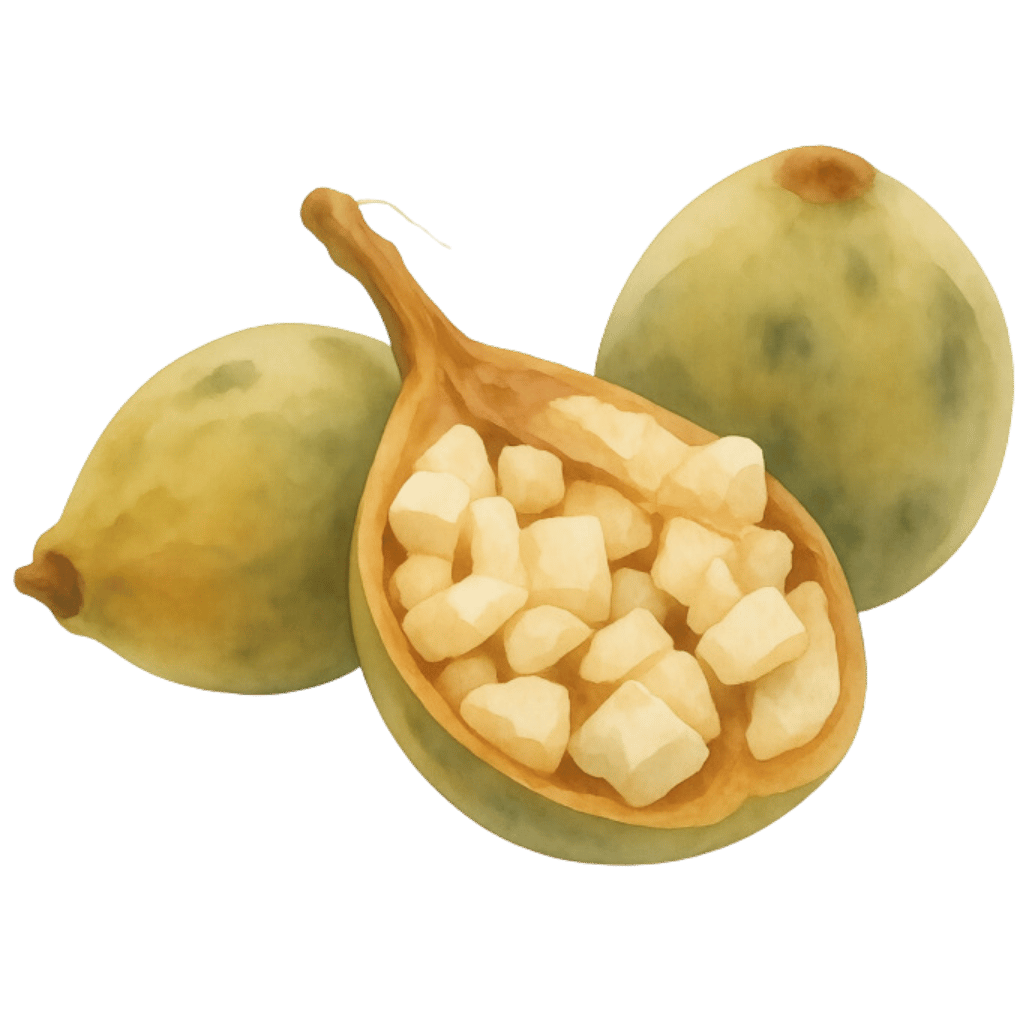
Baobab fruit
Adansonia digitataBotanical View
- Leaves are alternate, on petioles up to about 12 cm long. Seedlings and young trees bear simple leaves, becoming progressively digitately compound with age, typically with 3-9 leaflets (occasionally up to 11) radiating from a single point (hence "digitata," hand-shaped). Leaflets are oblong to ovate, about 5-15 x 3-7 cm, dark green with short soft hairs, looping lateral veins, tapering apex and base, entire margins, and are nearly sessile (petiolules absent or minute); the lowest leaflet is the smallest and the terminal leaflet the largest. The tree is deciduous, shedding its leaves for most of the dry season.
- The trunk is a massive, swollen bole, usually about 3-10 m in circumference but reaching up to roughly 28 m in the largest known individuals. Bark is soft, smooth to fibrous, reddish-brown, greyish-brown or purplish-grey, with a green photosynthetic layer beneath the outer waxy layer that lets the trunk photosynthesize while the tree is leafless. The wood and bark tissue store substantial volumes of water (historical accounts describe hollowed trunks holding from about 400 to over 2,000 gallons), sustaining the tree through drought; the trunk can visibly shrink during severe droughts as reserves are depleted. The fibrous bark is markedly fire-resistant, and trees often survive even when the interior is burnt out, regrowing a thickened, uneven bark that further protects against fire and gives mature trunks their wrinkled, elephant-hide-like appearance.
- The species develops a thick, prominent taproot that at six months of seedling age is already about three times the length of the seedling shoot, together with extensive, thick lateral roots ending in clusters of potato-like storage tubers. Roots grow rapidly at first but rarely penetrate beyond about 2 m depth, which is why large, heavy-branched old trees are sometimes found toppled. The species is very sensitive to waterlogging and is generally absent from deep sandy soils, presumably because such soils provide insufficient anchorage and moisture.
- Flowers are solitary, axillary and pendulous on long stalks, waxy-white, and among the largest of any tree flower (up to about 20 cm in diameter). They are bisexual (hermaphroditic) and actinomorphic (radially symmetric), with floral parts in fives: a deeply lobed calyx lined with white silky hairs inside, large, crinkled, spreading white petals that bruise and brown quickly after opening, and numerous stamens fused into a long central staminal column that is shed together with the petals after flowering. The ovary is superior and 5-10-chambered. Flowers open in the late afternoon or evening, last a single night, and emit a strong, unpleasant, carrion-like odor that attracts nocturnal pollinators.
- Although each flower is structurally bisexual, Adansonia digitata behaves as functionally self-incompatible: hand-pollination studies show that trees vary strikingly in fruit set, with some "female-functioning" trees setting fruit consistently every year while other "male-functioning" trees set little or no fruit unless hand-pollinated, despite both functional types showing comparable heterozygosity and outcrossing rates and no marked genetic differentiation between them. Populations also show flower polymorphism, including dichogamous flowers (with temporal separation of male and female function) and, in some individuals, pre-anthesis cleistogamous flowers capable of self-pollination before opening — a trait of interest for future domestication.
- The primary pollinators are fruit bats, chiefly the epauletted fruit bat (Epomophorus wahlbergii) and the Egyptian fruit bat (Rousettus aegyptiacus), drawn to the flowers' carrion-like scent at night. Secondary or opportunistic flower visitors include the greater bushbaby/thick-tailed bushbaby (Galago/Otolemur crassicaudatus), which feeds nocturnally on the flowers in East Africa and can aid pollination, the blowfly Chrysomyia marginalis, and several nocturnal moths, including the cotton bollworms Heliothis (Helicoverpa) armigera, Diparopsis castanea and Earias biplaga.
- Baobabs show a preference for well-drained soils, ideally acidic (pH below about 6.5), with sandy topsoil overlying a loamy subsoil, and favor sites with a comparatively high water table. They occur as isolated trees or in clumps across a range of soil types but avoid deep sand, where anchorage and available moisture are insufficient, and avoid poorly drained or waterlogged sites.
- Established, mature trees are highly drought-adapted and generally require no irrigation and little to no fertilization. However, in nursery and early-orchard trials, supplementary irrigation combined with intensified agronomic practices (fertilization, pest control) has brought seedlings into fruiting within about two years, versus much longer under unmanaged, rain-fed conditions. Farmyard manure, compost or green legume manure are recommended at planting time and to boost leaf production for the vegetable market; potash-rich ash from burnt bark, fruit shell and seed is also traditionally applied as a soil amendment. Compost and zeolite have been tested experimentally as substitutes for chemical fertilizer in seedling production.
- Propagation is mainly by seed. Seeds have a hard, largely water-impermeable coat that causes physical dormancy (roughly two-thirds of seeds in a typical lot are water-impermeable), so pre-sowing treatment is required for uniform germination. Effective methods documented in the literature include mechanical scarification (nicking or abrading the seed coat) followed by soaking in cold or hot water, or brief immersion in concentrated sulfuric acid (protocols ranging from about 30-60 minutes to several hours), after which germination can occur within about 5 days to a few weeks. Vegetative propagation by grafting is being tested experimentally (e.g., at ICRAF nurseries in Kenya) as part of domestication efforts to fix desirable fruiting traits, but it is not yet a standard commercial propagation method.
- Baobab seeds are classified as orthodox in storage behavior, tolerating desiccation to around 5% moisture content, and can remain viable for a year or more in hermetic cold storage (about 3-4 degrees C, 8-11% moisture content) without loss of viability; there are normally about 2,000-3,000 seeds per kilogram. Considerable phenotypic variability in seed size and weight exists among wild populations and provenances (documented in studies from Malawi, Benin, Mali and elsewhere), with individual seed weight and fruit/pulp/seed ratios differing several-fold between populations, reflecting substantial genetic diversity across the species' range.
- No formally registered or internationally standardized cultivars of Adansonia digitata currently exist; the species is still an underutilized/"orphan" crop harvested mainly from wild and semi-wild trees. Ongoing domestication research (World Agroforestry Centre/CIFOR-ICRAF and national programs in Mali, Benin, Malawi, Kenya) is characterizing wild provenances and individual "plus trees" with superior fruit pulp yield or vitamin C content, and testing grafting to propagate selected genotypes, but named, market-recognized cultivars have not yet been established.
- Adansonia digitata has no history of formal plant breeding or cultivar development; it has traditionally been used as a wild-harvested, multipurpose tree throughout its range rather than a cultivated crop. Since roughly the early 2000s, growing international demand for baobab fruit pulp (exported for food and nutraceutical uses) has driven domestication research, including provenance trials and genetic-diversity surveys in Mali, Benin, Malawi, Kenya and elsewhere, aimed at identifying superior "plus trees" for pulp yield, vitamin C content and other quality traits, and at trialling grafting for vegetative propagation of selected genotypes (e.g., at ICRAF/CIFOR-ICRAF nurseries in Kenya). This work remains at an early, pre-commercial domestication stage, and the species is still described in the scientific literature as an "orphan crop."