Back to Fruitpedia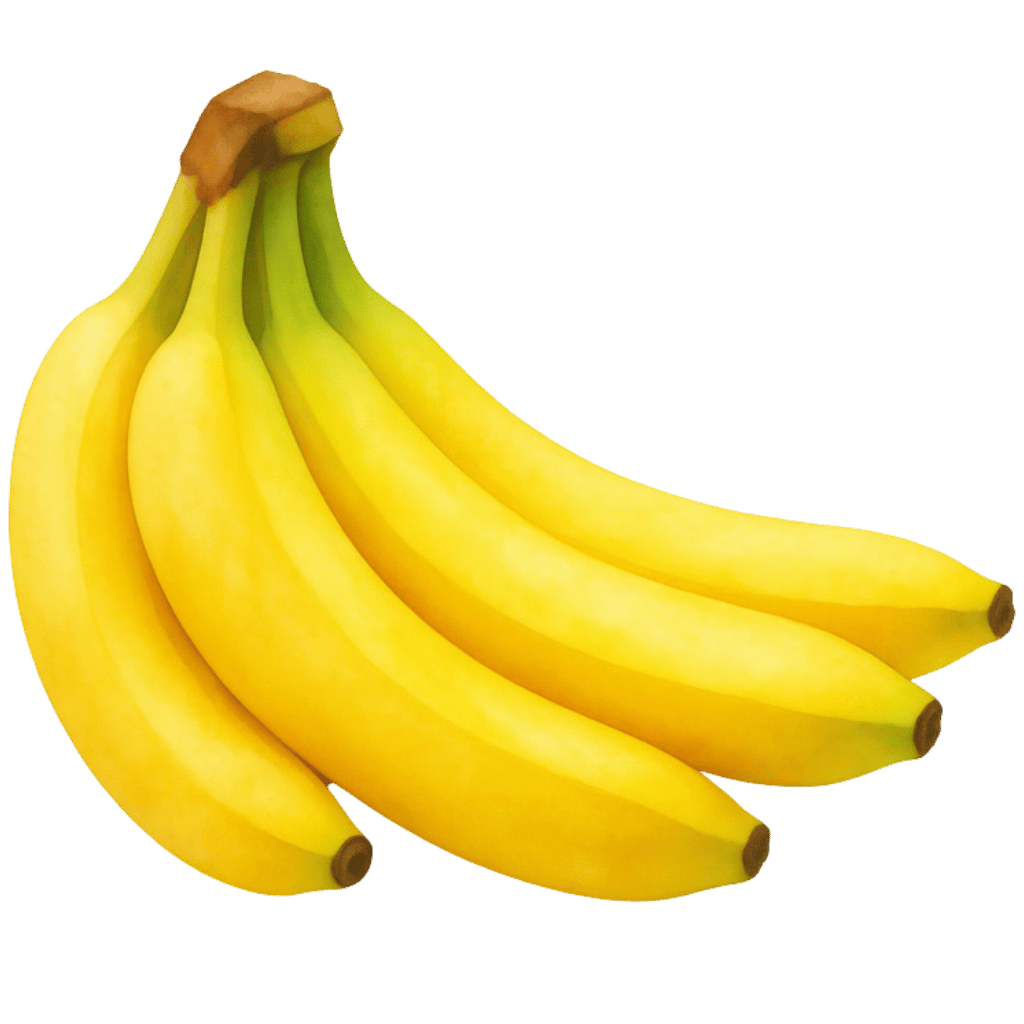
Banana
Musa spp.Varieties
Cavendish (Nanica/Nanicão/Grande Naine)
Prata (Prata-Anã)
27–28° BrixMaçã
Terra (Banana-da-terra / Plantain)
Ouro (Lady Finger)
BRS Platina
Botanical View
- The pseudostem is built from the leaf sheaths (petiole bases) rolled concentrically around one another, terminating above ground in a crown of long, broad leaves with a well-developed central midrib. A single plant produces roughly 30-70 leaves over its cycle, emitting a new leaf approximately every 7-11 days under favorable conditions; leaf emission rate and longevity increase with high relative humidity, while low humidity produces more leathery, shorter-lived leaves, and strong wind causes tearing along the secondary veins and consequent loss of functional leaf area.
- The true stem of the banana plant is an underground rhizome (corm), a short, thickened subterranean structure from which both the root system and the aerial shoot arise, and from which lateral buds regenerate new pseudostems (suckers) after each fruiting cycle. What appears above ground as a "trunk" is a pseudostem, formed entirely by the leaf sheaths (leaf bases) tightly wrapped around one another in concentric layers, ending at the top in a crown of leaves; the true floral stalk remains hidden at the base of the pseudostem until flowering, when it elongates and pushes up through the pseudostem's center to emerge terminally as the inflorescence. Each individual pseudostem is monocarpic, flowering and fruiting once before senescing, while the underlying rhizome persists and continues to produce new pseudostems, giving the mat/clump a perennial habit.
- The root system originates from the rhizome (underground stem) and is fasciculated (fibrous), with primary roots emitted from the rhizome in groups of three or four, totaling 200-500 roots per plant. Roots are predominantly less than 0.5 mm thick (occasionally to 8 mm), white and tender when young, becoming yellowish and hardened with age. Although roots can extend horizontally up to about 5 m, a spread of 1-2 m is more common depending on cultivar and soil conditions. The root system is markedly superficial: roughly 30% of roots occur in the top 0-10 cm of soil and about 62-82% are concentrated within the 0-50 cm layer, which is why deep (over 75 cm), well-drained soil free of compacted or impermeable layers is recommended even though most root activity is shallow. Poor soil aeration (from compaction or waterlogging) causes roots to lose rigidity, turn pale grayish-blue, and decay rapidly.
- The inflorescence emerges terminally from the center of the leaf crown at the tip of an internal floral stalk that elongates up through the pseudostem. It bears large, ovate, generally purplish-red bracts, in whose axils the flowers are borne in transverse double rows called "hands" (in Portuguese, "pencas"); a bunch typically carries 7-15 hands with a variable number of fruits (about 40-220) per bunch depending on cultivar. Flower zonation runs along the rachis: female flowers occupy the proximal (basal) nodal clusters nearest the pseudostem, a transitional zone of sterile/neuter flowers follows, and male flowers occupy the distal end beneath the terminal male bud ("mubu"/heart), which persists after the female flowers have set fruit and is often removed in cultivation once fruit set is complete.
- Banana flowers are morphologically bisexual but functionally unisexual due to differential abortion of male or female organs along the inflorescence: proximal flowers develop functional ovaries with aborted stamens (functionally female) and set fruit, a middle zone is sterile/neuter, and distal flowers retain functional stamens with an aborted gynoecium (functionally male), a spatial arrangement that limits self-pollination within a single inflorescence and promotes outcrossing in wild, seed-fertile populations. In cultivated edible bananas (mostly triploid, some tetraploid), the crop is functionally asexual for propagation purposes: fruit develops by parthenocarpy without pollination or fertilization, and most triploid cultivars are highly to completely sterile because of unbalanced chromosome pairing at meiosis, degenerate pollen, and ovule abortion, so viable seed is rarely or never produced under field conditions; a small number of triploids retain residual fertility and can be used, with great difficulty, as breeding parents.
- Wild seeded Musa acuminata is primarily zoophilous: its flowers, which have inconspicuous (non-brightly colored) tepals but produce abundant nectar, are pollinated mainly by nectar-feeding bats (Old World fruit bats such as Macroglossus spp. and Syconycteris spp.) and, secondarily, by nectarivorous birds such as sunbirds (Nectarinia spp.); insects visit the flowers frequently but are not considered effective pollinators. In cultivated triploid dessert bananas, fruit development is parthenocarpic (occurring without pollination or fertilization), so commercial production does not depend on pollinators, and viable seed set in these cultivars is rare to absent due to combined pollen sterility, ovule abortion, and disrupted pollen-tube growth through the style.
- Banana tolerates a wide range of soil classes (e.g., Latossolos/Oxisols, Argissolos/Ultisols, Cambissolos, Neossolos, Gleissolos, Vertissolos, and organic soils are all cultivated in Brazil, each with characteristic limitations such as low fertility, poor drainage, or shallow depth managed through liming, fertilization, or drainage). General requirements are: flat to gently rolling topography (under 8% slope) for ease of management; effective soil depth greater than 75 cm, since shallow (under 25 cm) or compacted soils restrict roots to 60-80 cm and predispose plants to toppling; good internal drainage and aeration, with a water table maintained deeper than about 1.0-1.8 m, since waterlogging causes root discoloration and decay; and absence of impermeable, stony or hardened subsurface layers. A near-neutral soil pH with adequate calcium and magnesium is favored both for plant nutrition and because it is less conducive to the Fusarium wilt pathogen.
- Fertilization should be based on prior soil chemical analysis. Organic manure (10-15 L/planting hole of cattle manure, or 3-5 L of poultry manure) is applied at planting to supply nitrogen and stimulate root development. Phosphorus (40-120 kg P2O5/ha, as simple/triple superphosphate or DAP/MAP) is applied in the planting hole since it is largely immobile in soil; deficiency causes stunted growth, poorly developed roots and marginal leaf chlorosis. Dolomitic limestone (supplying both Ca and Mg) is preferred over calcitic lime to avoid a Mg deficiency disorder known as "banana blue" ("azul da bananeira"), induced by excess potassium; lime is applied to raise base saturation to about 70% when below 60%. Potassium is the nutrient removed in largest quantity by the crop and is critical for bunch fill and fruit quality. Irrigation needs are high: banana water content is roughly 87.5% of total plant fresh weight, and crop evapotranspiration has been measured at about 3.9-4.0 mm/day (1,200-2,160 mm over a growing cycle), rising with plant age and leaf area (an adult plant with ~14 m2 of leaf area can consume 26 L/day on sunny days, dropping to 10 L/day under heavy cloud cover). Drip or microsprinkler systems are commonly used, with irrigation scheduled to keep at least 75% of soil water-holding capacity available without waterlogging, since poor soil aeration causes root discoloration and rapid decay.
- Banana is propagated vegetatively, since commercial cultivars are seedless and effectively sterile. Conventional methods use suckers/rhizome material removed from the mother clump, classified by size and leaf development as "chifrinho" (small sword sucker), "chifre", "chifrão" (larger sword suckers), whole adult rhizome, rhizome pieces (fractionated to yield about 4-12 plantlets per rhizome), rhizome-with-attached-sucker, or the broad-leaved "umbrella"-type sucker; rhizome-piece setts are typically cured for about 3 weeks before field planting to allow root initiation and lateral bud swelling. In vitro micropropagation from shoot-tip (meristem) explants is increasingly used for disease-free, higher-multiplication-rate planting material, yielding on the order of 20-50 plantlets per source rhizome versus 4-12 from simple rhizome fractionation, and is the preferred route for producing certified, pest- and pathogen-free nursery stock.
- Commercial banana cultivars are almost entirely seedless: fruit develops through parthenocarpy, and viable seed formation is suppressed by a combination of pollen sterility, disrupted pollen-tube growth in the style, and ovule abortion, most pronounced in triploid and tetraploid clones. Wild, diploid ancestral species (Musa acuminata, Musa balbisiana) are fully seed-fertile and produce fruit packed with large, hard seeds after pollination. In controlled breeding crosses using rare fertile triploid cultivars as female parents against fertile wild or improved diploids, seed set per bunch is very low and highly variable, typically averaging under one to about 20 or more seeds per bunch, reflecting the residual and inconsistent fertility of triploid genotypes.
- Edible bananas are classified by genome constitution (Simmonds & Shepherd system) rather than by classic botanical taxonomy: diploid AA and AB, triploid AAA (sweet dessert bananas), AAB (plantain-type, e.g., Prata, Prata Anã, Maçã, Terra), and ABB (cooking types, e.g., Figo/Bluggoe-type), plus tetraploid AAAB hybrids. In Brazil, EMBRAPA recognizes traditional cultivar groups Prata, Pacovan, Prata Anã, Mysore, Maçã and Terra (all AAB), D'Angola and Figo (ABB), and the Cavendish subgroup Nanica, Nanicão and Grande Naine, plus Gros Michel (all AAA). Embrapa Mandioca e Fruticultura has additionally released disease-resistant hybrids: Caipira (AAA, syn. 'Yangambi km 5'), Thap Maeo (AAB, similar to Mysore), and the tetraploid AAAB hybrids FHIA-18, Pacovan Ken, Prata-Graúda, Preciosa, Maravilha (from 'Prata Anã' x SH-3142) and Tropical, selected for resistance to Black and/or Yellow Sigatoka and Panama disease.
- Musa spp. cultivated bananas were domesticated more than 7,000 years ago from wild, seeded diploid ancestors in the Southeast Asia-New Guinea region, primarily from Musa acuminata (genome A) subspecies growing across the Indo-Malayan/Australasian rainforest margins. Early cultivators selected spontaneous parthenocarpic (seedless-fruited) mutants from wild populations and propagated them vegetatively via suckers, fixing the trait without further need for pollination. As cultivation spread through Asia, some parthenocarpic M. acuminata clones hybridized with the wild species Musa balbisiana (genome B), which contributed hardiness, vigor, and starchier fruit, giving rise to interspecific AB, AAB and ABB genome-group cultivars (e.g., plantains, cooking bananas). Most polyploid (triploid AAA, AAB, ABB; tetraploid AAAB) cultivars arose through the union of unreduced (2n) gametes from otherwise diploid ancestors rather than through deliberate breeding, and were subsequently propagated clonally, so the roughly 1,000+ named cultivars grown worldwide trace to a comparatively small number of original wild-hybrid events. Because triploid cultivars are largely sterile, classical breeding is very difficult; modern improvement programs (e.g., the Honduran Foundation FHIA and Brazil's Embrapa Mandioca e Fruticultura) rely on backcrossing rare fertile triploids to improved diploids to generate tetraploid hybrids (AAAB) combining Fusarium wilt and Sigatoka resistance with commercial fruit quality — examples released by Embrapa include Thap Maeo, FHIA-18, Pacovan Ken, Prata-Graúda, Preciosa, Maravilha and Tropical.