Back to Fruitpedia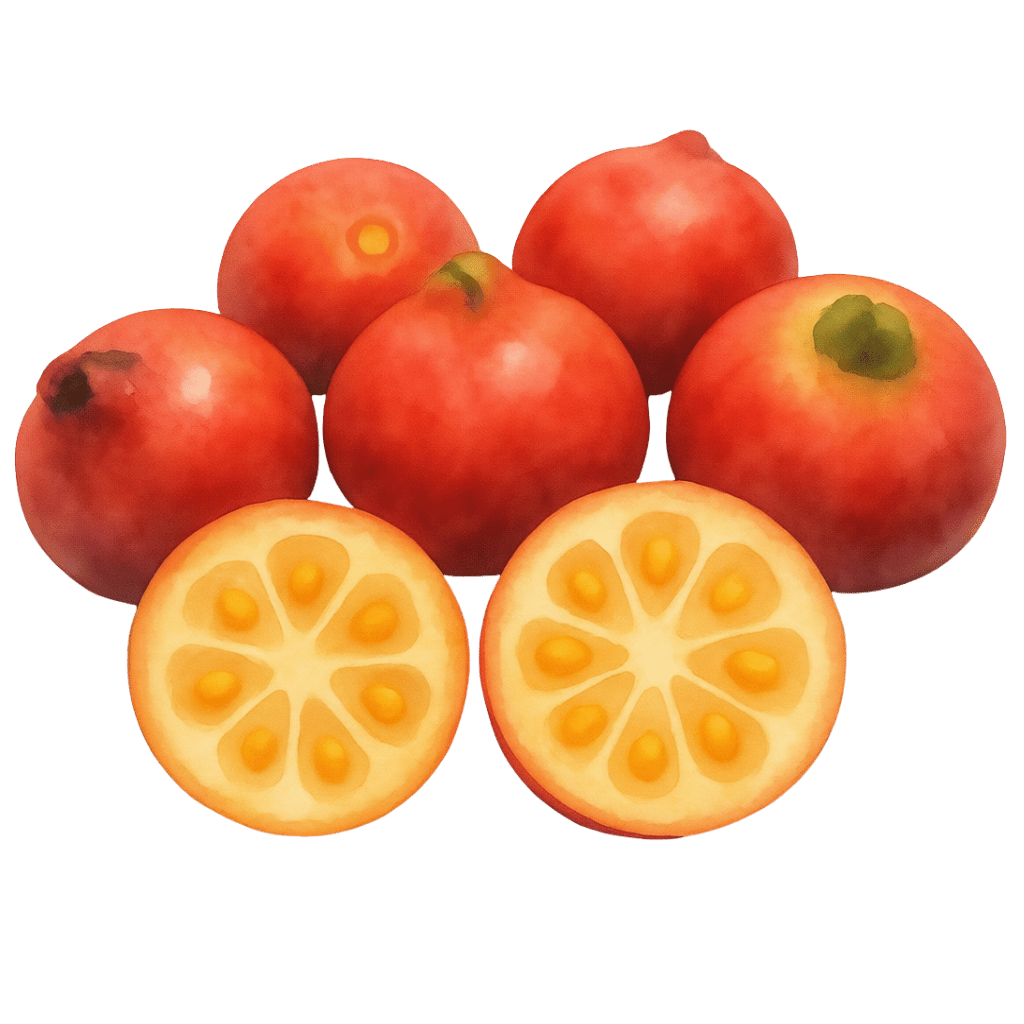
Red Araçá
Psidium cattleianumVarieties
Irapuã
Botanical View
- Leaves are opposite (decussate), simple, without stipules, and shortly petiolate (petiole roughly 3-10 mm). The blade is elliptic to obovate, about 4.5-12 cm long by 2-6 cm wide, thick and coriaceous, with a blunt to slightly acuminate apex and a cuneate base. The upper surface is dark green, glossy and somewhat waxy; the lower surface is paler. Leaves release a pleasant aroma when crushed and show brochidodromous venation typical of the genus Psidium. (Sources: CABI Compendium, cabidigitallibrary.org/doi/10.1079/cabicompendium.45135; Embrapa/Bezerra et al., Plantas para o Futuro - Região Centro-Oeste, infoteca.cnptia.embrapa.br; University of Florida IFAS Extension, ask.ifas.ufl.edu/publication/ST529)
- A shrub or small tree, often multi-stemmed and branching from the base when grown in full sun. Bark is smooth and thin, pinkish-, greenish- or greyish-brown, and characteristically peels off in small papery flakes; young twigs are slender and brown. (Sources: CABI Compendium, cabidigitallibrary.org/doi/10.1079/cabicompendium.45135; University of Florida IFAS Extension, ask.ifas.ufl.edu/publication/ST529; Morton, Fruits of Warm Climates, hort.purdue.edu/newcrop/morton/cattley_guava.html)
- The root system is shallow and spreading. The species readily produces root suckers and basal shoots that develop into new stems, giving it strong clonal/vegetative-spread capacity; this trait, combined with animal-mediated seed dispersal, underlies its tendency to form dense monospecific stands and its classification as invasive in many introduced ranges. (Sources: NSW Department of Primary Industries WeedWise, "Cherry guava (Psidium cattleyanum)," weeds.dpi.nsw.gov.au; Hawaiian Ecosystems at Risk project (HEAR/PIER), hear.org)
- Flowers are borne solitary or in groups of up to three in the leaf axils (the wider genus Psidium can also show small racemes or dichasia). Flowers are hermaphroditic, actinomorphic and pentamerous, 15-25 mm across, white to cream-colored, with five free petals and numerous prominent stamens (in the genus generally 60-320 stamens arranged in 3-12 whorls). The ovary is inferior with 2-5 locules, numerous ovules per locule on intrusive placentas, a single style and a single stigma. (Sources: CABI Compendium, cabidigitallibrary.org/doi/10.1079/cabicompendium.45135; Embrapa/Bezerra et al., Plantas para o Futuro - Região Centro-Oeste, infoteca.cnptia.embrapa.br, citing Soares-Silva & Proença 2008; Morton, Fruits of Warm Climates, hort.purdue.edu/newcrop/morton/cattley_guava.html)
- Flowers are hermaphroditic; the genus Psidium is generally self-compatible. In P. cattleianum, cyto-embryological studies of polyploid populations (including the yellow-fruited form, f. lucidum) document facultative apomixis - gametophytic apomixis coexisting with normal sexual reproduction in the same population - a strategy thought to buffer meiotic irregularities and hybrid sterility that arise from polyploidy. The species is also cross-compatible with the common guava (P. guajava) under controlled interspecific pollination, which has been used experimentally to produce hybrid seed. (Sources: bioRxiv preprints on apomixis frequency and embryo:endosperm balance in polyploid Psidium cattleyanum f. lucidum, biorxiv.org/content/10.1101/2025.08.18.670884 and 10.1101/2025.07.08.663781; "Pollination and in vitro germination of seeds for interspecific hybridization of Psidium guajava and Psidium cattleianum," ResearchGate/Bioscience Journal)
- Bees are the principal pollinators of Brazilian Myrtaceae, including Psidium, with pollen (not nectar) as the main floral reward; the numerous showy stamens function as the primary visual attractant, and flowers typically have a sweet scent that also draws pollinators. (Source: Embrapa/Bezerra et al., Plantas para o Futuro - Região Centro-Oeste, infoteca.cnptia.embrapa.br, citing Lughadha & Nic Lughadha and Proença 1996, Annals of the Missouri Botanical Garden, and Gressler, Pizo & Morellato 2006, Revista Brasileira de Botânica)
- The species tolerates poor, sandy soils, and even limestone-derived soils, that would barely support other fruit trees. It is tolerant of moderately to highly acidic soils, with a preferred pH of about 5.5-6.5 and tolerance extending across roughly pH 4.5-7.7. (Sources: Morton, Fruits of Warm Climates, hort.purdue.edu/newcrop/morton/cattley_guava.html; CABI Compendium, cabidigitallibrary.org/doi/10.1079/cabicompendium.45135)
- In a six-year Embrapa Clima Temperado orchard trial run under ecological/organic management (Rio Grande do Sul), fertility was maintained without mineral fertilizer or reported irrigation infrastructure: winter cover cropping with oat (Avena sativa) and vetch (Vicia sativa), tolerance of spontaneous ground cover in summer, and periodic applications of bovine vermicompost or poultry-litter compost at the base of the plants (spacing 1.0 m within rows x 3.0 m between rows). This low-input system produced an average of 2.5 kg fruit/plant (about 8.3 t/ha) at six years of age, and the authors concluded the system's low labor and input demand make it economically viable. (Source: Embrapa, "Produtividade do araçá-vermelho (Psidium cattleyanum L.) em pomar de seis anos sob manejo ecológico," embrapa.br/en/busca-de-publicacoes/-/publicacao/868375)
- Propagation is mainly by seed, which germinates readily (up to about 95%) in 10-15 days once extracted from ripe fruit picked from the plant (not fallen fruit), washed, sieved, shade-dried, and optionally cold-stored for 30-40 days before sowing; adding organic matter such as vermicompost to the growing substrate improves seedling growth. Seed propagation is preferred at this early stage of the crop's domestication because seed-derived plants show little pronounced genetic segregation. Vegetative propagation by cuttings has historically been difficult (rooting below 3% with indolebutyric acid/IBA alone) but has been improved to roughly 34-69% rooting using semi-hardwood cuttings with reduced foliage, treated with IBA (about 200 ppm) combined with about 70% shading of the stock plants. Grafting (top-cleft grafting, budding) has been tested but is not yet considered a reliable propagation method for the species. (Source: Embrapa/Bezerra et al., Plantas para o Futuro - Região Centro-Oeste, infoteca.cnptia.embrapa.br, citing Fachinello et al. 1994, Nachtigal et al. 1994, Mendez et al. 2000, Voltoline & Fachinello 1997, and Casagrande-Junior et al. 1996)
- Seed-derived plants show relatively little pronounced genetic segregation at the current stage of the crop's domestication, which is one reason seed propagation remains the standard method. At the same time, wild populations display substantial phenotypic variability, most visibly in fruit skin color (yellow versus red/purple forms, sometimes distinguished taxonomically). Some populations are polyploid and reproduce by facultative apomixis, a reproductive mode that fixes maternal genotypes through seed in those cytotypes and can reduce variability among their seed-derived offspring relative to fully sexual populations. (Sources: Embrapa/Bezerra et al., Plantas para o Futuro - Região Centro-Oeste, infoteca.cnptia.embrapa.br, citing Fachinello et al. 1994; bioRxiv preprint on apomixis frequency in polyploid Psidium cattleyanum f. lucidum, biorxiv.org/content/10.1101/2025.08.18.670884)
- Only two named cultivars are documented in Brazil, both selected and released by Embrapa Clima Temperado (Pelotas, RS): 'Ya-cy' - yellow-skinned fruit, 15-20 g, sweet with low acidity, up to ~4 kg fruit/plant/year across as many as three harvests (Dec-Feb, Mar-Apr, May); and 'Irapuã' - dark purplish-red-skinned fruit, more acidic with mild astringency (better suited to preserves/paste than fresh eating), yields rising from 3.4 to 14 kg fruit/plant/year at adult age, with production beginning in February. No commercial orchards existed at the time of the source publication; plantings remain mostly extractive/spontaneous. (Source: Embrapa/Bezerra et al., "Psidium spp. - Araçá," Plantas para o Futuro - Região Centro-Oeste, infoteca.cnptia.embrapa.br, citing Raseira & Raseira 1996, 2000a, 2000b)
- Formal breeding is limited. Embrapa Clima Temperado (Pelotas, RS) established a field germplasm bank in 1985 from eight accessions, collected mainly around Pelotas and Rio Grande and in the central plateau of Rio Grande do Sul (Ijuí, Passo Fundo) plus southern Paraná. Mass/clonal selection from this bank produced Brazil's only two named cultivars, 'Ya-cy' and 'Irapuã' (released by Raseira & Raseira, ~2000), of which more than 30,000 seedlings had been distributed to growers by the mid-2010s. A separate, larger germplasm collection of the related species P. guineense (108 accessions, mostly from Itamaracá Island, PE) is held by IPA in Pernambuco; smaller collections exist at IAC, EBDA, UNESP-Jaboticabal, Pesagro-Rio and UF Bahia. As of Embrapa's most recent comprehensive review, no commercial orchards of P. cattleianum existed in Brazil, cultivation is still largely from spontaneous stands, and documentation of in-situ genetic erosion was considered an urgent, largely unaddressed gap. (Sources: Embrapa/Bezerra et al., "Psidium spp. - Araçá," in Plantas para o Futuro - Região Centro-Oeste, infoteca.cnptia.embrapa.br, citing Raseira 1999; Raseira & Raseira 1996, 2000a/b; Silva 1999)