Back to Fruitpedia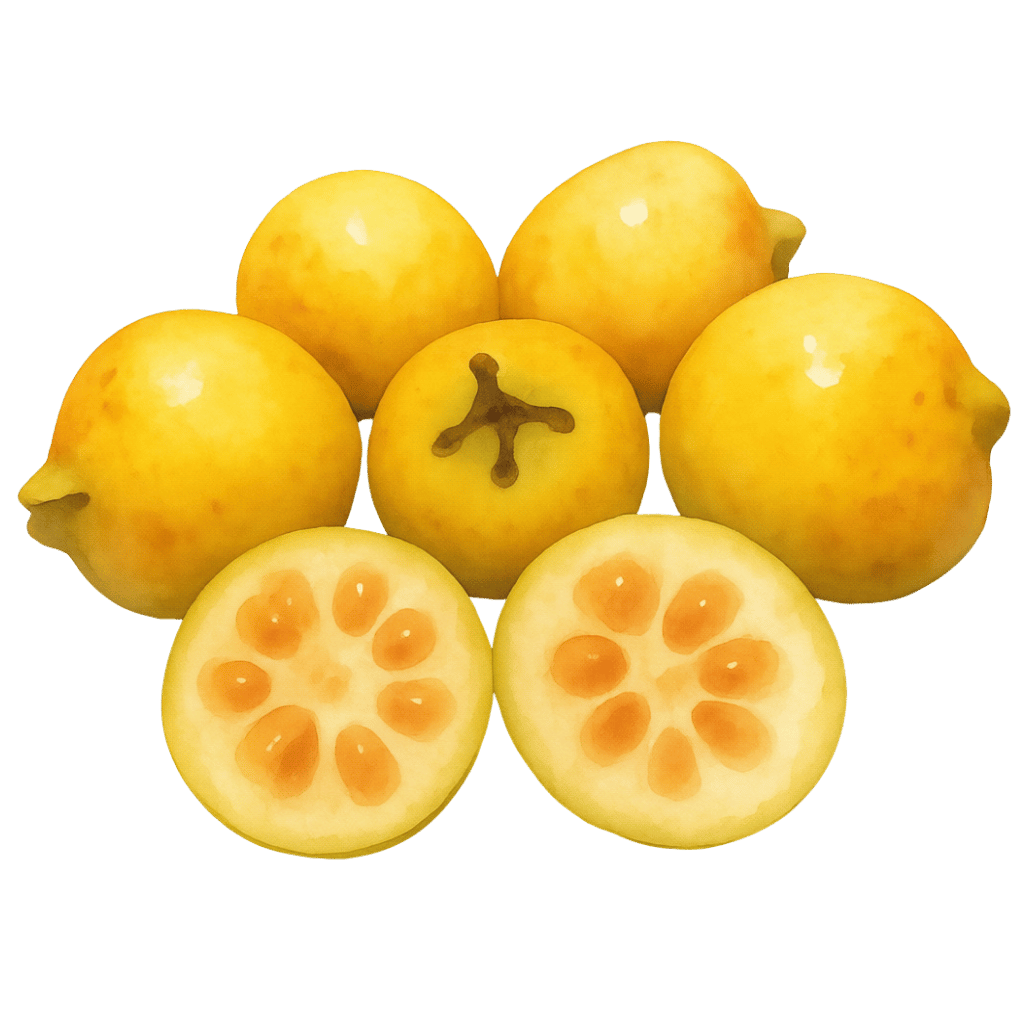
Yellow Araçá
Psidium cattleianumVarieties
Ya-cy
Irapuã
Botanical View
- Leaves are opposite to subopposite, simple, with an entire margin, coriaceous (leathery) and glabrous (hairless). Blade shape is elliptic to obovate/oblong, about 4-10 cm long by 3-6 cm wide, on a short petiole (0.4-1.0 cm). Upper surface is glossy dark green, the underside paler; venation is pinnate and brachidodromous, typically with about 6-7 pairs of secondary veins - a feature used to distinguish P. cattleianum from guava (Psidium guajava), whose leaves show 10-20 vein pairs and pubescent young growth. Foliage is evergreen with no seasonal color change.
- Growth habit is a multi-branched shrub or small tree with an irregular, round-to-vase-shaped crown; trunk is often tortuous, up to about 25 cm in diameter, typically multi-trunked, unarmed (no thorns). Bark is smooth, gray-brown to reddish-brown or golden, and characteristically exfoliates/peels off in thin flakes or sheets, exposing patches of contrasting underbark. Current-year twigs are thin, green to brown, and glabrous with a rounded (not angled) cross-section - again a diagnostic difference from P. guajava, which has quadrangular, pubescent young stems. Wood/branches are reported as resistant to breakage.
- Primary literature specifically characterizing the root architecture of P. cattleianum is limited. Nursery/seedling-production studies indicate the root system responds to soil amendments: organic inputs such as sewage sludge and mycorrhizal associations increase root and shoot biomass and secondary root volume, improving nutrient uptake, while root length itself did not differ significantly among fertilization treatments in at least one trial. The species is used in restoration plantings on degraded land, where its root system is credited with contributing to soil stabilization. Detailed descriptions of rooting depth or lateral spread in situ were not found in the sources consulted.
- Flowers are borne solitary or in small groups of up to three at the leaf axils (not in showy panicles). Each flower is hermaphroditic and actinomorphic, about 2-2.5 cm in diameter, fragrant and showy. The calyx has 4-5 lobes that rupture irregularly at anthesis; the corolla consists of 4-5 white, obovate petals roughly 7-8 mm long. Numerous prominent white stamens with yellow anthers dominate the open flower, giving a "powderpuff" appearance. The ovary is inferior, generally with 3-4 locules and typically more than 100 ovules per flower.
- Flowers are hermaphroditic (perfect), and the species is capable of both self-pollination (autogamy) and cross-pollination (xenogamy); controlled-cross studies (including artificially induced protogyny) have been used in breeding trials. Pollen viability varies widely among accessions (approximately 43-97% in staining assays), indicating substantial genetic variability even within populations from the same municipality. Wild polyploid populations (documented in P. cattleyanum f. lucidum) additionally show pseudogamous apomixis - fruit and seed set occurring in emasculated, unpollinated flowers - meaning asexual seed formation can occur alongside sexual reproduction in this species.
- As in Brazilian Myrtaceae generally, pollination is carried out mainly by bees, which are attracted to the flowers as a source of pollen and nectar; the mass of prominent stamens functions as the primary visual/olfactory attractant. Wind, and opportunistically other flower-visiting insects, may contribute secondarily, but bees are reported as the principal pollination vector.
- The species tolerates a wide range of soil textures and pH - sand, loam, and clay, from acidic to alkaline - provided drainage is adequate. Fruit quality (size, sweetness) is reported to improve markedly on richer, more fertile soils compared with poor sandy soils.
- Established plants are drought-tolerant and require little supplemental irrigation, but benefit from a thick organic mulch layer. Nursery-stage trials show that organic amendments (e.g., sewage sludge) and mycorrhizal inoculation improve seedling root and shoot biomass, reducing dependence on chemical fertilizer. In fruiting plantations, richer soil fertility is associated with improved fruit quality.
- Propagation is most commonly by seed, which germinates easily and rapidly without scarification; seedling-origin plants, however, take about 7-8 years to begin fruiting. Vegetative propagation methods - air-layering and, for the improved Brazilian cultivars, in vitro micropropagation (axillary shoot regeneration protocols developed for 'Ya-cy' and 'Irapuã') - are used to multiply true-to-type, earlier-fruiting plants for commercial orchards.
- Fruits contain numerous small, hard seeds. Pollen viability, and by extension reproductive/genetic variability, differs considerably between accessions (roughly 43-97% viability reported), including among plants collected close together geographically. Wild populations include polyploid cytotypes, and pseudogamous apomixis has been documented in polyploid P. cattleyanum populations, meaning seed lots from wild or open-pollinated material can include both sexually and asexually (clonally) produced seeds with correspondingly variable genetic uniformity.
- In Brazil, the breeding program at Embrapa Clima Temperado (Pelotas, RS) selected genotypes from its germplasm bank for productivity and reduced pest/disease susceptibility, releasing two named cultivars: 'Ya-cy' (yellow-skinned fruit, fruit weight up to ~40 g, begins fruiting around 18 months after field planting, yields reported up to ~4 kg/plant/year) and 'Irapuã' (purplish-red, medium-to-large fruit, begins fruiting around 2 years after planting, yields reported from ~3.4 up to 14 kg/plant/year). In vitro micropropagation protocols have since been developed for commercial-scale multiplication of both cultivars.
- Formal genetic improvement of P. cattleianum in Brazil has been centered at Embrapa Clima Temperado (Pelotas, Rio Grande do Sul), which maintains a germplasm bank of the species and selected the cultivars 'Ya-cy' and 'Irapuã' for productivity, fruit quality, and reduced susceptibility to pests and diseases. Subsequent research has developed controlled-crossing techniques (including artificially induced protogyny) to support ongoing breeding programs, alongside in vitro micropropagation protocols to enable commercial-scale multiplication of the released cultivars.