Back to Fruitpedia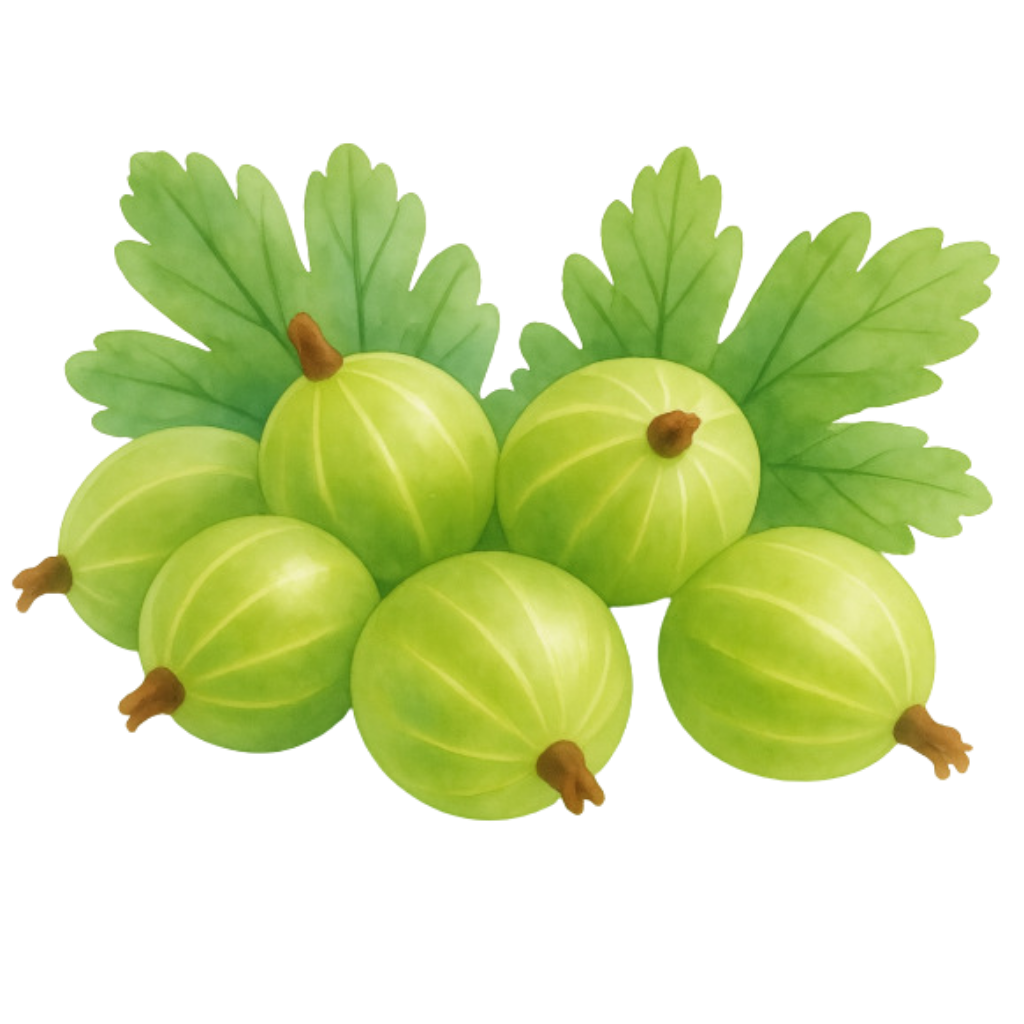
American Gooseberry
Ribes hirtellumVarieties
Pixwell
Poorman
Downing
Houghton
Welcome
Captivator
Botanical View
- Leaves are alternate, simple, and deciduous, with a rounded to diamond-shaped (reniform-orbicular) outline, about 10–25 mm (1–2.5 in) long and nearly as wide. Each blade has 3–5 palmately arranged lobes that may be further shallowly lobed, with coarsely toothed margins and palmate venation radiating from the base. The leaf base is wedge-shaped (cuneate) to nearly straight or truncate. Surfaces are smooth to softly hairy and lack glands or glandular hairs. Foliage is forest-green in summer, turning orange shades in autumn.
- Multi-stemmed from the crown. First- and second-year twigs are slender, green, and sparsely prickly, becoming reddish-brown with gray, shedding (exfoliating) bark on older wood. Nodal spines are slender, 3–8 mm long, but are few or often absent, and internodal bristles are sparse — making this species notably less prickly than most related gooseberries. Twigs bear few hairs.
- Like other Ribes, it develops a relatively shallow, fibrous root system spreading near the soil surface. Species-specific rooting depth and architecture are not well documented in the literature.
- Flowers are borne in small, drooping (pendulous) clusters of 1–3 stalked flowers arising from the leaf axils. Each flower is about 8 mm (1/3 in) long and bell-shaped, with a hypanthium, an inferior ovary, and radial symmetry. There are 5 oblong sepals about 3–4 mm long, 5 small thin petals that are greenish-white to whitish, often tinged purple at the edges, and 5 stamens positioned opposite the sepals that are roughly twice the petal length (exceeding the sepals). The style is green and densely covered with long spreading hairs on its lower half.
- Flowers are hermaphrodite (perfect — bearing both functional stamens and pistil). The species is largely self-fertile and does not require a second variety to set fruit, though some cultivars show partial self-incompatibility and set heavier crops when cross-pollinated with another gooseberry.
- Insect-pollinated, chiefly by bees (including bumblebees) which visit the early-season flowers; self-pollination also occurs given the perfect, self-fertile flowers.
- Adaptable to light sandy, medium loam, and heavy clay soils; prefers moist but well-drained soil. Tolerates mildly acid, neutral, and mildly alkaline (basic) pH. In the wild it favors moist to wet sites — fens, sedge meadows, swamps, streambanks and lakeshores — as well as rocky forest openings.
- Prefers consistently moist soil; because of its shallow fibrous roots it benefits from mulching and steady moisture, and tolerates moist-to-wet ground. Specific fertilizer regimes for this species are not well documented; general Ribes practice favors moderate feeding and incorporation of organic matter.
- Propagated by seed and vegetatively. Seed is best sown as soon as ripe in autumn in a cold frame; stored seed requires about 4–5 months of cold stratification at 0–9°C. Vegetative methods include hardwood cuttings of mature wood taken November–February in a cold frame, and half-ripe/softwood cuttings (10–15 cm with a heel) in July–August; mound or tip layering (typical of gooseberries) is also used.
- Seed remains viable for long periods (reported viable for 17+ years under normal storage). Open-pollinated seedlings are genetically variable and do not reliably reproduce cultivar traits; named cultivars and hybrids do not come true from seed and are propagated vegetatively.
- R. hirtellum is ancestral to many American and American × European hybrid gooseberry cultivars. Notable examples include 'Houghton' (R. uva-crispa × R. hirtellum, raised 1833 in Lynn, Massachusetts), 'Downing', 'Poorman', 'Pixwell', 'Welcome', 'Oregon Champion' and 'Captivator'. Fruit color across cultivars ranges from greenish-yellow to pink, red, and white.
- During the 1800s American growers crossbred the mildew-susceptible European gooseberry (R. uva-crispa) with the mildew-resistant R. hirtellum to create disease-resistant varieties, producing early hybrids such as 'Houghton' (1833), 'Downing' and 'Mountain'. R. hirtellum has remained an important donor of American gooseberry mildew resistance in gooseberry breeding programs.